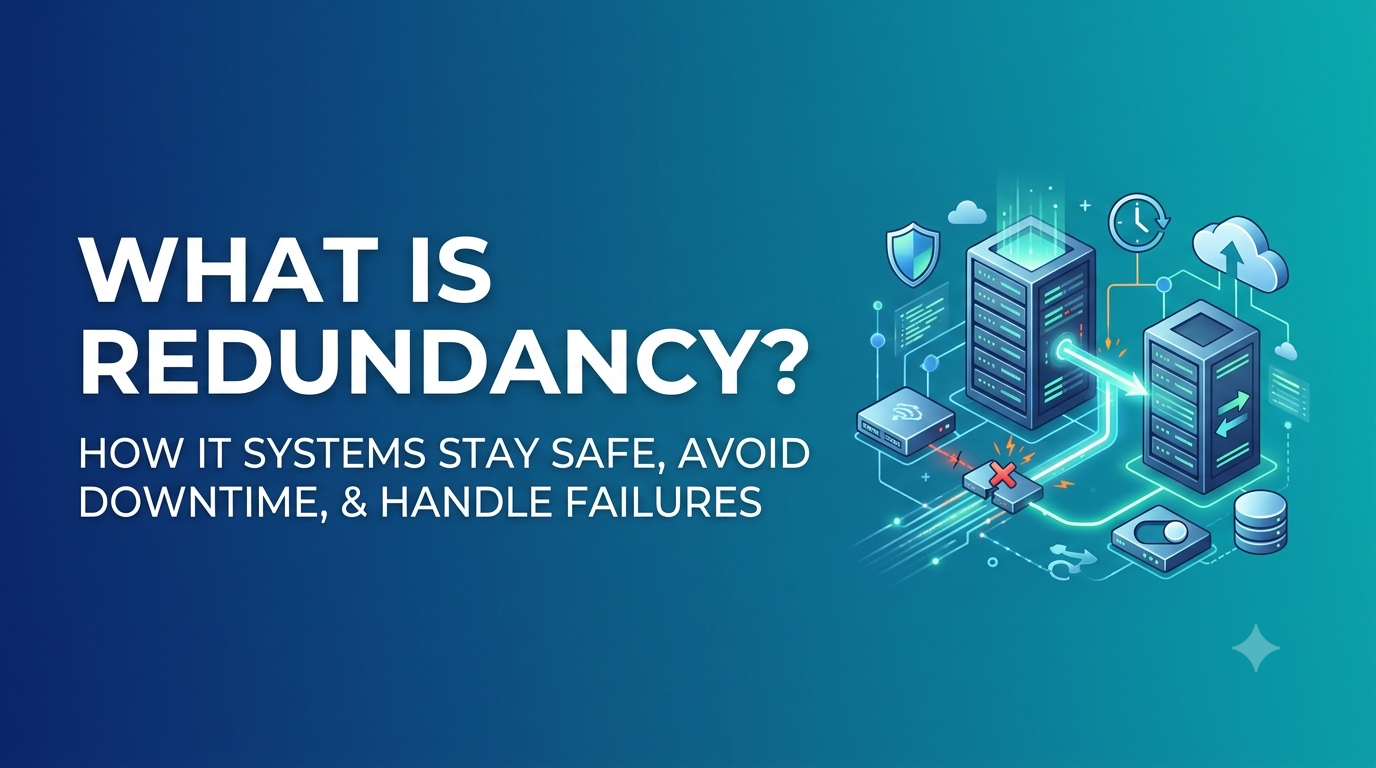
what is redundancy? Before we go into that first. Imagine your laptop suddenly crashes right before you submit an important assignment. Or worse — your company’s main server goes down during peak sales season. Many of us have had this experience. These nightmares happen every single day and to many other people and companies. In fact, server downtime now costs businesses an average of $9,000 per minute according to recent 2024 reports.
This is exactly why Data Redundancy matters so much in technology.
Quick note before we begin: If you landed here because your company said your role was being made “redundant,” that’s the HR version — it means layoffs. We’re not talking about jobs today. This article explains the IT meaning of redundancy and why it can be either your best friend or a hidden problem in systems.
Redundancy is one of those words that sounds complicated but is actually everywhere in tech. Let’s break it down in simple terms so you can finally understand it.
What is the Meaning of Redundancy?
Redundancy in technology means deliberately adding extra components, data, or pathways that aren’t strictly needed for normal operation — but exist as a backup in case something fails.
In simple words, it’s like keeping a spare tyre in your car. You don’t use it every day, but when one tyre bursts, you’re glad it’s there. The redundancy meaning in IT is basically “extra protection” that keeps systems running even when parts break.

However,
and this is the tricky part—not all repetition is good. In tech, we split this into two worlds:
- Good Redundancy: Backup power supplies, extra internet cables.
- Bad Redundancy: Storing the same user’s name 50 times in a database.
Let’s look at the types.
Types of Redundancy in Information Technology
Technology uses redundancy in four major areas. This is where students get confused in interviews. The word changes meaning based on where you use it. Some types protect you. Others can actually hurt performance if they’re not managed properly.
1. Hardware and Storage Redundancy (The Good Kind)
This is the hero version of redundancy.
Companies don’t want to lose important data when a hard drive fails. So they use systems like RAID (Redundant Array of Independent Disks). RAID 1 mirrors data across two drives — if one dies, the other keeps working. RAID 5 spreads data with parity so even if one drive fails, nothing is lost.
Real-world stat: Hard drives have a 1–2% annual failure rate. Large data centers see thousands of drives fail every year. Without hardware redundancy, companies would lose critical information daily.
You see this in action at banks, hospitals, and cloud providers like AWS and Google Cloud. They never rely on a single machine.
This is what people usually mean when they praise redundancy. It’s about keeping the lights on.
- RAID Systems: RAID 1 literally mirrors your hard drive. If Drive A dies, Drive B takes over instantly. No data loss.
- Power Supplies: High-end servers have two power cords. If one gets unplugged, the other keeps the machine running.
Career Tip: When an interviewer asks, “How do you ensure high availability?”, the magic word you say is “Hardware Redundancy.”
2. Network Redundancy (Keeping Connections Alive)
Ever wondered why big websites like Google or Amazon almost never go down?it’s cables.
They use network redundancy — multiple internet providers, backup routers, and automatic failover systems. If one connection drops, traffic instantly switches to another path.
This is critical for online businesses. A 2023 study by Gartner found that 82% of enterprises now invest heavily in network redundancy because even 5 minutes of downtime can cost millions in lost revenue and damaged reputation.
Companies don’t just have one internet line. They have two or three from different ISPs (Internet Service Providers).
- Primary ISP: Fiber Optic.
- Backup ISP: 5G/LTE.
If the backhoe digs up the fiber line (it happens all the time), the system instantly switches to 5G. That’s network redundancy.
3. Data Redundancy in DBMS (The Bad Kind)
Here’s where redundancy becomes a problem.
Data redundancy in databases happens when the same piece of information is stored in multiple places unnecessarily. For example, a student’s name, phone number, and address repeated across 6 different tables.
Why is this bad?
-
- It wastes storage space
-
- It causes data inconsistency (one table updated, others not)
-
- It creates update anomalies and slows down the system
This is exactly why database designers use normalization — to remove unnecessary data redundancy while keeping the information safe and organized.
If you’re studying DBMS or preparing for tech interviews, understanding this concept is very important.
| User ID | Name | Department | Dept Head |
|---|---|---|---|
| 101 | John | IT | Sarah |
| 102 | Jane | IT | Sarah |
| 103 | Bob | IT | Sarah |
See the problem? “IT” and “Sarah” are repeated 3 times. If Sarah quits, you have to update 3
Want to master database design and remove data redundancy professionally? Kaashiv Infotech offers excellent full-stack and database internships where you work on live projects and learn these skills hands-on.
4. Error Checking Redundancy (The “Math” Guy) 🧮
When data travels across networks, errors can creep in. That’s why systems add extra bits of information for checking. This one is super technical but cool. How does your computer know a file didn’t get corrupted during download?
The most popular method is Cyclic Redundancy Check (CRC). It’s like adding a digital signature to your data packet. The receiver checks this signature to confirm the data arrived safely. If not, it asks for a resend.
When you send data, the computer does some math on it and adds a tiny extra number (the “checksum”) at the end. The receiving computer does the same math. If the numbers don’t match? Data error. The file is rejected.
It’s redundant because you’re sending extra bits of data that aren’t part of the actual file—but they save you from opening a broken image.
This type of redundancy is small but extremely powerful in keeping your internet, mobile calls, and file transfers reliable.

Why is System Redundancy Important?
Let’s make this real with numbers:
-
- 93% of companies that suffer major data loss for 10+ days file for bankruptcy within a year.
-
- The average cost of a single data breach in 2024 is $4.45 million.
-
- Companies with proper redundancy recover from failures 3x faster than those without.
Let’s get real. Why do companies spend millions on this?
💰 The Cost of Downtime is Insane. According to Gartner, the average cost of IT downtime is $5,600 per minute.
- Amazon 1-hour outage in 2013? Lost $66,240 per minute.
- Google 5-minute outage in 2013? Lost $545,000 per minute.
Redundancy is the insurance policy against that. You spend $10k on a backup server to save $1M in lost sales. It’s a no-brainer.
| Uptime % | Downtime per Year | Reality Check |
|---|---|---|
| 99% | 3.65 days | Your home Wi-Fi |
| 99.9% | 8.7 hours | A bad day at work |
| 99.99% | 52 minutes | Great hosting |
| 99.999% | 5 minutes | Google/AWS (The Goal) |
You only get to “Five Nines” (99.999%) with heavy reundancy.
Redundancy gives you three big advantages:
-
- High Availability — Systems stay up even during failures
-
- Fault Tolerance — The system continues working when something breaks
-
- Disaster Recovery — You can bounce back quickly after major issues

For freshers entering the industry, knowing these concepts shows employers you understand real-world system design — not just theory.
Frequently Asked Questions
What is redundancy?
In technology, redundancy means having extra components or data copies so the system keeps working even if one part fails. It can be good (backups) or bad (wasted duplicate data in databases).
What is the meaning of redundancy in simple words?
It means “extra protection” built into a system. Like carrying two pens for an important exam — just in case one stops working.
Is redundancy good or bad in technology?
It depends on where it’s used. Hardware and network redundancy are usually good. Too much data redundancy in databases is bad because it wastes space and creates errors.
What is data redundancy in DBMS?
It happens when the same information is unnecessarily repeated across multiple tables in a database, leading to inconsistency and higher storage costs.
How does RAID ensure data redundancy?
RAID systems copy or spread data across multiple hard drives so that if one drive fails, the data remains safe and accessible from the other drives.
Conclusion
Redundancy is one of those foundational concepts that separates basic tech users from professionals who actually understand how reliable systems are built.
Whether it’s protecting customer data in a banking app, keeping an e-commerce site online 24/7, or designing clean databases — knowing when to add redundancy and when to remove it makes all the difference.
If you’re a student or fresher who wants to move from just learning theory to actually building real systems, this is the perfect time to start.
At Kaashiv Infotech, we offer practical programs like Full Stack Development course in Chennai, Cloud Computing internship in chennai, Database Management Sql Course in chennai, and more — where you work on live projects and learn concepts like redundancy, RAID, and normalization the right way.
Ready to build a strong tech foundation? Check out our current internship programs and take the first step toward becoming job-ready.