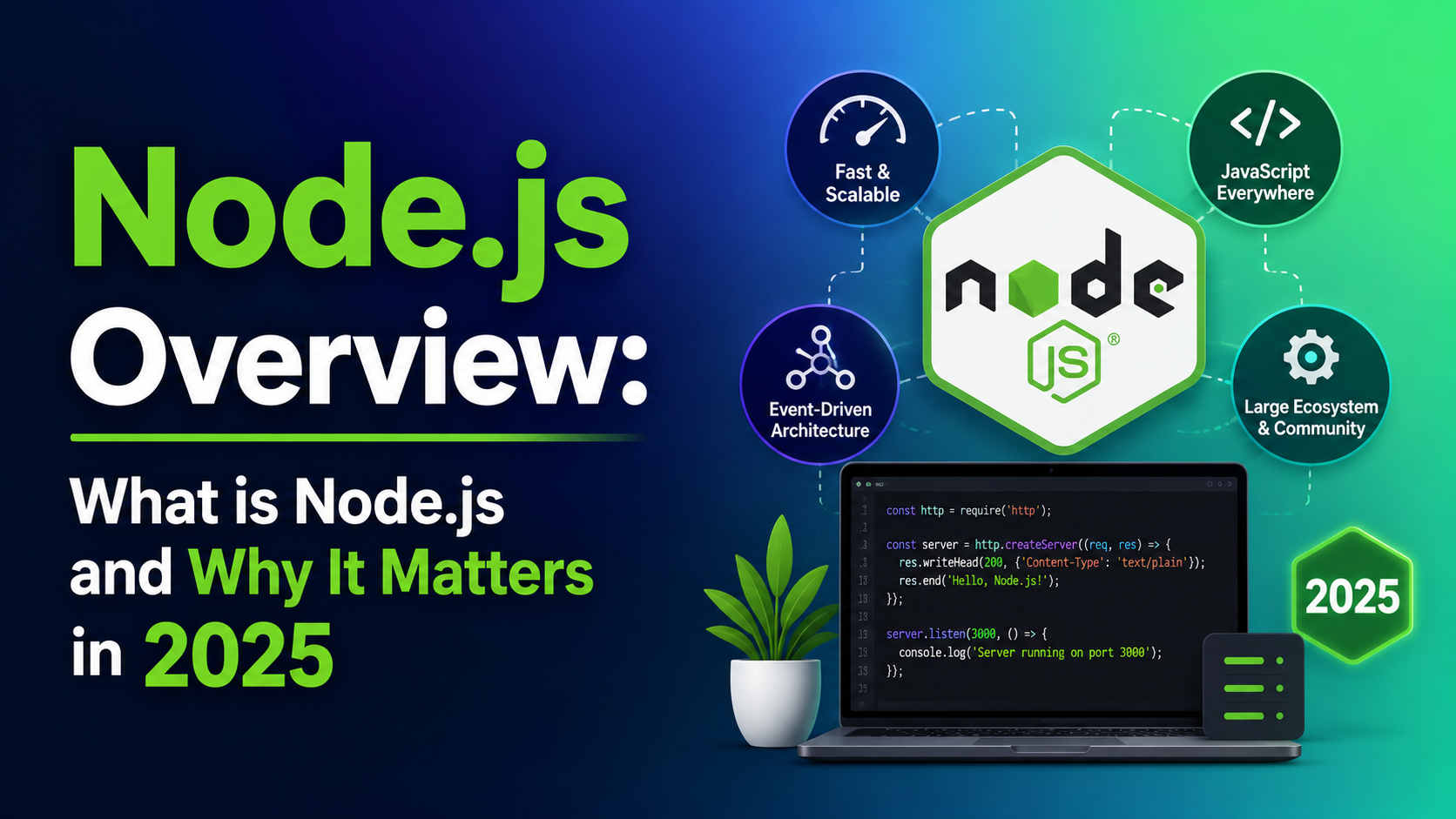
If you’ve ever wondered how modern websites handle millions of users simultaneously while staying lightning-fast, you’re about to discover the secret behind many of today’s most popular applications. Node.js has completely changed the game when it comes to building powerful, scalable server-side applications, and in this comprehensive guide, I’ll walk you through everything you need to know about this incredible technology.
Node.js Overview
What is Node.js?
Let me start with the basics. Node.js is an open-source, cross-platform JavaScript runtime environment that allows developers to run JavaScript code outside of a web browser. Think of it as taking the JavaScript you might have used for interactive buttons or form validations on a website, and bringing it to the server side where all the heavy lifting happens.
Created by Ryan Dahl in 2009, Node.js was initially designed to make building scalable network applications easier. The current LTS (Long Term Support) version continues to be updated regularly, with the Node.js community constantly working to improve its performance and add new features.

Here’s what makes Node.js truly special:
- Cross-platform compatibility – Works on Windows, macOS, Linux, and more
- Open-source nature – Free to use with a massive global community
- JavaScript-based – Leverages the most popular programming language
- Event-driven architecture – Handles multiple connections efficiently
The beauty of Node.js lies in its simplicity. If you already know JavaScript, you’re halfway there. You can now use that same knowledge to build servers, handle database connections, process files, and create entire web applications from front to back.
How Node.js Works
Understanding how Node.js operates under the hood can help you appreciate why it’s so powerful. At its core, Node.js is built on the V8 JavaScript engine – the same engine that powers Google Chrome. This engine compiles JavaScript directly into machine code, making execution incredibly fast.
Here’s where things get interesting. Traditional server technologies often use a multi-threaded approach, where each connection requires a separate thread. This can become problematic when you’re handling thousands of simultaneous connections, as each thread consumes memory and CPU resources.
Node.js takes a different approach with its single-threaded, event-driven architecture. Here’s the process:
- Request arrives – When a client sends a request to a Node.js server, it’s added to an event queue
- Event loop processes – Node.js continuously checks this queue and processes requests one by one
- Non-blocking operations – For I/O operations (like reading files or querying databases), Node.js doesn’t wait around. It offloads the work and moves on to the next task
- Callback execution – Once the I/O operation completes, Node.js executes the corresponding callback function
This non-blocking, asynchronous nature is what makes Node.js incredibly efficient. It can handle thousands of concurrent connections without breaking a sweat, making it perfect for real-time applications, streaming services, and chat platforms.
Why Do We Use Node.js?
You might be wondering why developers around the world choose Node.js over other backend technologies. Let me share the key reasons:
Blazing Fast Performance
Node.js runs on Google’s V8 engine, which is known for its exceptional speed. When you combine this with its event-driven architecture, you get a runtime that can process requests at incredible speeds.
Massive Package Ecosystem
The Node Package Manager (NPM) is home to over one million packages that you can integrate into your projects. Need authentication? There’s a package for that. Want to handle payments? There’s a package for that too. This massive ecosystem saves developers countless hours of coding from scratch.
Real-Time Applications Made Easy
Building chat applications, live notifications, or collaborative tools? Node.js excels at these because of its bidirectional communication capabilities. WebSockets work seamlessly, allowing instant data transfer between server and client.
JavaScript Everywhere
Perhaps the biggest advantage is the ability to use JavaScript for both frontend and backend development. This means your development team can work across the entire application without switching contexts or learning multiple languages.
Cost-Effective Scaling
Companies like Netflix, Uber, and LinkedIn have all benefited from Node.js‘s ability to handle massive loads without requiring expensive server infrastructure. This makes it an attractive option for startups and established enterprises alike.
Features of Node.js
Node.js comes packed with features that make it a developer favorite. Let’s explore the most important ones:

Asynchronous and Event-Driven
Remember how I mentioned non-blocking operations? This is one of Node.js’s superpowers. Unlike traditional servers that wait for one operation to complete before starting the next, Node.js processes multiple operations simultaneously. This significantly reduces waiting time and improves overall application performance.
Node.js Overview
Single-Threaded but Highly Scalable
While Node.js uses a single thread, it doesn’t mean it can’t handle multiple requests. Through the magic of the event loop and async operations, Node.js can handle thousands of concurrent connections efficiently.
No Buffering
Node.js applications never buffer data. They process data in chunks, which is particularly useful for video streaming or large file uploads where waiting for the entire file would be impractical.
Cross-Platform Development
Whether your team works on Windows, macOS, or Linux, Node.js has you covered. Write once, run anywhere – it’s that simple.
JSON Everywhere
JavaScript Object Notation (JSON) is native to Node.js. If you’re working with REST APIs or NoSQL databases like MongoDB, you’ll appreciate how seamlessly data flows between different parts of your application.
Is Node.js a Programming Language?
This is one of the most common misconceptions, so let’s clear it up right away. Node.js is not a programming language. It’s a runtime environment that executes JavaScript on the server side.
Think of it this way: JavaScript is the language you write, and Node.js is the platform that understands and runs that language outside of your browser. Python has its own runtime, Ruby has Ruby on Rails, and JavaScript has Node.js.

This distinction is important because it helps you understand what Node.js actually does – it extends JavaScript’s capabilities beyond the browser, enabling server-side programming while keeping the same syntax and patterns you’re already familiar with.
Node.js Architecture: Understanding the Building Blocks
To truly master Node.js, you need to understand its architecture. Let me break down the key components:
Modules
Node.js uses a modular architecture, where each functionality is encapsulated in modules. Think of modules as pre-packaged sets of functions you can import and use in your application. Need to work with files? Use the ‘fs’ module. Want to create a web server? Use the ‘http’ module. This modular approach keeps your code organized and reusable.
The Event Loop
The event loop is the heart of Node.js. It’s continuously running, checking the event queue for new tasks and processing them efficiently. Understanding this mechanism helps you write better asynchronous code.
Express.js Framework
While Node.js provides the foundation, Express.js is the framework that makes web development truly enjoyable. It simplifies routing, middleware management, and template rendering, allowing you to build robust APIs and web applications with minimal code.
Real-World Applications of Node.js
Wondering where Node.js is actually used? You’d be surprised by some of the household names:
Streaming Services
Netflix, the world’s leading entertainment platform, uses Node.js to handle millions of concurrent streams. The technology’s ability to process data in chunks makes it perfect for video streaming applications.
E-Commerce Giants
Walmart, the largest company by revenue, relies on Node.js for its e-commerce platform. The technology handles massive traffic during peak shopping seasons without breaking a sweat.
Ride-Sharing Apps
Uber’s entire platform is built on Node.js. Its real-time capabilities handle thousands of ride requests, driver locations, and payment processing simultaneously.

Social Platforms
LinkedIn, Twitter, and Medium all use Node.js for their backend operations. The technology’s efficiency and scalability make it ideal for social applications with millions of active users.
Financial Services
PayPal uses Node.js for its payment processing systems. The technology’s speed and reliability are critical when handling millions of financial transactions daily.
When Should You Use Node.js?
Node.js isn’t the right solution for every project. Here’s when it shines:
- Real-time applications – Chat apps, live collaboration tools, gaming servers
- API development – Building RESTful APIs and microservices
- Streaming applications – Video platforms, live broadcasting
- I/O-heavy applications – Apps that read/write many files or interact with databases frequently
- Single-page applications – Modern web apps with dynamic content updates
However, Node.js might not be ideal for:
- CPU-intensive tasks – Complex calculations, heavy data processing
- Relational database projects – While possible, other frameworks might be more suitable
- Simple CRUD applications – Overkill for basic Create, Read, Update, Delete operations
Getting Started with Node.js
Ready to dive in? Installing Node.js is straightforward. Simply download the installer from the official website, run it, and follow the prompts. Once installed, you’ll have access to Node.js itself and NPM (Node Package Manager), which gives you access to thousands of useful packages.
From there, you can start building your first server with just a few lines of code. The learning curve is gentle, especially if you’re already familiar with JavaScript.
Become A Node.js and JavaScript Developer With Kaashiv Infotech
Looking to dive into the world of web development and carve your path to success? Kaashiv Infotech is here for you! Our Comprehensive Node.js class in chennai , JavaScript Inplant Training is specially designed by experts to equip you with practical skills and real-world experience that will help you set your foot in the competitive software development industry.
Let’s break down our training offerings to see what makes our program stand out:
- Live Industry Projects + Real-Time Exposure: You’ll work on 2 real-time projects to build a solid portfolio and enhance your learning with practical exposure that showcases your skills to top employers.
- Hands-On Coding Practice: Get hands-on practice with daily coding exercises that enhance your learning and help you master key Node.js and JavaScript concepts.
- Doubt Clearing Sessions: Our regular doubt sessions ensure that no question goes unanswered, giving you clarity of all the concepts.
- Kaashiv Development Lab: Access our exclusive lab for coding practice and polish your web development skills in a supportive environment.
- Industry-Oriented Curriculum: Learn industry-relevant skills and techniques that are directly applicable to real-world full-stack scenarios.
- Triple Certification: Earn a prestigious Triple Certification (Internship Certificate, IPT Certificate, and Industrial Exposure Certificate) upon completion that is recognized and valued by employers in the industry.
- Community Forum: Engage with fellow batchmates and instructors in our forum to exchange ideas, seek advice, and collaborate on projects.
- Sessions by Microsoft MVPs & Experts: Benefit from interactive sessions led by Microsoft MVPs and Google-recognized experts who guide you every step of the way.
- Interview Opportunities: Gain access to exclusive interview opportunities and career guidance to help you land your dream job in Node.js development.
- 100% Job Assistance + ATS Resume Support: We’re offering 100% job assistance along with ATS-friendly resume tools and interview question banks to ensure you are interview-ready.
So what are you waiting for? Launch your career with confidence! Join the Kaashiv Infotech Node.js/JavaScript Program and unlock your potential today.
Conclusion
Node.js has fundamentally changed how we think about server-side development. Its event-driven, non-blocking architecture makes it exceptionally well-suited for modern applications that need to handle thousands of concurrent users while maintaining excellent performance.
Whether you’re building a real-time chat application, a streaming platform, or a scalable web API, Node.js provides the tools and ecosystem you need to succeed. Its massive community, extensive package library, and the ability to use JavaScript everywhere make it an attractive choice for developers and businesses alike.
If you haven’t explored Node.js yet, now is the perfect time to start. The technology continues to evolve, with new features and improvements being released regularly. Companies worldwide are actively seeking Node.js developers, making it a valuable skill in today’s job market.
So go ahead, take the leap, and discover what Node.js can do for your next project. You might just find that it’s exactly what you’ve been looking for.