How Database Servers Works – In the digital age, every click, search, login, and transaction depends on one critical component: the database server. Whether you’re using a mobile app, browsing an e-commerce site, or streaming content, a database server is constantly working behind the scenes to store, retrieve, and manage data efficiently.
This article takes a deep dive into how database servers work, explaining each step in detail with simple illustrations—so even beginners can clearly understand the architecture and flow.
📌 Understanding the Role of a Database Server
A database server is a powerful system designed to handle data-related operations. It accepts requests from applications, processes them, and returns the required information. Unlike a simple storage system, a database server is intelligent—it knows how to organize, retrieve, and secure data effectively.
Popular systems like MySQL, PostgreSQL, and MongoDB are widely used across industries to manage everything from user accounts to financial transactions.
How Database Servers Works
🧠 The Big Picture: How Everything Connects

At a high level, database servers sit between applications and data storage. When an application needs data, it sends a request to the server. The server processes that request, interacts with the storage system, and sends the result back.
User / App
|
| Request (Query)
v
Database Server
|
v
Data Storage
|
v
Response Returned
This simple flow powers complex systems like banking apps, social media platforms, and enterprise software.
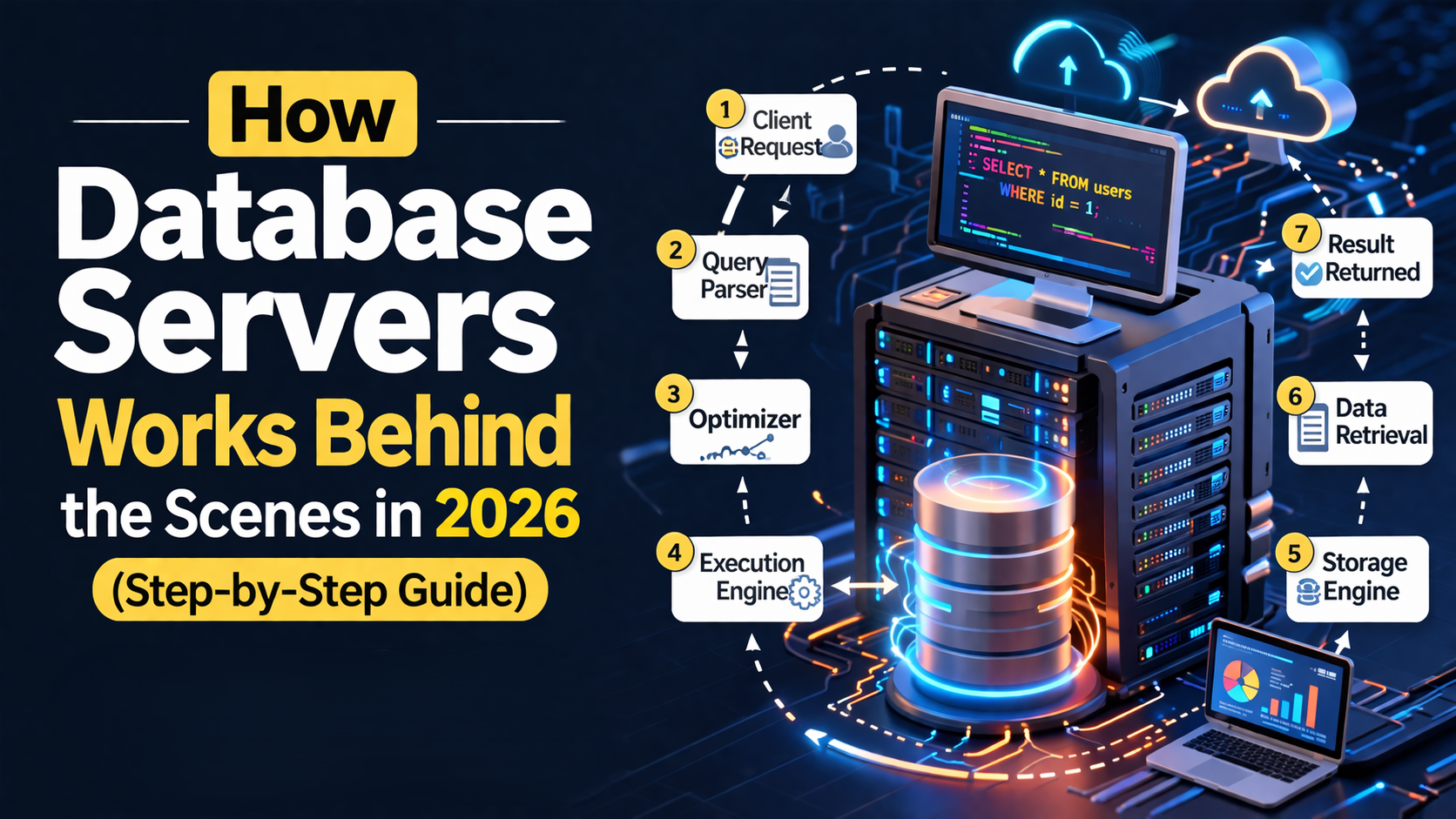
⚙️ Step-by-Step Workflow of a Database Server
Let’s walk through what happens internally when a request is made.
1. Request Initiation
Everything starts when a user interacts with an application. For example, logging into a website triggers a query that checks whether the entered credentials exist in the database.
SELECT * FROM users WHERE email = '[email protected]';
This query is sent from the application layer to the database server over a network connection.
2. Receiving and Interpreting the Query
Once the database server receives the query, it doesn’t execute it immediately. Instead, it first analyzes the structure and meaning of the request.
This stage involves checking whether the query is valid, ensuring that referenced tables and columns exist, and confirming that the user has permission to access the data.

3. Query Parsing and Optimization
After validation, the query goes through parsing and optimization. Parsing converts the query into an internal format that the system understands. Optimization then determines the fastest way to execute the query.
For example, if a table contains millions of rows, the optimizer decides whether to scan the entire table or use an index to locate the required data quickly.
SQL Query
↓
Parser
↓
Optimizer
↓
Execution Plan
This step is crucial for performance, especially in large-scale systems.
4. Execution Engine in Action
The execution engine is responsible for carrying out the plan generated by the optimizer. It performs operations such as filtering rows, joining tables, and sorting results.
If the required data is already available in memory, the engine retrieves it instantly. Otherwise, it communicates with the storage layer to fetch data from disk.
5. Storage Engine and Data Retrieval
The storage engine determines how data is physically stored and accessed. In relational databases like MySQL, engines such as InnoDB manage data in structured formats like tables and indexes.
Execution Engine
|
v
Storage Engine
|
v
Disk / Memory
The storage engine ensures that data retrieval is both efficient and reliable, even when dealing with massive datasets.
6. Returning the Result
Once the data is retrieved and processed, the database server formats the result and sends it back to the application. The application then displays it to the user.
Database Server
|
| Result
v
Application / User
This entire process typically happens in milliseconds, even for complex queries.
🔄 Understanding Data Operations in Depth
Database servers handle three primary types of operations: inserting new data, updating existing records, and deleting unwanted information. These operations may seem simple on the surface, but they involve multiple internal checks to ensure consistency and reliability.
Whenever data is modified, the server ensures that the operation follows the principles of ACID properties. This guarantees that transactions are safe, consistent, and recoverable even in case of failures.

⚡ Performance and Efficiency Mechanisms
To handle millions of requests efficiently, database servers rely on several optimization techniques. Instead of scanning entire datasets repeatedly, they use indexing to quickly locate specific records. Frequently accessed data is stored in memory caches, reducing the need for repeated disk access.
Additionally, modern systems distribute data across multiple servers to balance load and improve performance. This ensures that applications remain fast and responsive, even during peak usage.
🔐 Security and Data Protection
Database servers play a critical role in protecting sensitive information. They implement authentication mechanisms to verify users and authorization controls to restrict access.
Data encryption ensures that even if data is intercepted, it cannot be easily read. Backup and recovery systems further safeguard against data loss, allowing systems to restore information in case of hardware failure or cyberattacks.

🌐 Real-World Scenario: Login System
Consider a real-world login process. When a user enters their credentials, the application sends a query to the database server. The server checks whether the credentials match stored records. If they do, access is granted; otherwise, the request is denied.
Behind this seemingly simple process lies a complex chain of validation, optimization, and execution steps happening almost instantly.
🧩 Types of Database Systems
Database servers come in different forms depending on how they store and manage data. Relational databases organize data into structured tables, making them ideal for applications requiring strong consistency and relationships.
On the other hand, NoSQL databases like MongoDB provide flexibility by allowing unstructured or semi-structured data storage. This makes them suitable for modern applications dealing with large and diverse datasets.
📊 Advanced Architecture in Modern Systems
Large-scale applications often use advanced database architectures. Instead of relying on a single server, they distribute data across multiple systems.
Load Balancer
/ \
v v
Primary DB Replica DB
|
v
Data Storage
The primary server handles write operations, while replica servers manage read requests. This setup improves both performance and reliability.

🎯 Why Database Servers Matter More Than Ever
Database servers are the backbone of modern technology. Without them, applications would not be able to store user data, process transactions, or deliver personalized experiences.
From startups to global enterprises, every organization depends on efficient database systems to operate smoothly and scale effectively.
📝 Final Thoughts
Understanding how database servers work is essential for anyone interested in backend development, data engineering, or system design. While the internal processes may seem complex, breaking them down step by step reveals a logical and efficient system designed to handle data at scale.
If you’re starting your journey, tools like MySQL and PostgreSQL are great for learning structured data, while MongoDB helps you explore flexible data models.
Want to Learn More About Database, Kaashiv Infotech Offers, SQL Course, Mysql Course, SQL Internship & More Visit Our website www.kaashivinfotech.com.
Related Reads: