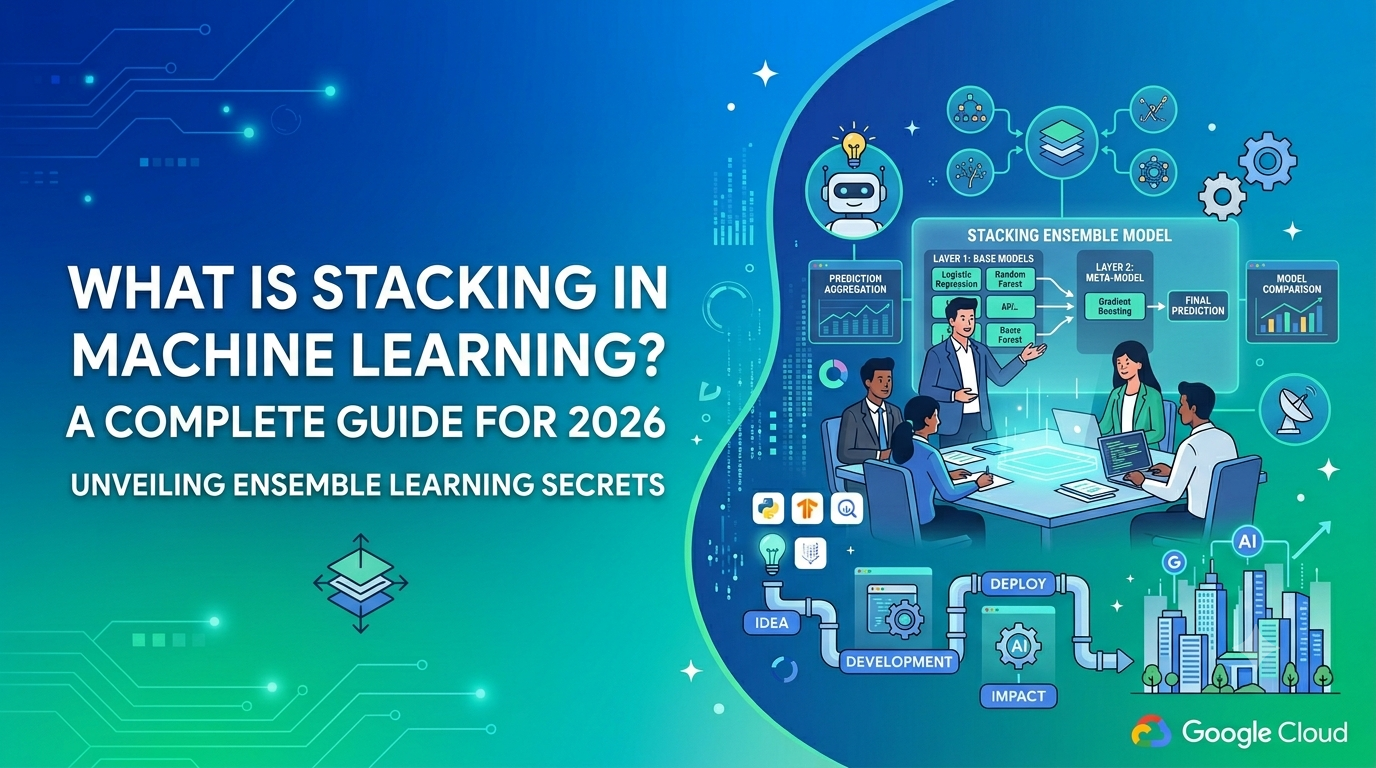
Stacking in machine learning, also known as stacked generalization, is one of the most advanced ensemble techniques in Machine Learning. It combines multiple machine learning models in a structured way to produce highly accurate predictions. Unlike traditional approaches that depend on a single algorithm, stacking builds a layered model architecture where different models collaborate to solve a problem more effectively.
This technique is widely used in real-world applications and competitive platforms like Kaggle, where achieving the highest accuracy is critical.
🔍 Understanding the Concept of Stacking in Machine Learning
At its core, stacking is based on a simple idea:
Instead of choosing the best model, combine multiple models and let another model decide how to use them.
Different algorithms have different strengths:
Some are good at linear relationships
Others capture complex patterns
Some handle noise better
Stacking intelligently combines these strengths into a single predictive system.
🧠 Architecture of Stacking in Machine Learning
Stacking typically consists of two main levels:
1. Level-0 Models (Base Models)
These are the first-layer models trained on the original dataset. They can be:
Homogeneous (same type of model)
Heterogeneous (different types of models)
Common Base Models:
Linear Regression
Decision Tree
Random Forest
Support Vector Machine (SVM)
K-Nearest Neighbors (KNN)
Gradient Boosting models
Each model learns patterns independently and produces predictions.
2. Level-1 Model (Meta-Model)
The meta-model is trained on the predictions made by base models.
Instead of using raw input features, it uses:
Popular Meta-Models:
Logistic Regression (classification)
Linear Regression (regression)
Gradient Boosting models
The meta-model learns:
Which base model is more reliable
When to trust each model
How to combine outputs optimally
⚙️ Detailed Step-by-Step Workflow
Here is how stacking is implemented in practice:
Step 1: Split the Dataset
Divide data into:
Training set
Validation set (or use cross-validation)
Step 2: Train Base Models
Train multiple models on the training data:
Model A
Model B
Model C
Each model learns different patterns.
Step 3: Generate Out-of-Fold Predictions
To avoid overfitting:
Use cross-validation
Generate predictions on unseen folds
This ensures the meta-model does not see biased predictions.
Step 4: Create a New Dataset
Construct a new dataset where:
Each column = prediction from a base model
Target variable remains the same
Example:
| Model A | Model B | Model C | Actual |
|---|---|---|---|
| 120K | 125K | 123K | 122K |
Step 5: Train the Meta-Model
Use this new dataset to train the meta-model.
Step 6: Final Prediction
For new data:
Base models make predictions
Meta-model combines them
Final output is produced
📊 Types of Stacking
1. Simple Stacking
Single layer of base models
One meta-model
2. Multi-Level Stacking
Multiple stacking layers
More complex architecture
3. Blending (Variant of Stacking)
Uses a holdout validation set instead of cross-validation
Simpler but less robust
🔄 Stacking vs Bagging vs Boosting
| Feature | Bagging | Boosting | Stacking |
|---|---|---|---|
| Model Type | Same models | Sequential models | Different models |
| Training Style | Parallel | Sequential | Parallel + Meta-learning |
| Goal | Reduce variance | Reduce bias | Combine strengths |
| Example | Random Forest | AdaBoost, XGBoost | Stacking |

✅ Advantages of Stacking
1. Higher Accuracy
Combining multiple models often leads to better performance than any single model.
2. Flexibility
You can use any combination of algorithms.
3. Robustness
Reduces both bias and variance.
4. Handles Complex Data
Works well for non-linear and high-dimensional datasets.
⚠️ Disadvantages of Stacking
1. Computational Cost
Training multiple models requires more time and resources.
2. Complexity
Harder to implement and debug compared to simple models.
3. Risk of Overfitting
If not properly validated, stacking can overfit.
4. Requires Expertise
Choosing the right models and architecture is critical.
🛠️ Implementation Using Python
Popular tools for stacking include:
Scikit-learn
XGBoost
LightGBM
Example (Scikit-learn):
from sklearn.ensemble import StackingClassifier
from sklearn.linear_model import LogisticRegression
from sklearn.tree import DecisionTreeClassifier
from sklearn.svm import SVC

# Base models
estimators = [
('dt', DecisionTreeClassifier()),
('svm', SVC(probability=True))
]

# Stacking model
model = StackingClassifier(
estimators=estimators,
final_estimator=LogisticRegression()
)

model.fit(X_train, y_train)
predictions = model.predict(X_test)
📌 Best Practices for Stacking
✔ Use Cross-Validation
Always generate out-of-fold predictions.
✔ Choose Diverse Models
Avoid using similar algorithms.
✔ Keep Meta-Model Simple
Complex meta-models can overfit.
✔ Normalize Predictions
Especially when models output different scales.
✔ Avoid Data Leakage
Never train meta-model on the same predictions used for training base models.
🚀 Real-World Applications
Stacking in Machine Learning is used in many industries:
🏦 Finance
Credit risk prediction
Fraud detection
🛒 E-Commerce
Product recommendations
Customer behavior analysis
🏥 Healthcare
Disease prediction
Medical diagnosis
📈 Stock Market
Price prediction
Trend analysis
🧪 Stacking in Competitions
Stacking is a game-changer in competitions like Kaggle.
Top data scientists often:
Combine 5–20 models
Use multi-level stacking
Fine-tune meta-models
This approach significantly boosts leaderboard rankings.
🧾 Conclusion
Stacking in Machine Learning is one of the most powerful techniques in Machine Learning, enabling developers and data scientists to build highly accurate predictive systems. By combining multiple models and introducing a meta-learning layer, stacking leverages the strengths of different algorithms while minimizing their weaknesses.
Although it comes with increased complexity and computational cost, the performance improvements make stacking an essential tool—especially in high-stakes applications and competitive environments.
Kaashiv Infotech Offers Machine Learning Course, Artificial Intelligence Course, Python Course, Visit Our Website www.kaashivinfotech.com.