
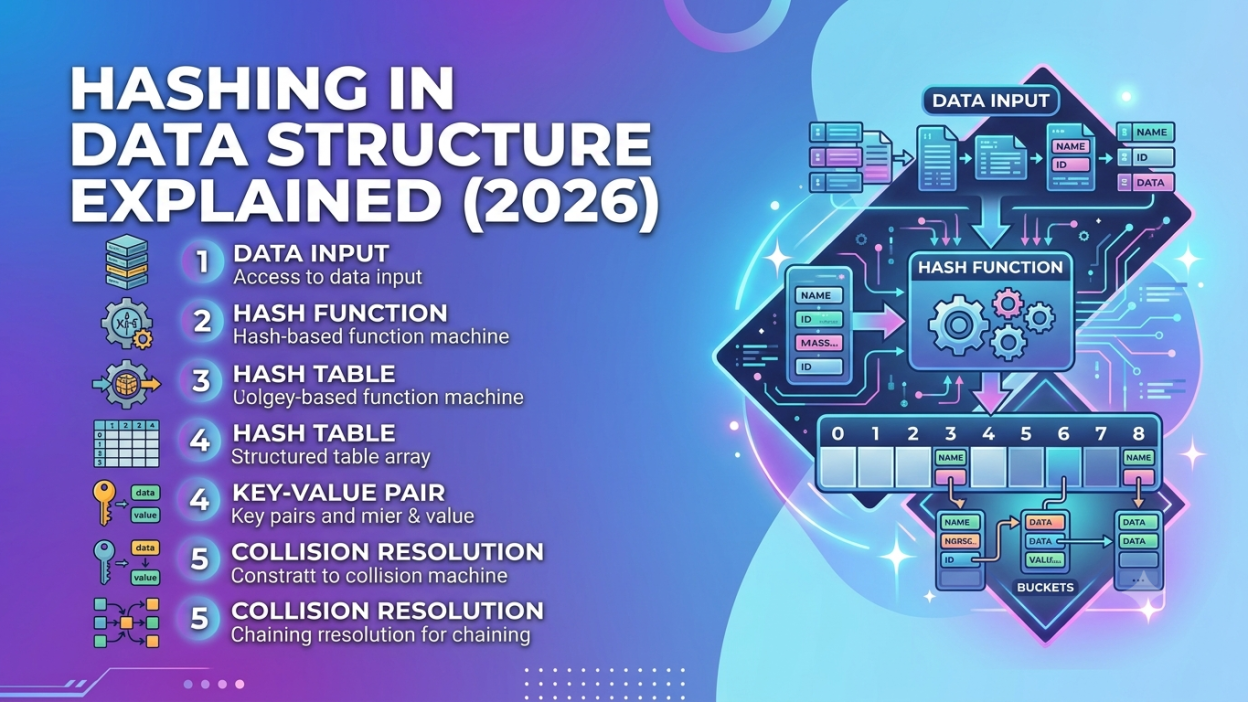
Hashing in Data Structure Explained (2026) is one of those topics that confused me when I first started learning Data Structures. Every tutorial kept talking about hash functions, hash tables, and collisions, but nobody explained why I should even care.
So if you’re searching for Hashing in Data Structure Explained (2026) because you’re preparing for interviews, exams, or simply trying to understand Data Structures, you’re in the right place.
In this guide, I’ll explain hashing in the simplest way possible—with examples from everyday life, a few stories from my own learning journey, and zero unnecessary jargon.
🌟 Key Highlights
- ✅ What is Hashing in Data Structure Explained (2026)?
- ✅ Why hashing is important
- ✅ Real-life examples anyone can understand
- ✅ Hash function explained simply
- ✅ Hash Table structure
- ✅ Collision and Collision Resolution Techniques
- ✅ Advantages and disadvantages
- ✅ Applications of hashing
- ✅ Time Complexity
- ✅ Interview questions
What is Hashing in Data Structure? 🤔
When I first heard the word hashing, I imagined something incredibly mathematical.
It wasn’t.
Think about this…
Imagine you visit a huge library with one million books.
Would you search every shelf one by one?
Of course not.
Instead, you would go directly to the correct shelf because the books are organized.
That is exactly what Hashing in Data Structure Explained (2026) is all about.
Hashing is a technique that stores data so we can find it very quickly without searching every element.
Instead of checking every item, hashing calculates the location where the data should be stored.
That’s why searching becomes incredibly fast.
A Real-Life Example I Always Remember 📚
Whenever I explain hashing to beginners, I use this example.
Imagine you’re staying in a hotel.
Instead of asking,
The receptionist simply asks,
Within seconds, they know exactly where to look.
The room number acts like the output of a hash function.
No unnecessary searching.
Just direct access.
That is the power of Hashing in Data Structure Explained (2026).
Why Do We Need Hashing?
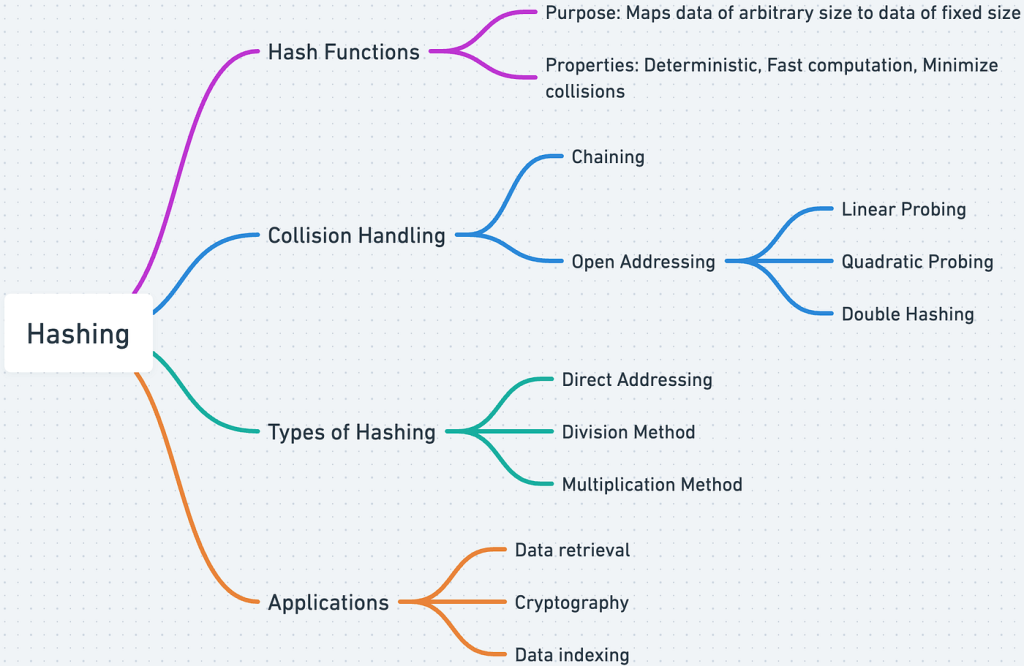
Without hashing, searching can become slow as data grows.
Imagine these situations:
- Searching customer information
- Looking for a student’s record
- Finding your friend’s username
- Banking applications
- Online shopping websites
Millions of records exist.
If every search required checking each record one by one, websites would become painfully slow.
Hashing solves this problem.
It gives us almost instant access to stored information.
What is a Hash Function? 🔑
A hash function is simply a formula that converts a key into an index.
For example,
Suppose our hash table size is 10.
We use this formula:
Index = Key % 10
Let’s see.
| Key | Calculation | Index |
|---|---|---|
| 25 | 25 % 10 | 5 |
| 37 | 37 % 10 | 7 |
| 42 | 42 % 10 | 2 |
Now instead of storing data randomly, we know exactly where each item belongs.
That’s why Hashing in Data Structure Explained (2026) is so efficient.
What is a Hash Table?
A Hash Table is simply an array that stores data.
For example,
| Index | Value |
| 0 | |
| 1 | |
| 2 | 42 |
| 3 | |
| 4 | |
| 5 | 25 |
| 6 | |
| 7 | 37 |
| 8 | |
| 9 |
Notice something?
We didn’t search the entire table.
We jumped directly to the correct location.
Pretty cool, right? 😄
Components of Hashing
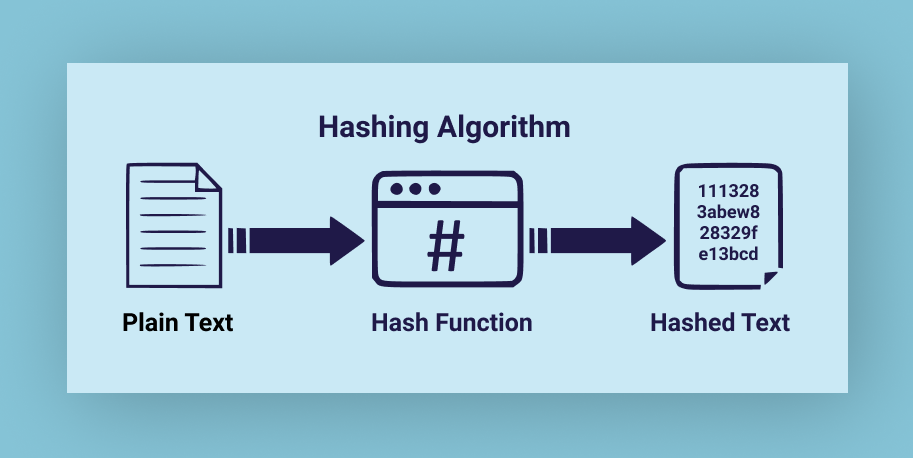
Hashing mainly has three parts.
1. Key
The original value.
Example:
- Student ID
- Employee ID
- Roll Number
2. Hash Function
Converts the key into an index.
Example:
Index = Key % Table Size3. Hash Table
Stores the actual data.
Together, these three make Hashing in Data Structure Explained (2026) one of the fastest searching techniques.
What is Collision? 💥
This confused me the first time I learned hashing.
Let’s see why collisions happen.
Suppose the table size is 10.
25 % 10 = 5

35 % 10 = 5
Oops!
Both keys want to occupy index 5.
This situation is called a Collision.
Collisions are completely normal.
Good hashing techniques simply know how to handle them.
Collision Resolution Techniques
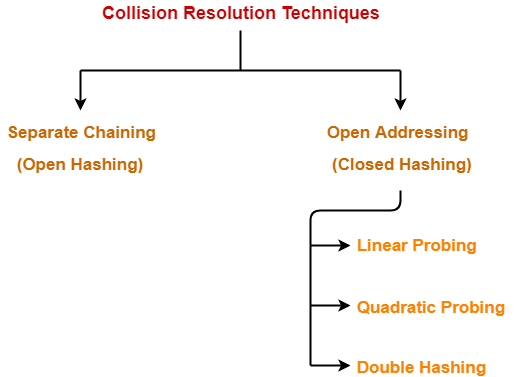
Here are the most common methods.
1. Separate Chaining
Each index stores a linked list.
Example:
Index 5

↓

25 → 35 → 45
Simple and effective.
2. Linear Probing
If the position is occupied…
Move to the next empty slot.
Example
5 occupied

↓

Store at 6
3. Quadratic Probing
Instead of moving one step,
Move
+1²
+2²
+3²
This reduces clustering.
4. Double Hashing
Use another hash function to find the next available position.
Many modern systems use this because it spreads data more efficiently.
Advantages of Hashing 🌟
I personally love hashing because it offers huge performance improvements.
Some major advantages include:
- Very fast searching
- Fast insertion
- Fast deletion
- Efficient memory usage
- Perfect for large databases
- Ideal for dictionaries and caches
Disadvantages of Hashing
Nothing is perfect.
Hashing also has limitations.
- Collisions can occur.
- Choosing a poor hash function reduces performance.
- Resizing hash tables can be expensive.
- Memory may be wasted if the table is too large.
Applications of Hashing

Once I understood hashing, I started noticing it everywhere.
Here are some real-world applications.
🔍 Search Engines
Search engines quickly locate indexed information using hashing techniques.
💳 Banking Systems
Customer records are retrieved quickly.
📱 Social Media
Finding usernames and profiles becomes extremely fast.
📂 Databases
Most databases rely on hashing for efficient indexing and searching.
🌐 Web Browsers
Browsers use hashing to improve cache lookups and speed up loading.
🔐 Password Storage
Instead of storing plain-text passwords, applications store cryptographic hash values (using secure algorithms such as bcrypt, Argon2, or PBKDF2). This improves security because the original password cannot be directly retrieved from the stored hash.
Time Complexity
| Operation | Average Case |
| Search | O(1) |
| Insert | O(1) |
| Delete | O(1) |
Worst case (when many collisions occur):
O(n)
This is why selecting a good hash function matters.
Hashing vs Linear Search
| Feature | Hashing | Linear Search |
| Searching | O(1) | O(n) |
| Insertion | Fast | Moderate |
| Deletion | Fast | Moderate |
| Efficiency | Excellent | Poor for large data |
The difference becomes dramatic when working with thousands or millions of records.
Simple C Example of Hashing
#include <stdio.h>

int main()
{
    int table[10] = {0};

    int key = 25;

    int index = key % 10;

    table[index] = key;

    printf("Stored at Index %d", index);

    return 0;
}
Output
Stored at Index 5This tiny program demonstrates the basic idea behind hashing.
My Final Thoughts 💡
When I first learned Hashing in Data Structure Explained (2026), I made the mistake of memorizing definitions instead of understanding the idea behind them. Once I started thinking of hashing as a way to find the right place instantly, everything clicked.
My advice is simple: don’t just read about hashing—draw a small hash table on paper, insert a few values, create a collision, and resolve it yourself. That hands-on practice helped me remember the concept far better than any textbook ever did.
If you’re preparing for coding interviews or learning Data Structures from scratch, mastering hashing is worth the effort. It’s one of the most practical and frequently used concepts in software development.
Happy learning! 🚀
Frequently Asked Questions (FAQs)
1. What is hashing in a data structure?
Hashing is a technique that maps a key to a specific index in a hash table, allowing data to be stored and retrieved very quickly.
2. Why is hashing faster than linear search?
Hashing usually finds data in O(1) average time because it calculates the storage location directly instead of checking every element.
3. What is a collision in hashing?
A collision occurs when two different keys produce the same hash index. Common solutions include separate chaining, linear probing, quadratic probing, and double hashing.
4. Where is hashing used in real life?
Hashing is widely used in databases, search engines, browser caching, password storage, compiler symbol tables, and programming language dictionaries/maps.
5. Is hashing always O(1)?
No. The average time complexity is O(1), but in the worst case—when many collisions occur—it can degrade to O(n).
Want to learn more ??, Kaashiv Infotech Offers Data Analytics Course, Data Science Course, Cyber Security Course & More Visit Their Website www.kaashivinfotech.com.


