
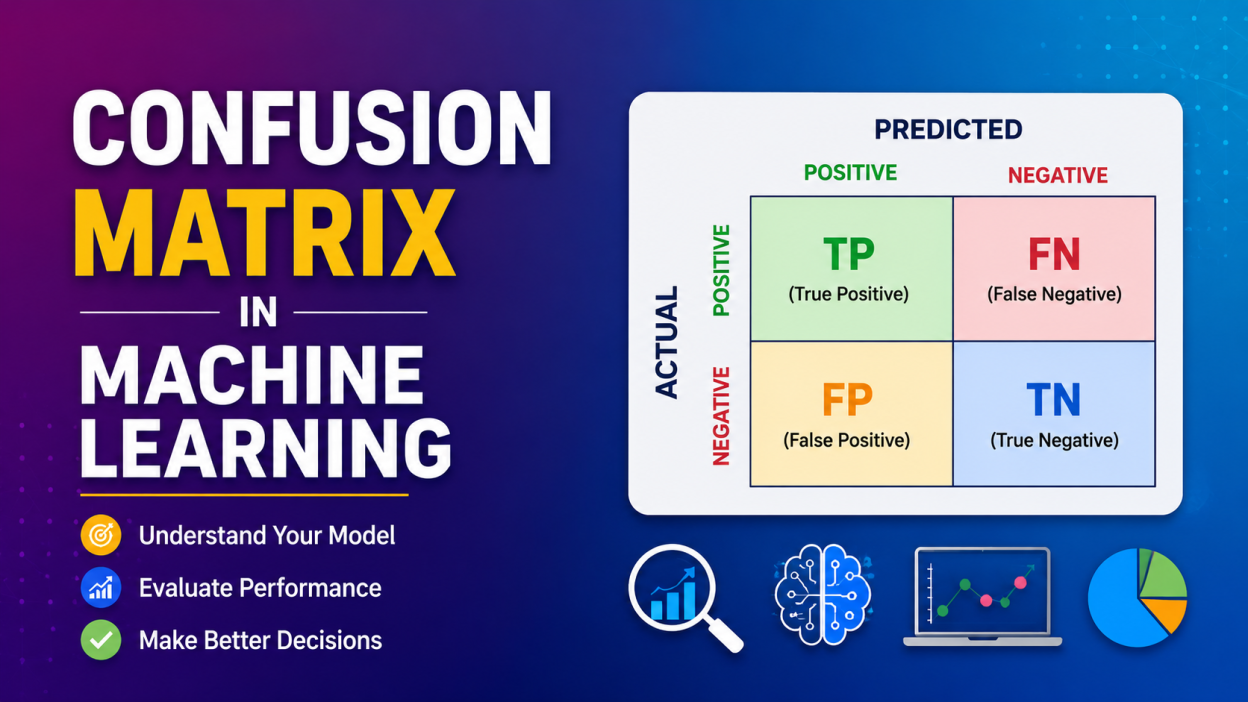
If you’ve been searching for Confusion Matrix in Machine Learning, you’ve come to the right place. Confusion Matrix in Machine Learning is one of the easiest and most effective ways to measure how well a machine learning model performs. Instead of simply saying a model is “90% accurate,” a confusion matrix tells us where the model is making mistakes and why.
When I first started learning machine learning, I thought accuracy was the only thing that mattered. If a model showed 95% accuracy, I assumed it was excellent. But after working on a few practice projects, I realized that accuracy alone can be misleading. That’s when I discovered the Confusion Matrix in Machine Learning, and honestly, it completely changed the way I evaluated models.
In this guide, I’ll explain everything in simple words. Whether you’re a student, preparing for interviews, or just curious about machine learning, you’ll understand the Confusion Matrix in Machine Learning without needing an advanced math background.
✨ Key Highlights
By the end of this article, you’ll learn:
- ✅ What a Confusion Matrix in Machine Learning is
- ✅ Why it is important
- ✅ Understand True Positive, True Negative, False Positive, and False Negative
- ✅ Learn with a real-life example
- ✅ Know how to calculate Accuracy, Precision, Recall, and F1 Score
- ✅ Discover common mistakes beginners make
- ✅ Find out where confusion matrices are used in real-world applications
🤖 What Is a Confusion Matrix in Machine Learning?

A Confusion Matrix in Machine Learning is a table that helps us measure how well a classification model performs.
Instead of giving us only one number, it tells us:
- How many predictions were correct ✅
- How many predictions were wrong ❌
- What type of mistakes the model made
- Whether the model is confusing one class with another
Think of it like a school report card.
Imagine you wrote a math exam.
Your teacher doesn’t simply say,
Instead, the teacher explains:
- You answered 40 questions correctly.
- You got 5 easy questions wrong.
- You missed 3 difficult questions.
- You left 2 questions unanswered.
That detailed report helps you improve.
A Confusion Matrix in Machine Learning works exactly the same way.
🤔 Why Is a Confusion Matrix Important?
This is something I didn’t understand initially.
I kept asking myself,
“If accuracy tells me everything, why do I need another metric?”
Here’s the reason.
Imagine a hospital uses AI to detect cancer.
There are:
- 990 healthy patients
- 10 cancer patients
Now suppose the model predicts:
“Everyone is healthy.”
Its accuracy would be:
990 ÷ 1000 = 99%
Sounds amazing, right?
Not really.
The model failed to identify every single cancer patient.
That means accuracy alone doesn’t tell the whole story.
A Confusion Matrix in Machine Learning reveals these hidden mistakes, making it one of the most important evaluation tools.
🧩 Components of a Confusion Matrix

Every confusion matrix contains four important values.
These four numbers tell the complete story of your model.
✅ True Positive (TP)
A True Positive means the model predicted Positive, and the answer was actually Positive.
Example
A medical AI predicts:
The patient really has diabetes.
✔ Correct prediction.
This is a True Positive.
✅ True Negative (TN)
A True Negative means the model predicted Negative, and the answer was actually Negative.
Example
The AI predicts:
The patient is indeed healthy.
✔ Correct prediction.
This is a True Negative.
❌ False Positive (FP)
A False Positive happens when the model predicts Positive, but the actual answer is Negative.
Example
Airport security flags an innocent passenger as suspicious.
The passenger is completely innocent.
This is a False Positive.
It is sometimes called a False Alarm.
❌ False Negative (FN)
A False Negative happens when the model predicts Negative, but the actual answer is Positive.
Example
A medical test says:
But the patient actually has cancer.
This is a False Negative.
In healthcare, False Negatives can be dangerous because the disease goes undetected.
📊 Structure of a Confusion Matrix
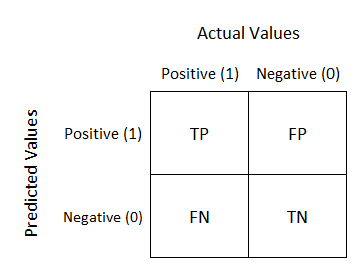
A confusion matrix is usually represented like this:
| Actual / Predicted | Positive | Negative |
|---|---|---|
| Positive | True Positive (TP) | False Negative (FN) |
| Negative | False Positive (FP) | True Negative (TN) |
Once I understood this table, many machine learning evaluation metrics suddenly became much easier to understand.
☕ A Real-Life Example
Let’s imagine an email spam filter.
Suppose we have 100 emails.
After testing the model, we get these results:
| Result | Count |
| True Positive | 45 |
| True Negative | 40 |
| False Positive | 5 |
| False Negative | 10 |
What does this mean?
- The model correctly detected 45 spam emails.
- It correctly identified 40 normal emails.
- It wrongly marked 5 normal emails as spam.
- It failed to detect 10 spam emails.
Now we know exactly where the model struggles.
Without a Confusion Matrix in Machine Learning, we’d only see an overall accuracy score and miss these valuable insights.
🌍 Real-World Applications of Confusion Matrix in Machine Learning
One thing I love about machine learning is that it’s everywhere. The Confusion Matrix in Machine Learning is used across many industries to evaluate models.
Some common examples include:
🏥 Healthcare
- Disease prediction
- Cancer detection
- Diabetes diagnosis
- Heart disease analysis
📧 Email Services
- Spam detection
- Phishing email identification
- Malware detection
💳 Banking
- Credit card fraud detection
- Loan approval systems
- Risk assessment
🛒 E-commerce
- Product recommendations
- Customer churn prediction
- Fake review detection
🚗 Self-Driving Cars
- Traffic sign recognition
- Pedestrian detection
- Lane detection
- Obstacle identification
No matter the industry, a Confusion Matrix in Machine Learning helps developers understand whether a model is making the right decisions—or making costly mistakes.
📐 How to Calculate Metrics Using a Confusion Matrix in Machine Learning
Now that we understand the four components—True Positive (TP), True Negative (TN), False Positive (FP), and False Negative (FN)—let’s see how they help us calculate the most important evaluation metrics.
When I first learned these formulas, they looked intimidating. But once I understood what each metric was trying to answer, everything clicked.
✅ Accuracy
Accuracy tells us how many predictions the model got right out of all predictions.
Formula
Accuracy = (TP + TN) ÷ (TP + TN + FP + FN)
Example
Suppose a model gives the following results:
- TP = 45
- TN = 40
- FP = 5
- FN = 10
Accuracy = (45 + 40) ÷ (45 + 40 + 5 + 10)
Accuracy = 85 ÷ 100 = 85%
This means the model correctly predicted 85 out of 100 cases.
💡 Remember: A high accuracy doesn’t always mean a model is good, especially when the dataset is unbalanced.
🎯 Precision
Precision answers an important question:
Formula
Precision = TP ÷ (TP + FP)
Using our example:
Precision = 45 ÷ (45 + 5)
Precision = 45 ÷ 50 = 90%
A high precision means the model produces very few false alarms.
Real-Life Example
Imagine an email spam filter.
If it marks an important office email as spam, that can create problems. In this situation, high precision is very important because we want to avoid false positives.
🔍 Recall (Sensitivity)
Recall answers another important question:
Formula
Recall = TP ÷ (TP + FN)
Using our example:
Recall = 45 ÷ (45 + 10)
Recall = 45 ÷ 55 ≈ 81.8%
Real-Life Example
Think about cancer detection.
Missing a patient who actually has cancer is much more dangerous than mistakenly testing a healthy person again.
That’s why healthcare models often prioritize high recall.
⚖️ F1 Score
Sometimes, focusing only on Precision or only on Recall isn’t enough.
The F1 Score balances both.
Formula
F1 Score = 2 × (Precision × Recall) ÷ (Precision + Recall)
The F1 Score becomes especially useful when the dataset is imbalanced.
I usually think of it as a “balance score.” If Precision and Recall are both strong, the F1 Score will also be high.
📊 Accuracy vs Precision vs Recall vs F1 Score
| Metric | What It Measures | Best Used When |
|---|---|---|
| Accuracy | Overall correct predictions | Balanced datasets |
| Precision | Correct positive predictions | False positives are costly |
| Recall | Finding all actual positives | Missing positives is risky |
| F1 Score | Balance of Precision and Recall | Imbalanced datasets |
👍 Advantages of a Confusion Matrix in Machine Learning
One reason I appreciate the Confusion Matrix in Machine Learning is that it gives much more insight than a single accuracy score.
Some major advantages include:
- ✔ Shows exactly where the model makes mistakes
- ✔ Helps calculate Accuracy, Precision, Recall, and F1 Score
- ✔ Makes model evaluation more reliable
- ✔ Easy to understand with practice
- ✔ Widely used in machine learning projects
- ✔ Useful for comparing different classification models
👎 Limitations of a Confusion Matrix in Machine Learning
Like every tool, a confusion matrix also has a few limitations.
- ❌ Mainly useful for classification problems
- ❌ Can become difficult to interpret with many classes
- ❌ Doesn’t directly measure prediction confidence
- ❌ Needs additional metrics for deeper evaluation
Even with these limitations, the Confusion Matrix in Machine Learning remains one of the most valuable evaluation techniques.
💡 Common Mistakes Beginners Make
I made several of these mistakes when I first learned machine learning, so don’t worry if you do too!
❌ Thinking Accuracy Is Enough
A model with 99% accuracy can still perform poorly if it misses all positive cases.
❌ Mixing Up False Positives and False Negatives
A simple trick I use:
- False Positive → The model says “Yes,” but the answer is “No.”
- False Negative → The model says “No,” but the answer is “Yes.”
❌ Ignoring Dataset Imbalance
If one class has many more samples than another, Accuracy can be misleading. In such cases, Precision, Recall, and the F1 Score become much more meaningful.
🌍 Why Companies Use a Confusion Matrix
Many industries rely on the Confusion Matrix in Machine Learning to improve their AI systems.
Some examples include:
- 🏥 Hospitals for disease diagnosis
- 💳 Banks for fraud detection
- 📧 Email providers for spam filtering
- 🛍️ E-commerce platforms for recommendation systems
- 🚗 Self-driving cars for object detection
- 🔐 Cybersecurity companies for threat detection
This shows how important the confusion matrix is in real-world machine learning applications.
❓ Frequently Asked Questions (FAQs)
What is a Confusion Matrix in Machine Learning?
A Confusion Matrix in Machine Learning is a table used to evaluate the performance of a classification model by comparing actual values with predicted values.
Why is a Confusion Matrix important?
It helps identify the types of mistakes a model makes instead of showing only an overall accuracy score.
What are the four components of a confusion matrix?
True Positive (TP)
True Negative (TN)
False Positive (FP)
False Negative (FN)
Is a confusion matrix only used for machine learning?
It is mainly used for evaluating classification models in machine learning, but it can also be applied in statistics and data analysis.
Which metric is better: Accuracy or F1 Score?
It depends on the problem. For balanced datasets, Accuracy is often sufficient. For imbalanced datasets, the F1 Score usually provides a better picture of model performance.
🎯 Final Thoughts
When I first heard the term Confusion Matrix in Machine Learning, I imagined it would be one of the hardest concepts to understand. The name itself sounded intimidating! But after spending time with real examples, I realized it’s actually one of the easiest and most useful tools for evaluating a machine learning model.
A confusion matrix doesn’t just tell you whether a model is good or bad—it tells you why. It highlights the model’s strengths, reveals its weaknesses, and helps you decide what needs improvement. That’s something a simple accuracy score can never do on its own.
If you’re just beginning your machine learning journey, don’t rush through this topic. Take your time to understand True Positive, True Negative, False Positive, and False Negative. Once these four concepts become clear, metrics like Accuracy, Precision, Recall, and F1 Score will make much more sense.
I hope this guide on Confusion Matrix in Machine Learning helped simplify a topic that often feels overwhelming. Keep practicing with real datasets, experiment with different models, and remember—every expert was once a beginner. Happy learning! 🚀
Kaashiv Infotech Offers, Full Stack Python Course, Data Science Course, & More, visit their website www.kaashivinfotech.com.

