Choosing the right IT career in 2026 is no longer about hype, reels, or what everyone else is learning. It’s about skills that survive change, salary growth that compounds, and roles companies cannot afford to remove. Two careers dominate almost every serious tech discussion today:👉 Full Stack Developer vs DevOps Engineer
Both roles are powerful.
Both are in demand.
Both can change your financial future.
But they are not the same. And choosing the wrong one—for the wrong reason—can cost you years.
This in-depth guide breaks down everything that actually matters:
skills, salary, competition, AI impact, freshers’ reality, job demand, roadmaps, and long-term safety—so you can make a future-proof decision, not an emotional one.
Why This Comparison Matters More Than Ever in 2026
The IT industry of 2026 looks nothing like it did five years ago.
Here’s what has changed:
- Cloud is no longer optional – it’s the default
- Automation is mandatory, not “nice to have”
- AI is accelerating development, not replacing people outright
- Companies want fewer engineers with broader impact
Hiring managers today don’t ask:
“Can you code?”
They ask:
“Can you ship, scale, and sustain systems?”
That’s exactly why understanding the difference between Full Stack Developer vs DevOps Engineer matters before you invest time, money, or months of learning.
What Is a Full Stack Developer? – Real-World Explanation
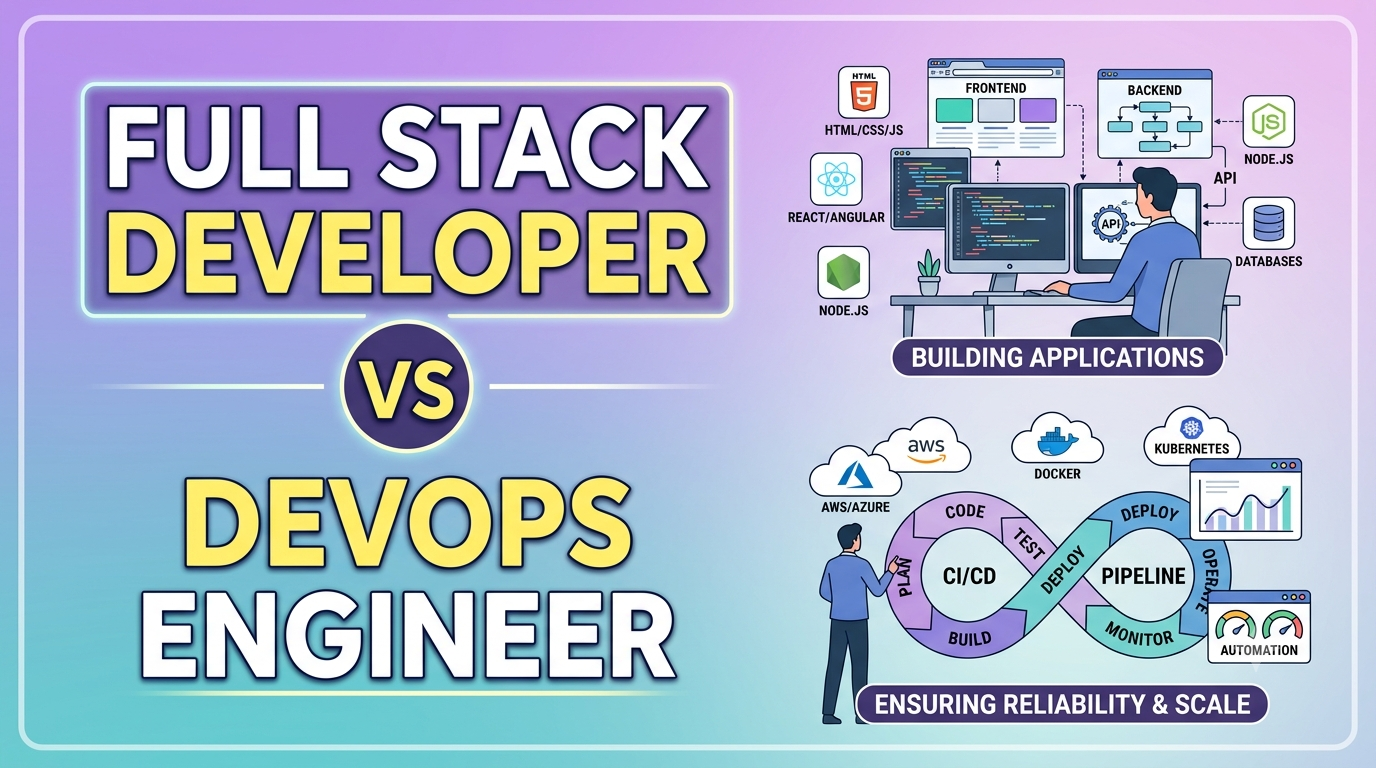
A Full Stack Developer is someone who can build a complete web application—from screen to server to storage.
In simple terms:
If a website or app works end-to-end, a Full Stack Developer understands how every part connects.
Not theory. Not slides. Real working systems.
Core Areas of Full Stack Development
🔹 Frontend (What users see and interact with)
- HTML – structure
- CSS – layout and design
- JavaScript – behavior
- React / Angular – modern UI frameworks
This is where user experience lives or dies.
🔹 Backend (Logic & processing)
- Java / Python / Node.js / .NET / PHP
- APIs, authentication, business logic
- Handling requests, security, workflows
This is the brain of the application.
🔹 Database (Data storage)
- MySQL, PostgreSQL, Oracle, MongoDB
- Data modeling, queries, performance
No data = no application.
🔹 Version Control
- Git, GitHub
This is how real teams work together.
👉 When someone understands frontend + backend + database, they earn the title Full Stack Developer.
What Is a DevOps Engineer? -Reality, Not Buzzwords
A DevOps Engineer focuses on deployment, automation, cloud infrastructure, reliability, and scalability.
If developers build the product, DevOps engineers make sure:
- It runs
- It scales
- It updates automatically
- It doesn’t go down at 3 AM
In simple words:
DevOps engineers take applications to production—and keep them alive.
Key Responsibilities of a DevOps Engineer
- Deploy applications to cloud servers
- Automate builds and deployments
- Manage containers and infrastructure
- Monitor systems and prevent failures
- Improve speed, reliability, and security
DevOps is less about writing application features and more about systems, automation, and cloud discipline.
Skill Comparison: Full Stack Developer vs DevOps Engineer
🔧 Full Stack Developer Skills
- HTML, CSS, JavaScript
- React or Angular
- Backend language (Java / Python / Node.js)
- SQL databases
- Git & GitHub
- End-to-end project development
⚙️ DevOps Engineer Skills
- Linux & networking fundamentals
- Cloud platforms (AWS / Azure / GCP)
- Docker (containerization)
- Jenkins (CI/CD pipelines)
- Kubernetes (orchestration)
- Ansible (automation)
- Monitoring tools (Prometheus, Grafana, Nagios)
- Git & Jira
👉 Key difference
- Full Stack = heavy coding
- DevOps = minimal coding, more automation
Coding Requirement: The Honest Truth (No Marketing Lies)
| Role | Coding Level |
|---|---|
| Full Stack Developer | 🔥 High (daily coding) |
| DevOps Engineer | ⚡ Low–Medium (scripts & commands) |
If you love writing code, solving logic, and building features → Full Stack fits you.
If you prefer automation, infrastructure, and tools → DevOps is the smarter choice.
Competition Level: The Part No One Talks About
This is where many career decisions collapse.
Full Stack Developer Reality
- Extremely popular
- High competition
- Thousands of applicants per role
DevOps Engineer Reality
- Fewer skilled professionals
- Lower competition
- Higher interview conversion rate
Approximate real-world ratio:
- Full Stack → 1 job : 2000+ applicants
- DevOps → 1 job : 300–400 applicants
👉 This single factor gives DevOps a massive edge.
Salary Comparison in India (2026 Projection)
💰 Full Stack Developer Salary
- Freshers: ₹3 – ₹6 LPA
- Experienced: ₹10 – ₹15 LPA
💰 DevOps Engineer Salary
- Freshers: ₹4 – ₹7 LPA
- Experienced: ₹10 – ₹20+ LPA
👉 On average, DevOps pays more, especially after 2–3 years.
Job Demand: Which Role Is Growing Faster?
Both roles are in demand—but DevOps demand is growing faster.
Why DevOps Is Rising Rapidly
- Every company is moving to cloud
- Automation reduces operational cost
- AI + DevOps (AIOps) is becoming standard
- Downtime is expensive—DevOps prevents it
Full Stack Demand
- Stable and strong
- Essential in startups & product companies
- Slightly impacted by AI tools—but not replaced
AI Impact: Full Stack Developer vs DevOps Engineer
AI Impact on Full Stack Developers
AI will:
- Speed up coding
- Reduce repetitive work
- Improve productivity
AI will not replace Full Stack Developers, but:
- Fewer developers will do more work
- Skill depth will matter more
AI is a helper, not a threat.
AI Impact on DevOps Engineers
DevOps itself is automation.
AI strengthens DevOps:
- Predictive monitoring
- Intelligent alerts
- Faster deployments
👉 DevOps is AI-aligned and AI-powered, making it one of the safest tech careers.
Why Many People Fail in These Roles (Hard Truth)
Why Full Stack Developers Struggle
- Learn frameworks without fundamentals
- No real projects
- Weak problem-solving
- Overcrowded job market
Why DevOps Learners Fail
- Skip networking basics
- Learn tools without understanding systems
- Expect “easy jobs”
- Avoid Linux & troubleshooting
👉 Both careers punish shortcuts.
Best Career for Freshers in 2026?
Choose Full Stack Developer if:
- You love coding
- You enjoy UI + logic
- You want creative technical work
Choose DevOps Engineer if:
- You prefer systems & infrastructure
- You dislike heavy coding
- You like cloud, tools, and automation
⚠️ Important reality check
Freshers in DevOps must learn networking + Linux + cloud basics. Tools alone are not enough.
Roadmap: Full Stack Developer (Beginner → Job)
- HTML
- CSS
- JavaScript
- React / Angular
- Backend (Java / Python / Node.js)
- SQL Database
- Git & GitHub
- Real-world projects
👉 Projects are mandatory, not optional.
Roadmap: DevOps Engineer (Beginner → Job)
- Computer & networking basics
- Linux fundamentals
- Cloud (AWS / Azure / GCP)
- Docker
- Jenkins (CI/CD)
- Ansible
- Kubernetes
- Monitoring tools
- Git & Jira
👉 Strong foundations decide success.
Long-Term Safety: Which Career Is Safer?
Both careers are safe—but DevOps has an edge due to:
- Lower competition
- Higher salaries
- Strong AI alignment
- Cloud dominance
Still, interest beats trends every time.
Final Verdict: Full Stack Developer vs DevOps Engineer
There is no single “best” career.
The best career is the one that:
- Matches your interest
- Matches your learning style
- Matches your long-term goals
Quick Summary
- Love coding? → Full Stack Developer
- Love automation & cloud? → DevOps Engineer
- Want higher pay with less coding? → DevOps
- Want creative app development? → Full Stack
Final Advice
Don’t choose a career because it’s trending.
Don’t choose because someone else earned well.
Choose what you can do consistently for years.
With the right skills, both careers can change your life.
📚 Related Reads
- Big Data vs Everything: The Ultimate Guide to Clearly Understanding the Differences in 2026
- Augmented Reality vs Virtual Reality: The Powerful Truth About a High-Growth Tech Career in 2026
- QA Testing vs Business Analyst: The Brutal Truth About Salary, Growth & Job Security in 2026
- Difference Between Product Based and Service Based Company – Shocking Truth Behind Salary, Growth, and Stress in 2026
If you’d like, I can also format this in HTML for direct WordPress paste.