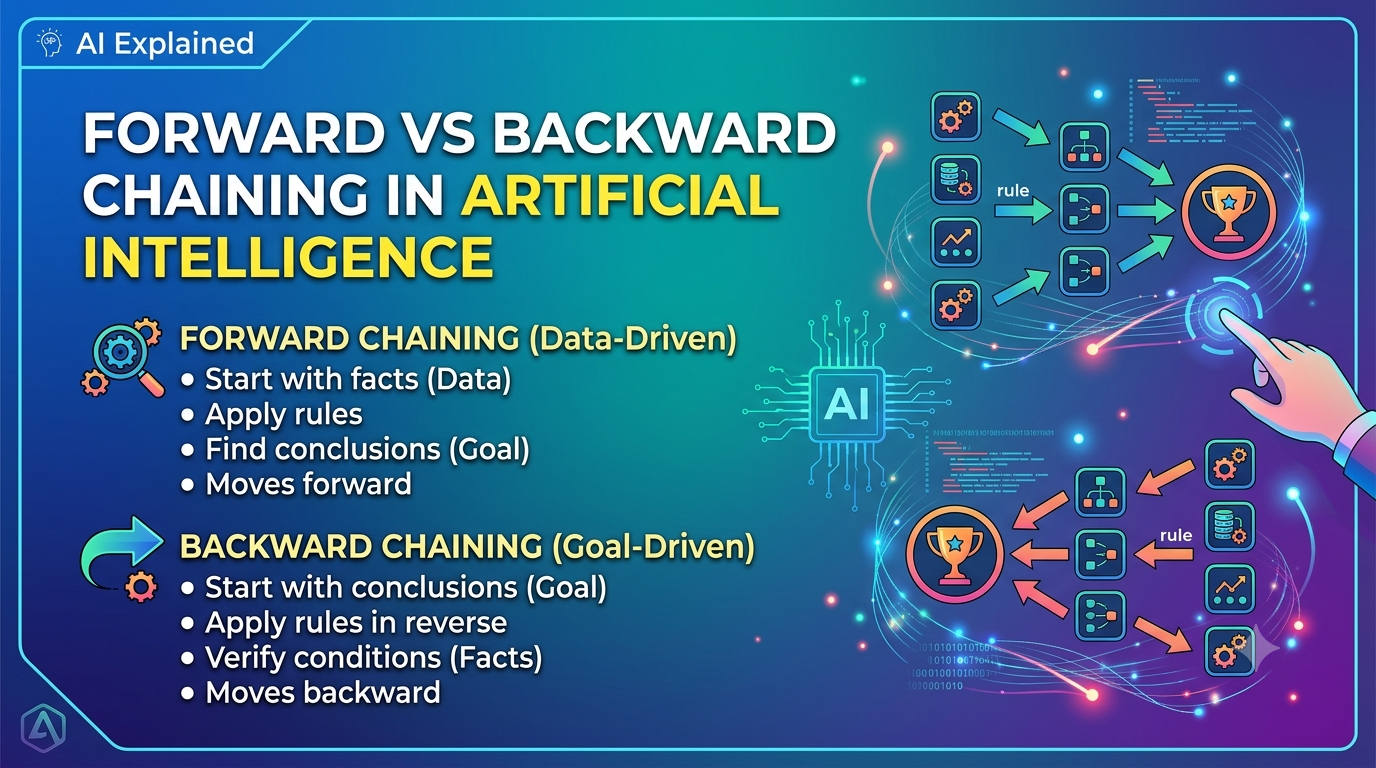
Forward and Backward Chaining Artificial Intelligence (AI) relies heavily on logical reasoning to make decisions, solve problems, and simulate human thinking. Among the most important reasoning techniques used in AI are Forward Chaining and Backward Chaining. These methods are widely used in expert systems, rule-based systems, and decision-making engines.
In this comprehensive guide, we’ll explore what forward and backward chaining are, how they work, their differences, real-world applications, advantages, and when to use each approach.
What is Chaining in Artificial Intelligence?
In AI, chaining refers to the process of applying rules to a set of known facts to derive new information or reach a conclusion. These rules are usually written in IF-THEN format, such as:
IF condition → THEN action/result
Chaining techniques use these rules to perform reasoning in two main ways:
- Forward Chaining (data-driven)
- Backward Chaining (goal-driven)
What is Forward Chaining?
Definition
Forward Chaining is a data-driven reasoning approach that starts with known facts and applies inference rules to generate new facts until a goal is reached.
How It Works
Forward chaining follows these steps:
- Begin with a set of known facts.
- Check all applicable rules whose conditions match the facts.
- Apply the rule and generate new facts.
- Repeat the process until the goal is achieved or no more rules can be applied.
Example
Let’s consider a simple rule-based system:
- Rule 1: IF it is raining → THEN the ground is wet
- Rule 2: IF the ground is wet → THEN the road is slippery
Given fact: It is raining
Process:
- Apply Rule 1 → Ground is wet
- Apply Rule 2 → Road is slippery
Conclusion: The road is slippery
Characteristics
- Works from facts to conclusion
- Explores all possible outcomes
- Suitable for problems where all data is available at the start
What is Backward Chaining?
Definition
Backward Chaining is a goal-driven reasoning approach that starts with a goal and works backward to determine which facts must be true to achieve that goal.
How It Works
Backward chaining follows these steps:
- Start with a goal (hypothesis).
- Check if the goal matches any rule’s conclusion.
- Break the goal into sub-goals (conditions of the rule).
- Verify if sub-goals are true using known facts or further rules.
- Continue until the goal is confirmed or disproved.
Example
- Rule 1: IF it is raining → THEN the ground is wet
- Rule 2: IF the ground is wet → THEN the road is slippery
Goal: Is the road slippery?
Process:
- Check Rule 2 → Need to prove ground is wet
- Check Rule 1 → Need to prove it is raining
- Given fact: It is raining
Conclusion: The road is slippery
Characteristics
- Works from goal to facts
- Focuses only on relevant rules
- Efficient when the goal is predefined
Key Differences Between Forward and Backward Chaining
| Feature | Forward Chaining | Backward Chaining |
|---|---|---|
| Approach | Data-driven | Goal-driven |
| Starting Point | Known facts | Goal or hypothesis |
| Direction | Bottom-up | Top-down |
| Rule Application | Applies all possible rules | Applies only relevant rules |
| Efficiency | Less efficient for large systems | More efficient for specific goals |
| Use Case | Monitoring systems, prediction | Diagnosis, query systems |
Real-World Applications
Forward Chaining Applications
Forward chaining is commonly used in:
- Expert systems for medical diagnosis
- Weather prediction systems
- Stock market analysis
- Real-time monitoring systems
It is ideal when:
- Data is continuously changing
- You need to explore multiple possible outcomes
Backward Chaining Applications
Backward chaining is used in:
- Diagnostic systems
- Debugging tools
- AI-based question answering systems
- Logic programming (e.g., Prolog)
It is best when:
- You have a clear goal
- You want to minimize unnecessary computations
Advantages of Forward Chaining
- Simple and intuitive approach
- Works well with large sets of data
- Useful for systems that require continuous updates
- Can generate multiple conclusions
Limitations
- Can be slow due to unnecessary rule evaluations
- Not efficient when the goal is specific
Advantages of Backward Chaining
- More efficient for targeted problem-solving
- Reduces unnecessary computations
- Faster for goal-specific queries
- Widely used in AI reasoning engines
Limitations
- Requires a clearly defined goal
- May not explore all possible solutions
Forward vs Backward Chaining: When to Use What?
Choosing between forward and backward chaining depends on the problem:
- Use Forward Chaining when:
- You start with a lot of data
- You want to discover all possible outcomes
- The system is event-driven
- Use Backward Chaining when:
- You have a specific goal
- You need efficient reasoning
- You are working with query-based systems
Forward and Backward Chaining in Expert Systems
Both techniques are fundamental in expert systems, which simulate human decision-making.
- Forward chaining helps in predictive reasoning
- Backward chaining helps in diagnostic reasoning
Modern AI systems often combine both approaches to improve performance and accuracy.
Conclusion
Forward Chaining and Backward Chaining are two powerful reasoning techniques in Artificial Intelligence that enable machines to think logically and solve problems effectively. While forward chaining focuses on deriving conclusions from known facts, backward chaining works backward from a goal to determine the necessary conditions.
Understanding these methods is crucial for building intelligent systems, designing expert systems, and improving decision-making processes in AI applications.
In practice, the choice between the two depends on the nature of the problem—whether it is data-driven or goal-driven. Mastering both approaches will give you a strong foundation in AI reasoning and help you design more efficient and intelligent systems.
Kaashiv Infotech Offers Machine Learning Course, Artificial Intelligence Course, Python Course, Visit Our Website www.kaashivinfotech.com.