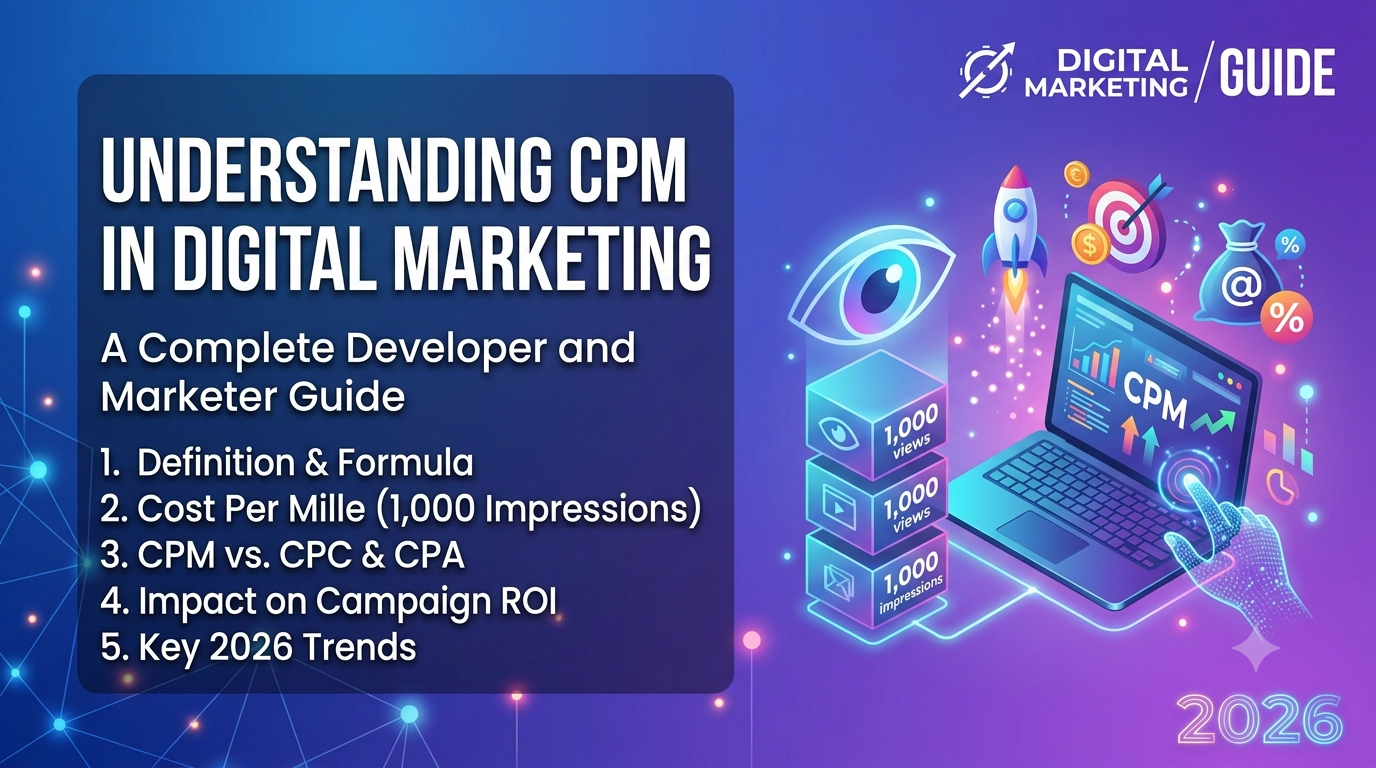
CPM in Digital Marketing – Digital marketing has become one of the most powerful ways for businesses to reach their target audience. With millions of advertisements displayed online every day, marketers rely on specific metrics to measure the effectiveness of their campaigns. One of the most widely used advertising metrics is CPM (Cost Per Mille).
CPM plays a crucial role in digital advertising because it focuses on impressions and visibility, helping brands measure how often their ads are shown to users. Instead of paying for clicks or conversions, advertisers pay for every 1,000 times their advertisement appears on a screen. This makes CPM an ideal metric for campaigns focused on brand awareness, reach, and visibility.
In this comprehensive guide, we will explore what CPM is, how it works, how to calculate it, the average CPM costs in 2026, factors that influence CPM, advantages and disadvantages, and advanced strategies to optimize CPM campaigns.
What is CPM in Digital Marketing?
CPM stands for Cost Per Mille, where the word mille comes from Latin meaning one thousand. In digital marketing, CPM represents the cost an advertiser pays for 1,000 ad impressions.
An impression occurs every time an advertisement is displayed on a webpage, mobile application, or social media platform. It does not require a user to click the ad; it only measures how often the ad is shown.
For example, if an advertiser pays $10 CPM, they will pay $10 for every 1,000 impressions their advertisement receives.
CPM is widely used in different types of digital advertising, including:
Display advertising
Video advertising
Social media advertising
Programmatic advertising
Native advertising
Brand awareness campaigns
Because CPM focuses on exposure rather than interaction, it is commonly used by companies that want to increase brand visibility and reach a large audience quickly.
How CPM Works in Online Advertising
When advertisers run digital campaigns, they participate in ad auctions where advertising platforms determine which ads are shown to users. In a CPM model, advertisers set a bid amount indicating how much they are willing to pay for 1,000 impressions.
The advertising platform then uses algorithms to determine:
Which ad should appear
Where the ad should be placed
How often the ad should be shown
Which audience will see the ad
Platforms such as search engines, social networks, and advertising networks use real-time bidding systems to deliver ads to the most relevant users.
CPM campaigns are particularly effective for businesses that want to:
Launch new products
Increase brand awareness
Promote large marketing campaigns
Reach broad audiences
Build brand recognition
CPM Formula: How to Calculate CPM
The CPM calculation helps advertisers determine how much they are paying for ad impressions.
CPM Formula
CPM = (Total Advertising Cost ÷ Total Impressions) × 1000
This formula converts the cost of advertising into the price paid for every 1,000 impressions.
Example Calculation
Imagine a company spends $500 on a display advertising campaign that generates 120,000 impressions.
CPM = (500 ÷ 120,000) × 1000
CPM = 4.16
This means the advertiser is paying approximately $4.16 for every 1,000 impressions.
Understanding this calculation helps marketers evaluate whether their advertising campaigns are cost-effective and competitive.
CPM vs CPC vs CPA: Key Differences
Digital advertising uses several pricing models depending on campaign objectives. CPM is just one of many performance metrics used by marketers.
| Advertising Model | Meaning | Best Use Case |
|---|---|---|
| CPM | Cost per 1,000 impressions | Brand awareness campaigns |
| CPC | Cost per click | Driving website traffic |
| CPA | Cost per acquisition | Generating conversions or sales |
| CPL | Cost per lead | Lead generation campaigns |
For example:
If the goal is visibility, CPM works best.
If the goal is traffic, CPC is more suitable.
If the goal is sales, CPA is the preferred model.
Successful digital marketing strategies often combine multiple pricing models.
Average CPM Costs Across Platforms in 2026
CPM rates vary depending on advertising platform, target audience, ad format, and competition. Below is an approximate overview of CPM rates across major advertising platforms.
| Platform | Average CPM Range |
|---|---|
| Display Advertising Networks | $2 – $10 |
| Social Media Ads | $6 – $15 |
| Video Advertising | $8 – $25 |
| Professional Networks | $20 – $45 |
| Programmatic Advertising | $3 – $12 |
However, CPM can vary significantly depending on factors such as:
Audience demographics
Geographic location
Time of year
Industry competition
Ad placement quality
For example, advertising in highly competitive industries like finance, insurance, or SaaS often leads to higher CPM costs.
Factors That Affect CPM Rates
Several factors influence how much advertisers pay for impressions.
Audience Targeting
Highly specific audience targeting can increase CPM because multiple advertisers may compete for the same users.
For instance, targeting high-income professionals or business executives often results in higher CPM costs.
Geographic Location
Advertising costs differ significantly depending on location.
Countries with higher purchasing power, such as the United States or Western Europe, generally have higher CPM rates compared to developing markets.
Ad Placement
Premium ad placements, such as homepage banners or top-of-page ads, tend to have higher CPM rates because they attract more visibility.
Industry Competition
Industries with intense advertising competition naturally drive CPM prices higher.
Common high-CPM industries include:
Finance
Technology
Healthcare
Education
E-commerce
Ad Quality and Relevance
Advertising platforms reward ads that provide good user experiences. Ads with strong engagement often receive lower CPM costs and better placement.
Advantages of Using CPM Advertising
CPM advertising offers several benefits for businesses looking to expand their reach.
Strong Brand Awareness
Since CPM focuses on impressions, it helps businesses reach large audiences quickly. This is especially valuable for brand-building campaigns.
Predictable Advertising Budget
CPM allows marketers to estimate how many impressions they will receive for a specific budget.
For example, a budget of $1,000 with a $5 CPM can generate approximately 200,000 impressions.
Effective for Visual Advertising
CPM works particularly well for display banners, rich media ads, and video campaigns where visual impact is important.
Ideal for Product Launches
New products or services benefit from CPM campaigns because they help introduce brands to new audiences.
Limitations of CPM Advertising
Although CPM is useful, it also has certain limitations.
No Guarantee of Engagement
Impressions only measure ad views. They do not guarantee that users will click or interact with the advertisement.
Ad Blindness
Internet users often ignore display ads due to banner blindness, reducing engagement rates.
Limited Performance Tracking
Unlike CPC or CPA campaigns, CPM does not directly measure conversions or user actions.
Because of this, many marketers combine CPM with retargeting and conversion-focused campaigns.
Strategies to Optimize CPM Campaigns in 2026
Optimizing CPM campaigns can help advertisers achieve greater reach while controlling advertising costs.
Improve Ad Creatives
High-quality visuals, compelling headlines, and engaging designs can improve ad performance and reduce CPM.
Use Smart Audience Segmentation
Target audiences carefully, but avoid overly narrow targeting that increases competition.
Leverage AI Advertising Tools
Artificial intelligence tools now help advertisers automatically optimize campaigns by analyzing user behavior and engagement patterns.
Test Multiple Ad Formats
Different formats perform differently depending on the audience.
Examples include:
Video ads
Carousel ads
Interactive ads
Native ads
Testing multiple formats helps identify which ad style delivers the lowest CPM.
Implement Frequency Capping
Showing the same advertisement repeatedly to the same users can reduce engagement. Frequency capping limits how often users see the same ad.
Use Programmatic Advertising
Programmatic platforms automatically purchase ad placements where impressions are most affordable, helping advertisers achieve better CPM efficiency.
Future Trends in CPM Advertising
The digital advertising industry continues to evolve, and CPM strategies are changing alongside new technologies.
AI-Driven Ad Optimization
Artificial intelligence is now used to automatically optimize campaigns for better targeting and lower CPM costs.
Privacy-Focused Advertising
With the decline of third-party cookies, advertisers are shifting toward first-party data and contextual targeting to maintain effective CPM campaigns.
Interactive Advertising
Interactive ads that encourage user engagement are becoming more common, helping brands combine awareness with engagement.
Advanced Analytics
Modern advertising platforms provide detailed analytics that allow marketers to track:
Viewability rates
Audience behavior
Brand recall
Campaign performance
These insights help businesses refine their CPM strategies and improve results.
Best Practices for Successful CPM Campaigns
To maximize the effectiveness of CPM advertising campaigns:
Focus on high-quality creative design
Optimize ads for mobile devices
Use engaging visuals and video content
Test different audience segments
Monitor campaign performance regularly
Combine CPM with conversion-focused strategies
Following these best practices can significantly improve campaign performance while keeping advertising costs under control.
Conclusion
CPM remains one of the most important pricing models in digital advertising, especially for campaigns focused on visibility and brand awareness. By understanding how CPM works, how it is calculated, and what factors influence its cost, marketers can make smarter decisions about their advertising budgets.
As digital marketing continues to evolve in 2026, businesses that adopt data-driven strategies, AI-powered tools, and high-quality ad creatives will achieve the greatest success with CPM campaigns.
When used correctly, CPM advertising can help brands reach millions of potential customers, strengthen brand recognition, and build long-term marketing success.
If you’re thinking of starting a career in digital marketing, now’s the time. There are amazing online courses from platforms like Kaashiv Infotech to get you started.