Let me throw a wild statistic at you. Over 77% of companies globally are either actively using or seriously exploring artificial intelligence right now. That isn’t a prediction for next year. That is happening today.
But honestly, even with AI popping up in practically every industry, nobody saw what came next. The CEO of the world’s most valuable chipmaker just dropped a bombshell that sent shockwaves through Silicon Valley.
I was casually listening to the Lex Fridman podcast on Monday, and my jaw practically hit the floor. If you’re searching for the artificial general intelligence latest news, congratulations. You just found the most important story of the year.
During a remarkably candid interview, Nvidia CEO Jensen Huang looked straight into the camera and declared that we have already achieved AGI. And that wasn’t even the wildest part. He suggested that fully autonomous AI could soon run entire companies—without human intervention.
Let that sink in for a second.
Before your mind starts racing, let’s slow down. What does this actually mean for developers, for the stock market, and most importantly, for your career? Let’s break it all down in plain English right here.
🎙️ The Podcast Moment That Shook the Tech World
Lex Fridman is famous for asking deep, thought-provoking questions. During this specific episode, he posed a seemingly straightforward one: How long will it take to reach the benchmark of artificial general intelligence?
Jensen Huang didn’t pause. He didn’t give a vague, PR-approved answer. He simply said, “I think it’s now. I think we’ve achieved AGI.”
Now, to be clear, the Nvidia CEO Jensen Huang AGI claim wasn’t about some highly classified project hidden deep inside Nvidia’s research labs. He was talking about the broader tech ecosystem. The absolute explosion in AI usage among consumers and businesses has collectively pushed machine intelligence far beyond what most experts thought possible.
Fridman pushed harder. Could this technology actually operate an entire company from top to bottom?
Huang didn’t flinch. He said it was “possible.”

Enter OpenClaw: The AI Employee
To back up his claim, Huang pointed to OpenClaw, an open-source AI agent platform built to operate autonomously on behalf of a user. Think of it as a digital employee that never needs a coffee break, never takes a vacation day, and never asks for a raise. Interestingly, OpenAI is currently in the process of acquiring OpenClaw.
But before you start panicking that a robot is about to steal your boss’s corner office, Huang injected some much-needed reality. He acknowledged that many people try AI agents for a few months before the excitement fizzles out. And in a surprisingly blunt moment, he stated that the chances of an AI agent building a massive hardware empire like Nvidia from scratch is exactly “0%.”
The headline is massive, yes. But the nuance matters just as much.
🧠 What Is Artificial General Intelligence Anyway?
If you’re scratching your head right now, trust me, you aren’t alone. Even seasoned tech professionals argue over this concept.
If you find yourself asking, what is artificial general intelligence, here is the simplest explanation.
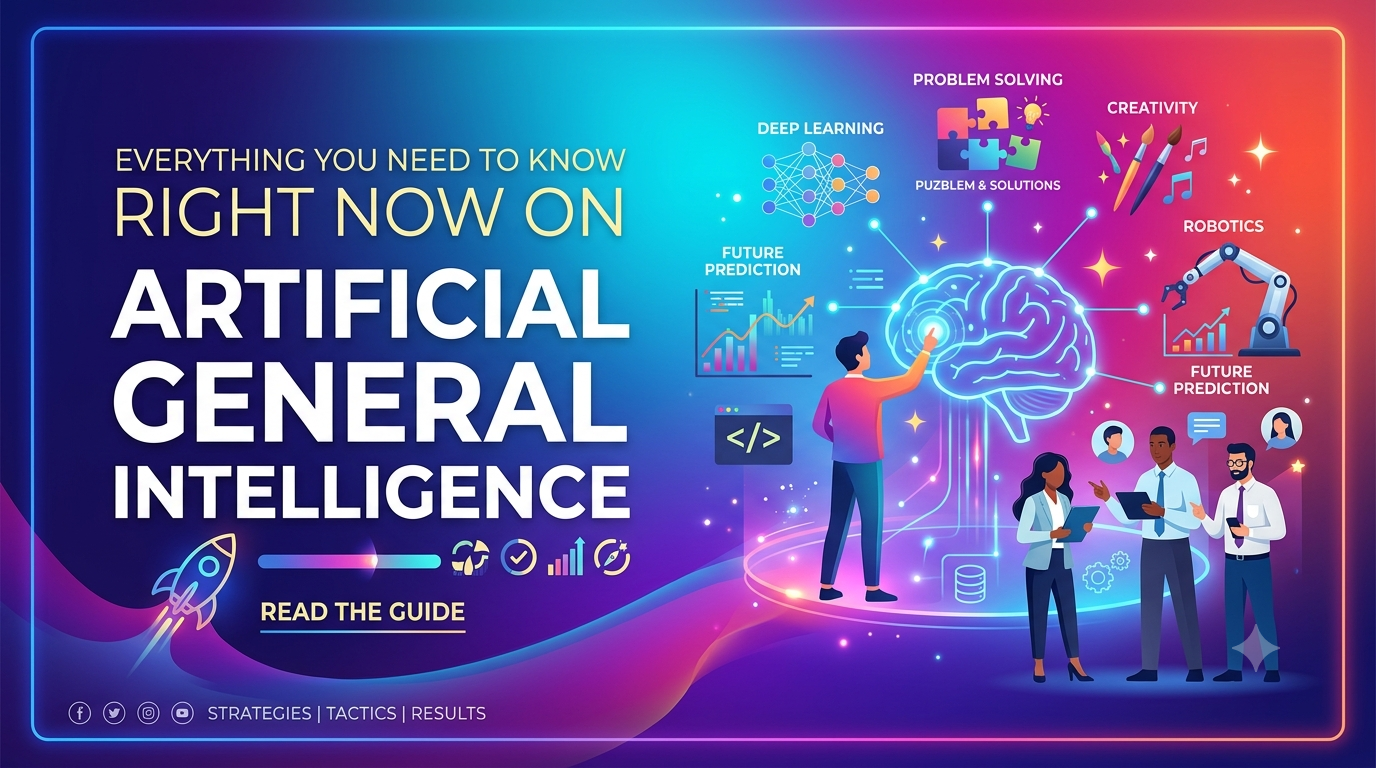
Artificial general intelligence (AGI) describes an AI system that matches or completely surpasses human intelligence across a massive, unpredictable range of tasks.
AGI vs. Narrow AI
The AI tools you use today fall under “Narrow AI.” Think about your phone’s autocomplete, early versions of ChatGPT, or Spotify’s algorithm. Each one does a specific job brilliantly. But if you ask your music recommendation AI to draft a legally binding contract, it fails completely.
AGI is fundamentally different. A true AGI system can:
- Reason through highly complex, multi-layered problems.
- Plan long-term, multi-step strategies.
- Learn entirely new skills on its own.
- Manage human workflows and organizations.
- Make high-level strategic decisions usually reserved for CEOs.
The problem? The definition of AGI is frustratingly loose. Different researchers draw the finish line in different places. And that disagreement has sparked the greatest debate in modern tech history.
⚔️ The Billionaire Divide: Three Leaders, Three Answers
If you expect the most powerful people in AI to agree with each other, you’re going to be disappointed. The top three players in this space hold completely different opinions on whether AGI exists today.
- Jensen Huang (Nvidia): “It’s now. We’ve achieved AGI.” No hesitation.
- Sam Altman (OpenAI): Last month he told Forbes, “We basically have built AGI, or very close to it.” But he quickly walked it back, calling his comment a “spiritual” statement rather than a literal one. Altman believes true AGI requires a series of “medium-sized breakthroughs.”
- Satya Nadella (Microsoft): Nadella completely disagrees with both of them. He recently stated the industry is nowhere near AGI, adding bluntly, “It’s not about Sam or me declaring it.”
Why This Debate Impacts Your Wallet
This isn’t just an academic argument for tech nerds. The stock market reacts violently to every major update regarding the artificial general intelligence latest news.
Right after Huang’s podcast dropped, Nvidia shares closed up 1.5% on Monday. That provided welcome relief for investors, considering the AI darling’s stock had dropped nearly 6% earlier in the year. Every investor tracking the Nvidia CEO Jensen Huang AGI storyline knows these statements move billions of dollars in hours.
💻 Developer Insights: What Are We Actually Building?
Let’s step out of the billionaire boardroom and onto the development floor. What does AGI look like for the people actually writing code?
Right now, the hottest trend in software engineering is autonomous AI agents. These aren’t your basic 2023 chatbots. With a traditional chatbot, you type a prompt and wait for a text response. An autonomous agent flips the script: you give it an end goal, and it figures out the intermediate steps by itself.
A Real-World Use Case
Imagine a developer needs to accomplish three things:
- Scrape pricing data from 50 competitor websites.
- Organize the messy data into a clean, formatted spreadsheet.
- Draft summary emails highlighting the key takeaways for the sales team.
In the old world, this required hours of writing complex Python scripts, debugging web scrapers, and manually formatting cells. Today, using an autonomous agent, the developer simply states the objective. The agent browses the web, hits an anti-bot roadblock, writes a workaround script to bypass it, finishes the spreadsheet, and drafts the emails.
🚨 Best Practice: The “Human-in-the-Loop” Warning
Here is a developer insight you absolutely cannot ignore: Never let an AI agent execute critical tasks without human oversight.
Why? Because AI hallucinates. It confidently invents facts that sound incredibly convincing but are entirely fake. If you allow an AGI-powered agent to automatically email your top-tier clients without reviewing the draft first, you are begging for a PR nightmare. Always keep a human in the loop.
📊 What AGI Means for Everyday People – And Your Career
Reading about software that can run organizations is scary. It’s totally normal to feel anxious about job security. But let’s look at the hard data before we hit the panic button.
- The Threat: A recent Goldman Sachs report found that generative AI could expose roughly 300 million full-time jobs to automation globally.
- The Upside: That same report projects a 7% increase in global GDP over the next decade directly driven by AI adoption.
- The Job Shift: The World Economic Forum estimates AI will displace 85 million jobs, but will simultaneously create 97 million new roles.
The net effect is positive—but only for those willing to adapt.
Here is your ultimate career reality check: AI isn’t going to replace you. A human who knows how to use AI is going to replace you.
How AGI Will Help the Common Person
For the average person, AGI technology will evolve into a hyper-competent personal assistant.
- Need to lower your exorbitant internet bill? Your AI agent will wait on hold and negotiate with customer service on your behalf.
- Planning a family vacation on a strict budget? Your agent will monitor flight algorithms for weeks and automatically book the cheapest route.
These capabilities aren’t science fiction. Rough, early versions exist right now, and they are improving at breakneck speed.
🗺️ The Blueprint: How to Go from AI Beginner to Hired Professional in 6 Months
If Jensen Huang’s AGI announcement proved anything, it’s that companies are about to aggressively hunt for talent who can actually build and manage AI systems. You don’t need to wander aimlessly through random YouTube tutorials to get there.
Here is your exact, step-by-step roadmap to transition from a tech enthusiast into a highly paid AI/ML Engineer using Kaashiv Infotech’s proven framework.
Step 1: The Foundation – Skip the Fluff
You can’t build autonomous AI agents without a rock-solid base. Instead of generic online videos, your fastest route is Kaashiv Infotech’s Inplant Training (IPT) and specialized Artificial Intelligence course in Chennai. You’ll dive deep into their hands-on Python training and core ML algorithms, bridging the gap between textbook theory and actual industry demands.
Step 2: The Practical Phase – Real-World Muscle
Employers are tired of seeing the same basic, copy-paste coding projects on resumes. To stand out, you need real-world experience. At Kaashiv, your training is led directly by Microsoft MVPs and Google-recognized experts. Even better? Whether you enroll in their Artificial Intelligence internship in Chennai or Machine Learning internship in Chennai, you are guaranteed to build and deploy 2 Live Industry Projects. When you sit in an interview, you’re talking about real AI software you built for real business scenarios.
Step 3: Credentialing – Make Recruiters Look Twice
A basic digital badge won’t cut it in today’s AI job market. You need proof. Upon completing your tech training, you earn Kaashiv’s exclusive Triple Certification:
- Internship Certificate: Proving you’ve worked in a demanding, project-driven environment.
- IPT Certificate: Validating your core technical foundation.
- Industrial Exposure Certificate: Showing hiring managers you understand corporate workflows.
Step 4: The Career Jump – Getting the Offer
You have the skills and the projects. Now it’s time to get hired. Kaashiv provides 100% Job Assistance to make your transition seamless. You get access to ATS-friendly resume tools to bypass automated robotic screeners, plus exclusive interview question banks tailored specifically for AI roles. By the time you sit down with a hiring manager, you already know exactly what they are going to ask.
The AI revolution is here. Stop watching from the sidelines. Enroll in an AI internship at Kaashiv Infotech today and start building your future!
🚀 Conclusion: Future-Proof Your Tech Career
I know the ground beneath your feet feels like it’s shifting fast. One day you’re learning basic prompt engineering, and the next day, the CEO of Nvidia announces that AGI is basically here.
The loose definitions will persist. The tech leaders will keep arguing. The stock market will keep swinging with every new headline.
But one truth cuts through all the noise: the professionals who understand how to build, manage, and optimize AI systems will write their own paychecks for the next two decades. You can’t just sit on the sidelines and hope this wave passes. It won’t. It’s only accelerating.
If you want to transition from a worried observer into an in-demand tech expert, you need hands-on experience. Kaashiv Infotech offers incredible, industry-tailored courses and internships designed to give you real-world experience. Whether you want to master Python, dive into machine learning, or understand the frameworks powering these autonomous AI agents, their programs deliver the exact practical skills employers are desperately hunting for right now.
Don’t let the AI wave wash over you. Learn to surf it. Explore the latest AI courses and software development internships at Kaashiv Infotech today, and take absolute control of your career!
❓ 10 Frequently Asked Questions About AGI
1. What is the artificial general intelligence latest news in 2025?
The biggest story right now is Nvidia CEO Jensen Huang declaring on the Lex Fridman podcast that we have achieved AGI. This claim sparked a major debate among tech leaders and immediately impacted tech stocks.
2. Did Nvidia CEO Jensen Huang really say AGI is here?
Yes. During an interview with Lex Fridman, Huang stated clearly, “I think it’s now. I think we’ve achieved AGI.” He also suggested that autonomous AI could potentially run entire companies.
3. What is artificial general intelligence in simple words?
AGI is an AI system capable of performing any intellectual task a human can do. Unlike standard AI, which specializes in one specific function, AGI can reason, learn new skills, plan, and make executive decisions.
4. What is the difference between AGI and regular AI?
Regular (narrow) AI excels at specific tasks, like language translation or facial recognition. AGI handles a massive, unpredictable range of tasks at or above human-level intelligence without needing specific programming for each new problem.
5. Does Sam Altman agree that AGI has been achieved?
Partially. Altman recently stated that OpenAI has “basically built AGI,” but quickly clarified it was a “spiritual” statement. He expects true AGI to emerge through incremental, medium-sized breakthroughs.
6. What does Microsoft CEO Satya Nadella think about AGI?
Nadella strongly disagrees with both Huang and Altman. He publicly stated that the industry is nowhere near achieving AGI, noting that individual CEOs declaring it doesn’t change the technological reality.
7. Will AGI take away human jobs?
While AI will automate certain roles, research from Goldman Sachs and the World Economic Forum shows it will create millions of new jobs. Professionals who learn to integrate AI into their daily workflows will remain highly employable.
8. What is OpenClaw in AI?
OpenClaw is an open-source AI agent platform designed to operate autonomously on behalf of users. Jensen Huang highlighted it during his podcast interview, and OpenAI is currently in the process of acquiring it.
9. How can I start a career in AI and machine learning?
Start by learning Python and foundational machine learning concepts. Structured, hands-on programs—like the courses and internships offered by Kaashiv Infotech—provide the practical, career-ready training you need.
10. Is AGI dangerous for humanity?
AGI carries potential risks if deployed without proper safety guardrails. Tech experts widely agree that maintaining strict regulations and always keeping a “human-in-the-loop” for critical decisions is vital to safely integrating AGI into society.