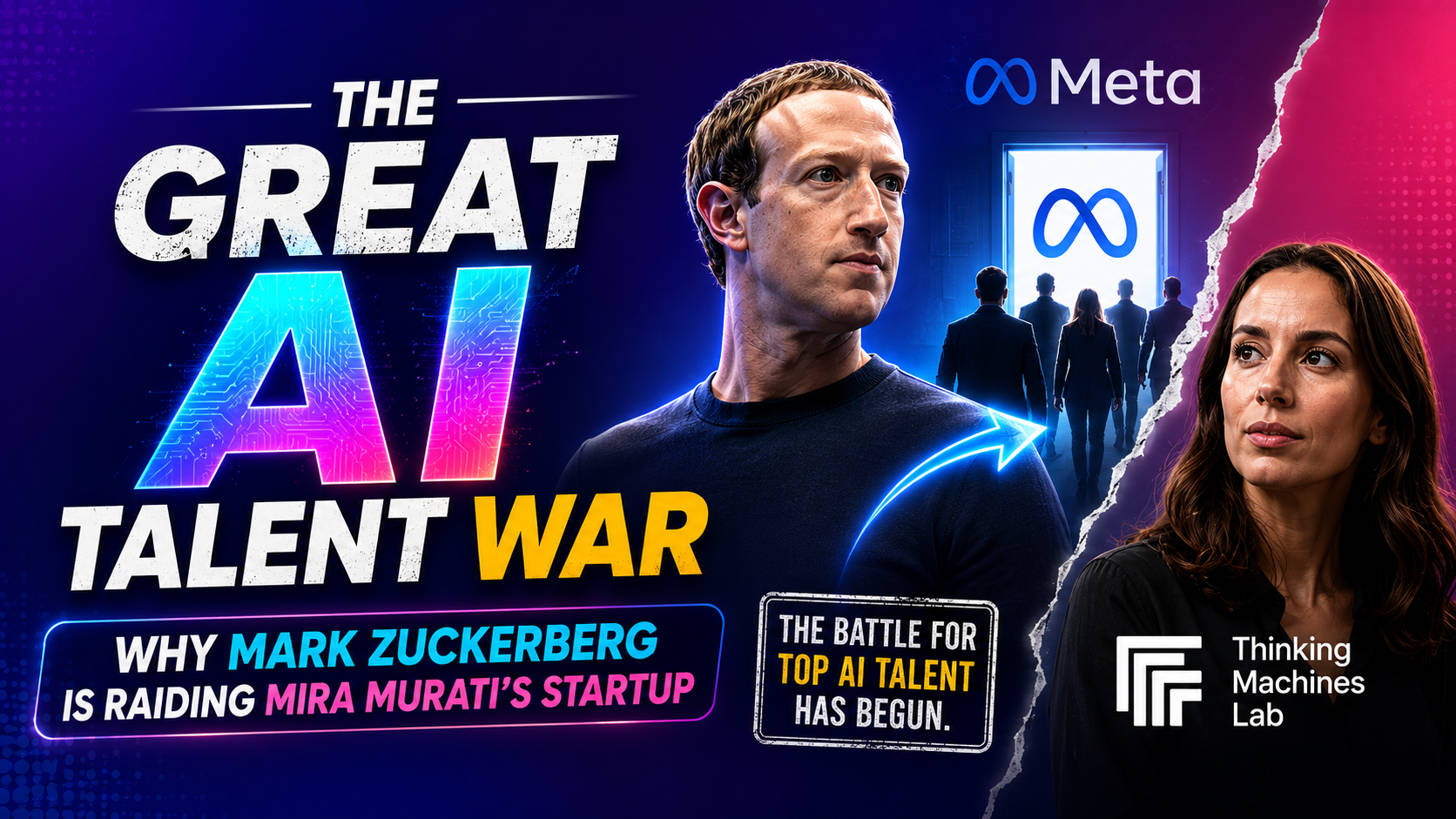
What do you do when a rival startup, led by one of the most respected minds in AI, rejects your $1 billion buyout offer?
If you’re Mark Zuckerberg, you don’t just walk away. According to a report from the Times of India, you launch an “almost full-scale raid” to hire away their entire founding team, one by one.
This isn’t a plot from a TV show; this is the reality of the brutal “AI Talent War” raging in Silicon Valley right now. The tech world is buzzing with the news that Meta has successfully poached a fifth founding member from Thinking Machines Lab, the high-flying startup created by Mira Murati, the former CTO of OpenAI.
This isn’t just a story about a high-profile hire. It’s a deep-dive into what makes an engineer so valuable that a tech giant would rather spend billions on salaries than try to replicate their work. This is a critical career lesson for every aspiring developer in India.
Who is Mira Murati and What is Thinking Machines Lab?
To understand the drama, you need to know the players. Mira Murati is AI royalty. As the former Chief Technology Officer at OpenAI, she was one of the key figures behind the launch and development of ChatGPT and DALL-E. When she left to create her own startup, Thinking Machines Lab, the entire industry paid attention.
Her new company quickly became a hub for the world’s most elite AI talent. The numbers are staggering: last year, the startup raised a massive $2 billion in funding at a $12 billion valuation, making it one of the most important AI startups on the planet.

The “Full-Scale Raid”: Meta’s Aggressive Poaching Strategy
Meta and Mark Zuckerberg wanted in. As first reported by the Times of India, Meta tried to acquire Thinking Machines Lab outright for a cool $1 billion. Mira Murati said no.
Zuckerberg’s response was swift and aggressive. He began a systematic campaign to poach the startup’s core talent. The latest domino to fall, according to Business Insider, is Joshua Gross, a veteran software engineer who was instrumental in building Thinking Machines Lab’s flagship product, Tinker, from the ground up. He has now rejoined Meta to lead engineering teams at Meta Superintelligence Labs.
He is the fifth founding member to be hired away by Meta. This isn’t just hiring; it’s a strategic attack designed to gut a competitor by stealing its most valuable assets: its founding engineers.

Why They’re Worth Billions: It’s Not Just About Coding
So, why would Meta go to such extreme lengths? Why offer one founder, Andrew Tulloch, a pay package reportedly worth up to $1.5 billion over six years, depending on bonuses and stock performance?
Because they aren’t just hiring hands to type code; they’re acquiring entire brains full of irreplaceable knowledge. A technical analysis from LetsDataScience points out that when you hire a founding engineer, you are buying:
- Repository Knowledge: Deep, intimate knowledge of the startup’s entire codebase.
- Architecture Tradeoffs: Understanding why certain technical decisions were made, and which dead ends were already explored.
- Dataset Design Experience: The secret sauce of how they curated and cleaned the data to train their models.
- Institutional Memory: All the lessons learned from months of failed experiments that are never published.
This kind of deep expertise can save a giant company like Meta years of development time and billions of dollars in wasted effort. It’s cheaper to buy the brain than to replicate the work.
The AI Talent War is a Two-Way Street
While Meta’s raid is a huge blow, don’t count Thinking Machines Lab out. This talent war is a two-way street.
As reported by Business Insider, Mira Murati has been making power moves of her own. She successfully hired Soumith Chintala, the legendary creator of PyTorch (one of the most important AI frameworks in the world), to be her new CTO. She also quietly hired Neal Wu, a celebrated coding prodigy and programming Olympiad gold medalist.
This shows that while Big Tech has the money, visionary startups led by respected figures like Murati still have the magnetic pull to attract A-list talent. Despite the high-profile departures, the startup has more than quadrupled in size to about 130 staffers since its founding.

What This Means For Your Tech Career in India
For every aspiring developer in India watching this unfold, the lesson is incredibly powerful: In the age of AI, elite human talent is the most valuable commodity on the planet.
Companies are not looking for people who can just use an API. They are desperately searching for engineers with deep, foundational knowledge of system architecture, data structures, and machine learning principles. They are looking for the kind of expert who has the “institutional memory” that is worth billions.
This level of expertise isn’t something you learn from a quick online tutorial. It’s built through dedicated, project-based learning and a relentless focus on the fundamentals of computer science.
Conclusion: Becoming the Talent They Fight For
The great AI talent war proves that the fear of AI replacing developers is misplaced. AI is a tool, but the architects who can build, wield, and understand these complex systems are now more valuable than ever before.
The goal isn’t to be a user of AI; it’s to become the kind of expert that companies like Meta and Google would fight a war to hire. This is where the real work begins.
If you are ready to build that deep, foundational knowledge, we are here to help. At Kaashiv Infotech, we offer industry-leading internships and training programs like Artificial Intelligence Course in Chennai, Data Science course in Chennai, and Full-Stack Development course in chennai. Our project-based curriculum is designed to move you beyond surface-level skills and turn you into a true software architect.
Become the talent they fight for. Visit kaashivinfotech.com to explore our programs, or get more career-focused tech insights on wikitechy.com today!
Frequently Asked Questions (FAQs)
1. Who is Mira Murati?
Mira Murati is a leading figure in the AI industry, best known as the former Chief Technology Officer (CTO) of OpenAI, where she was instrumental in the development of ChatGPT. She has since left to found her own AI startup, Thinking Machines Lab.
2. What is Thinking Machines Lab?
Thinking Machines Lab is a high-profile AI startup founded by Mira Murati. It raised $2 billion at a $12 billion valuation and is focused on building advanced AI products, attracting top talent from across the tech industry.
3. Why is Meta poaching AI engineers from Mira Murati’s startup?
After Thinking Machines Lab reportedly rejected Meta’s $1 billion acquisition offer, Meta began aggressively hiring its founding engineers. This is a strategic move to acquire deep institutional knowledge, accelerate Meta’s own AI development, and simultaneously weaken a major competitor.
4. How much do top AI engineers make?
While salaries vary, top-tier AI engineers and researchers, especially those with founding-level experience, can command multi-million dollar compensation packages. One founder from Thinking Machines Lab was reportedly offered a package from Meta that could reach $1.5 billion over six years.
5. What is the “AI Talent War”?
The “AI Talent War” refers to the intense, high-stakes competition between major tech companies (like Meta, Google, OpenAI) and well-funded startups to hire the world’s most skilled and experienced AI researchers and engineers.