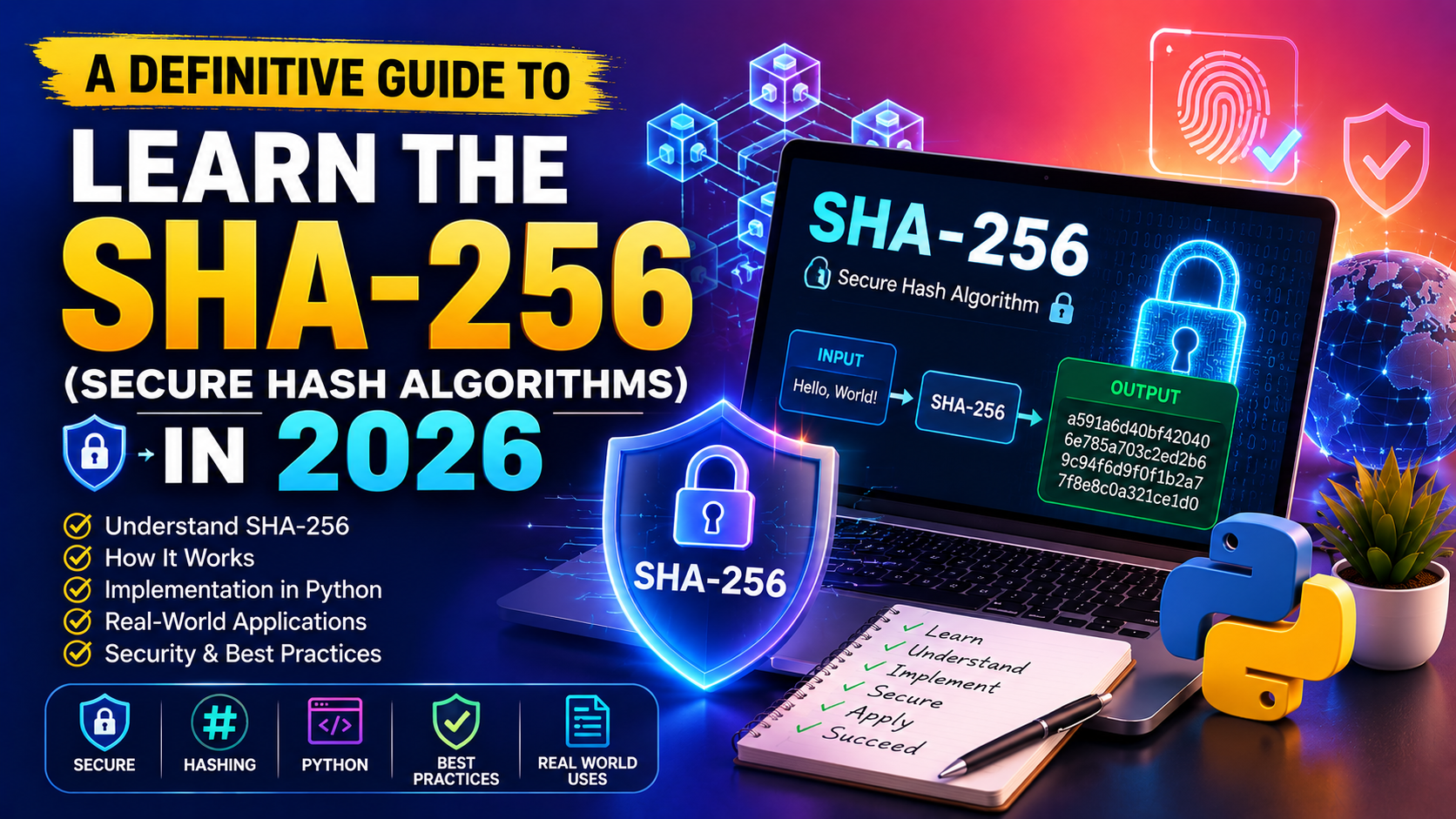
Hey there! If you’ve ever wondered how Bitcoin stays secure, how websites safely store your passwords, or why downloaded files sometimes come with a weird string of letters and numbers – congratulations, you’ve just stumbled upon the hero behind all of it:
A Definitive Guide to Learn The SHA-256
Don’t worry if “cryptographic hash function” sounds scary. By the end of this guide, you’ll not only understand SHA-256 inside out, but you’ll also be able to explain it to your friends over coffee. Let’s dive in!
What Exactly is Hashing? (The Foundation You Need)
Before jumping into SHA-256, let’s talk about hashing in general – think of it as a magical blender for data.
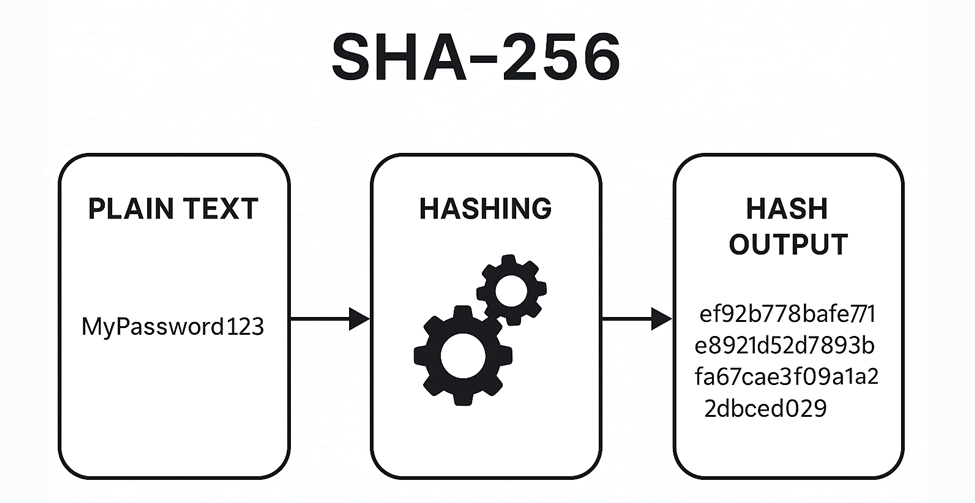
Imagine you throw any file, sentence, or password into this blender. Out comes a fixed-size gibberish string (called a hash or digest) that looks completely random. The cool parts?
- Same input = always the same output
- Tiny change in input = completely different output
- You can NEVER reverse it back to the original (one-way street!)
Real-Life Examples of Hashing
- When you log into Gmail, Google never sees your actual password – only its hash.
- When you download Linux or software updates, they give you a hash to verify the file wasn’t tampered with.
Simple, right? Now let’s meet the king of modern hashing.
What is SHA-256? The Superhero of Secure Hashing
SHA-256 (Secure Hash Algorithm 256-bit) is part of the SHA-2 family designed by the NSA and published by NIST in 2001. It was created because its older brother SHA-1 started showing cracks against supercomputers.
The “256” means it always spits out a 256-bit hash – that’s exactly 64 hexadecimal characters long. Whether you hash a single letter or a 10 GB movie, you’ll always get a 64-char string.
Example:
<span class="line">Input: "hello world"</span>
<span class="line">SHA-256: a591a6d40bf420404a011733cfb7b190d62c65bf0bcda32b57b277d9ad9f146e</span>Change one tiny thing (“Hello world”) → completely different hash!
Key Characteristics That Make SHA-256 Unbreakable (So Far)
Here are the superpowers that make SHA-256 the gold standard in 2025:
- Fixed Output Size: Always 256 bits / 64 hex chars
- Avalanche Effect: Change 1 bit → ~50% of output bits flip
- Collision Resistance: Practically impossible to find two different messages with the same hash (would take billions of years)
- Preimage Resistance: Given a hash, you can’t figure out the original message
- Fast to Compute, Slow to Break: Perfect balance for real-world use
How Does SHA-256 Actually Work? (Step-by-Step Breakdown)
Okay, let’s roll up our sleeves. Here’s the actual process – explained like you’re five (but accurate!).
Step 1: Preprocessing – Padding the Message
SHA-256 works on 512-bit blocks. So first, we pad your message:
- Add a single “1” bit
- Add enough “0” bits until length ≡ 448 mod 512
- Add the original message length (in 64 bits)
Now total length is perfect multiple of 512 bits.
Step 2: Break Into 512-bit Blocks
Your padded message is now split into chunks of 512 bits each.
Step 3: Initialize Eight 32-bit Variables (The Heart)
These start with special constant values (first 32 bits of fractional parts of square roots of first 8 primes):
- H0 = 0x6a09e66
- H1 = 0xbb67ae85
- H7 = 0x5be0cd19
Step 4: The Message Schedule – Creating 64 Words
Take the 512-bit block → split into 16 × 32-bit words (W[0..15])
Then expand them into W[16..63] using some clever math (sigma functions + rotations).
Step 5: 64 Rounds of Compression Magic
For each round i (0 to 63):
- Calculate Ch, Maj, Σ0, Σ1 (using bitwise operations)
- Update temporary variables T1 and T2
- Shuffle the eight variables (a through h)
It looks scary in code, but it’s just a lot of XOR, rotations, and additions.
Step 6: Add Compression Result to Current Hash
After 64 rounds, add the changes back to H0–H7. That becomes the new hash state.
Step 7: Repeat for All Blocks & Final Output
Process every 512-bit block. When done, concatenate H0–H7 → your final 256-bit (64 hex) hash!
Still with me? Awesome – you just mentally ran SHA-256
Where Do We Actually Use SHA-256 in 2025?
You interact with SHA-256 literally every day:
1. Blockchain & Cryptocurrencies
- Bitcoin uses SHA-256 twice (SHA-256d) for mining and transaction hashes
- Every block header contains a SHA-256 hash
- Proof-of-Work = finding a hash below a target number

2. Password Storage
Modern systems store , but many still use PBKDF2-SHA256 or just salted SHA-256.
3. Digital Signatures & Certificates
- SSL/TLS certificates (HTTPS 🔒) use SHA-256
- Code signing (Windows, macOS apps)
- Git commits are identified by SHA-256 hashes now (since 2020)
4. File Integrity & Downloads
- GitHub, Linux ISOs, npm packages all provide SHA-256 checksums
- Tools like
or PowerShell
5. Blockchain Beyond Bitcoin
Ethereum (pre-Merge), Solana, Cardano – many chains use SHA-256 somewhere.
A Definitive Guide to Learn The SHA-256
SHA-256 vs Other Algorithms (Quick Comparison)
| Algorithm | Output Size | Status in 2025 | Common Uses |
|---|---|---|---|
| MD5 | 128-bit | Completely broken | Legacy only |
| SHA-1 | 160-bit | Deprecated | Old Git commits |
| SHA-256 | 256-bit | Secure & widely used | Bitcoin, HTTPS, Git |
| SHA-3 | Variable | Secure (newer design) | Emerging use |
| BLAKE3 | Variable | Super fast | Modern apps, new projects |
Is SHA-256 Still Safe in 2025?
Yes – for all practical purposes.
- Best known attack (2020) reduces security to ~61 bits of collision resistance (still way beyond feasible)
- Quantum computers? Grover’s algorithm would give ~128-bit security (still safe)
- NIST recommends SHA-256 until at least 2030–2035
So unless nation-states are after your cat memes, you’re good
Become a Cryptography and Blockchain Specialist with Kaashiv Infotech
Looking to dive into the world of decentralized technologies and carve your path to success? Kaashiv Infotech is here for you! Our Comprehensive Cryptography and Blockchain Training is specially designed by top-tier tech experts to equip you with practical skills and real-world experience that will help you set your foot in the competitive Web3 and cybersecurity industry.
Let’s break down our specialized training offerings to see what makes Kaashiv stand out:
- 2 Live Industry Projects: You’ll work on two real-time industry projects to build a solid portfolio and enhance your learning with practical exposure that showcases your skills.
- Practice Exercises: Get hands-on practice with daily practice exercises that enhance your learning and help you master secure coding and decentralized networks.
- Doubt Clearing Sessions: Our regular doubt sessions ensure that no question goes unanswered, giving you total clarity on complex cryptographic concepts.
- Advanced Tech Labs for Coding: Access our specialized labs for smart contract development and polish your coding skills in a supportive environment.
- Industry-Oriented Curriculum: Learn industry-relevant skills and techniques that are directly applicable to real-world blockchain and security scenarios.
- Exclusive Triple Certification: Earn a prestigious Triple Certification upon completion—including an Blok chain Internship Certificate, IPT (Inplant Training) Certificate, and Industrial Exposure Certificate—highly valued by global employers.
- Q&A Forum: Engage with fellow batchmates and instructors in our forum to exchange ideas, seek advice, and collaborate on blockchain security.
- Led by Microsoft MVPs & Google-Recognized Experts: Benefit from interactive sessions led by elite Microsoft MVPs and Google-recognized experts who guide you every step of the way.
- ATS-Friendly Resume Tools & Question Banks: Gain access to specialized ATS-friendly resume builders and comprehensive interview question banks to give you a career edge.
- 100% Job Assistance Guarantee + Kaashiv Alumni Network: We’re offering 100% job assistance along with ongoing support from our vast network of successfully placed professionals.
So what are you waiting for? Launch your career with confidence! Join Kaashiv Infotech’s Cryptography and Blockchain Program and unlock your potential today.
Conclusion: Your SHA-256 Journey Starts Now!
There you have it – the complete beginner-to-intermediate guide to SHA-256 in 2025!
You now know:
✓ What hashing really means
✓ How SHA-256 turns any data into a unique 64-character fingerprint
✓ Why it powers Bitcoin, secure logins, and your HTTPS connection
✓ And that it’s going to stay relevant for many more years
Want to play with SHA-256 yourself?
- Try online tools like sha256.online
- In terminal:
- In Python:
At Kaashiv Infotech, we help hundreds of students and professionals master cryptography concepts like SHA-256 through hands-on ethical hacking and cybersecurity training programs.
Ready to level up your cyber skills? Drop a comment below if you want a part 2 on implementing SHA-256 from scratch in Python! 👇
5 FAQs (Based on Google’s “People Also Ask”)
- Is SHA-256 still secure in 2025?
Yes! While theoretical attacks exist, finding collisions or preimages remains computationally infeasible. SHA-256 is still recommended by NIST and widely used in Bitcoin, HTTPS, and Git. - What is the difference between SHA-256 and SHA-1?
SHA-1 produces 160-bit hashes and is broken (real collisions found in 2017). SHA-256 produces 256-bit hashes and is currently secure against all known practical attacks. - Can SHA-256 be reversed or cracked?
No. It’s designed to be one-way. Even with the hash, you cannot recover the original message (preimage resistance). - Why does Bitcoin use SHA-256?
Bitcoin uses double SHA-256 (SHA-256d) for mining difficulty and transaction IDs because it’s fast on hardware, secure, and provides the perfect balance for Proof-of-Work. - How long is a SHA-256 hash?
Always exactly 64 hexadecimal characters (256 bits). Example: