Let us face it: Google has been around for over 25 years. We can barely imagine our lives without Google. Whether we are looking for the pizza place researching a new laptop or trying to solve a coding bug we rely heavily on search engines like Google. Because of this any business that wants to survive and thrive in the digital landscape must invest heavily in Search Engine Optimization or SEO.
With the digital space becoming more competitive by the minute the demand for SEO professionals is skyrocketing. Whether you are a graduate trying to land your first gig or an experienced digital marketer aiming for an executive role you need to be prepared for SEO interviews.
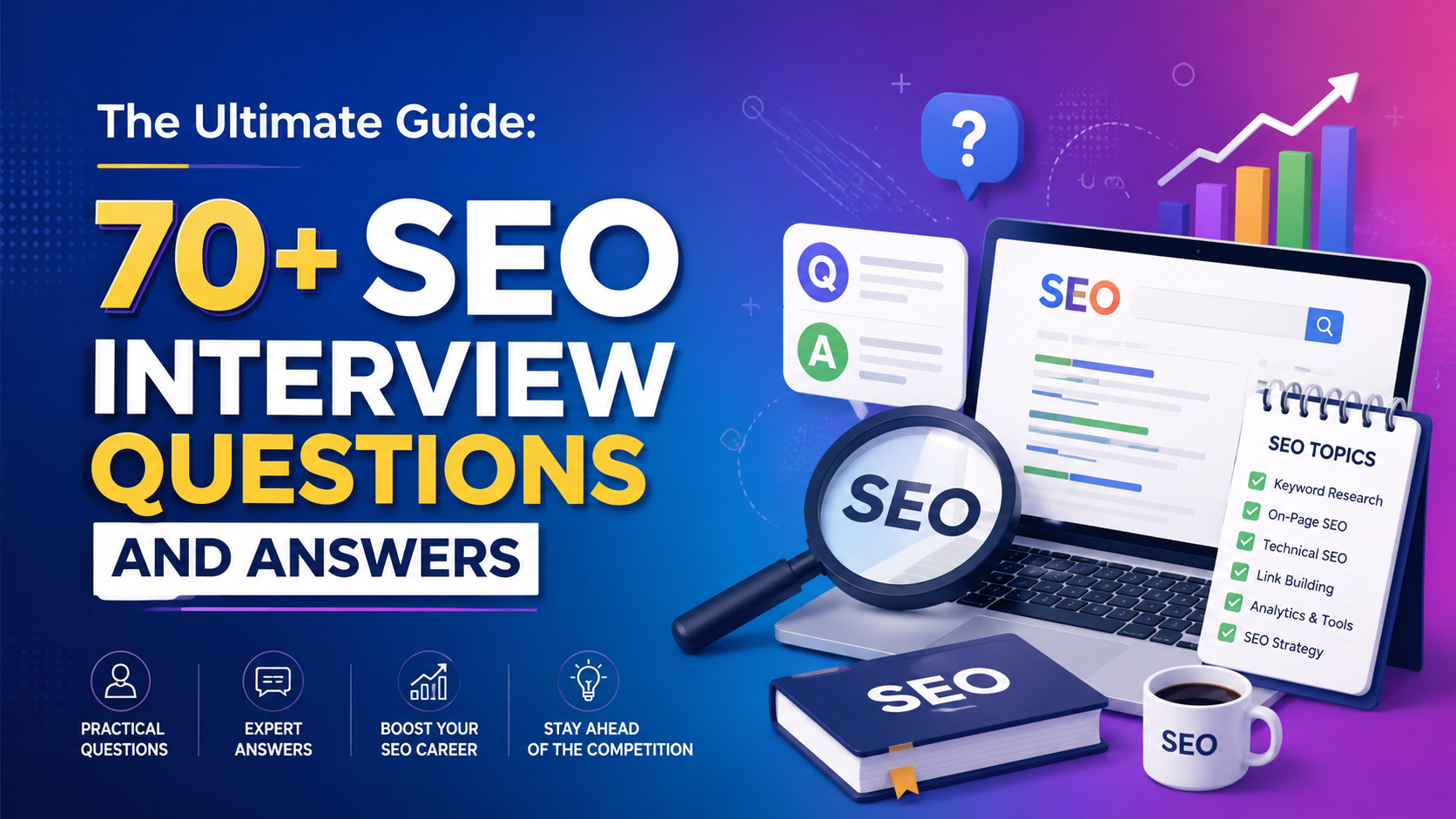
To help you secure that dream job we have put together this guide featuring the top 70+ SEO Interview Questions and Answers for 2026. Brought to you by Kaashiv Infotech.com this guide is broken down into to-digest sections covering everything from the absolute basics to complex technical SEO strategies.
Grab a cup of coffee. Let us get you ready to ace that SEO interview.
70+ SEO Interview Questions and Answers for 2026
A. General SEO Interview Questions for Freshers
If you are just starting out in the SEO industry interviewers want to see that you have a grasp of the core SEO concepts. Here are some of the common SEO questions you will face.
1. What is Search Engine Optimization or SEO?
Search Engine Optimization or SEO is the practice of improving a website’s structure, content and authority to increase its visibility on search engines like Google. The goal of SEO is to rank for relevant search queries organically without paying for ads. Good SEO drives quality targeted traffic to a website, ultimately leading to more conversions and sales for the business.
2. Why is SEO important for a business?
There’s a joke in the digital marketing world: “Where is the best place to hide a dead body? On page two of Google.”
Jokes it’s the truth. Most users never click past the page of search results. If a business isn’t ranking on page one for its target keywords its competitors are stealing all the customers. Unlike paid advertising, where traffic stops the second you stop paying SEO provides term sustainable results for the business.
3. What is the difference between paid results?
Organic Results are the “listings on a search engine results page. Search engines rank these pages based on relevance, quality, backlinks and user experience. You cannot pay Google to rank organically.
Paid Results are advertisements that appear at the top or bottom of the search engine results pages. Advertisers pay a fee every time someone clicks on their ad.
4. Can you define Bounce Rate?
Bounce rate is the percentage of visitors who land on your website and leave without interacting with any pages. A high bounce rate usually tells search engines that the user didn’t find what they were looking for which can negatively impact rankings for the website.
How to fix it? Improve page load speed make your content highly engaging and use Call-to-Actions.
5. Explain Keyword Frequency, Density, Difficulty and Proximity.
These are terms every SEO fresher should know:
- Keyword Frequency is the total number of times a specific keyword appears on a single webpage.
- Keyword Density is the percentage of times a keyword appears compared to the total word count.
- Keyword Difficulty is a metric used to gauge how hard it will be to rank for a term based on competition.
- Keyword Proximity is the distance between two related search terms on a webpage.
6. What are Long-Tail Keywords?
Long-tail keywords are specific search phrases that usually contain three or more words. While they have search volumes compared to broad keywords they boast much higher conversion rates because the users intent is very clear. For example “shoes” is a keyword but “womens red running shoes size 8” is a long-tail keyword.
B. Advanced SEO Interview. Answers
Once you have a years of experience under your belt interviewers will expect you to think strategically about SEO. They want to know how you handle SEO problems and measure SEO success.
7. How do you measure SEO success?
Success metrics depend largely on the companys goals but as an advanced SEO professional you should mention Key Performance Indicators or KPIs such as:
- Increases in organic website traffic.
- Higher conversion rates, such as sales, sign-ups, downloads.
- Growth in the number of quality inbound backlinks.
- Improvements in keyword rankings for money-making search terms.
- Reductions in bounce rate and increases in session duration.
8. What is a Canonical Issue. How do you fix it?
A canonical issue occurs when duplicate content appears on URLs. This confuses search engines because they don’t know which version to index and rank.
To fix this you use a “Canonical Tag” in the HTML header. This tag acts as a signpost telling Google “Hey, out of all these pages this specific one is the master copy you should rank.”
9. What is a Link Audit. Why is it necessary?
A link audit is a dive into the backlinks pointing to your website. It’s crucial because not all links are links. Toxic spammy links can result in a Google penalty. By performing a link audit you can identify these links and use Google’s Disavow Tool to ask the search engine to ignore them thereby protecting your sites reputation.
10. How do you approach Keyword Research?
Don’t name-drop tools; explain your SEO strategy! A great answer looks like this:
“I start by understanding the target audience and their pain points. Then I use tools like Ahrefs, SEMrush or Google Keyword Planner to find a mix of tail and long-tail keywords. I specifically look for the ‘sweet spot’—keywords with search volume but low to medium competition. I also analyze the search intent to ensure we are creating the kind of content for Search Engine Optimization.”
C. Technical SEO Interview Questions for Executives
If you are aiming for a manager or technical specialist role you need to understand the backend of SEO. This is where you prove you know how search engines actually crawl and index the web.
11. Why is Page Speed important. How do you improve it?
In 2026 user experience is king. Nobody waits for a slow website. Google uses page speed as a ranking factor.
Here is how you can drastically improve site speed:
- Compress and optimize images.
- Minimize HTTP requests.
- Enable browser caching.
- Use a Content Delivery Network or CDN.
- Minify CSS, JavaScript and HTML.
- Remove render-blocking JavaScript.
12. What is the difference between an HTML Sitemap and an XML Sitemap?
HTML Sitemap is designed for humans. It’s a list of pages on your website that helps users navigate your site easily.
XML Sitemap is designed for search engine bots. It’s a file written in Extensible Markup Language that lists all your URLs telling search engines what to crawl what has been updated recently and how often they should check back.
13. What is Robots.txt?
Robots.txt is a text file placed in the root directory of a website. It gives instructions to search engine web crawlers telling them which pages or folders they are allowed to crawl and which ones they should ignore. It is a tool for managing your crawl budget.
14. Explain Structured Data or Schema Markup.
Structured data is a vocabulary added to a websites code. It helps search engines easily understand the context of the content. When implemented correctly structured data can generate “Rich Snippets” in the search results—such as star ratings on recipes event dates or product prices. These appealing snippets significantly boost Click-Through Rates or CTR.
15. What are Do-Follow and No-Follow links?
Do-Follow links allow search engines to crawl them and pass “link juice” from the linking site to the destination site.
No-Follow links are added via a rel=”nofollow” HTML tag telling search engines not to follow the link and not to pass any authority. It is widely used for sponsored content, affiliate links and blog comments to prevent spam.
D. Local and Social Media SEO Interview Questions
Local visibility and social signals are becoming incredibly important. Expect questions on how to dominate markets and leverage social platforms.
16. Who needs SEO?
Any business that serves a specific geographic area needs Local SEO. This includes:
- Brick-and-mortar stores, such, as restaurants, cafes, retail shops.
- Service-area businesses, such
18. How does Social Media impact Search Engine Optimization?
Social Media is really important for Search Engine Optimization. Even though likes and shares on Social Media do not directly affect how Google ranks your website they can still help your Search Engine Optimization efforts a lot.
- High-quality content on Social Media can bring a lot of people to your website.
- When your content becomes popular it can also get links from websites and bloggers which is great for Search Engine Optimization.
- If your brand is active on Social Media people can find you easily when they search for your brand name on Google.
E. Behavioral and Scenario-Based Questions
Employers want to know how you work and what you do every day. They want to know about your habits. What you think is right and wrong.
19. How do you stay updated with Google Algorithm changes?
Do not say that you just search for it on Google.
You should say that you follow blogs like Search Engine Land, Search Engine Journal and the Moz Blog.
You can also say that you follow Google Search Central on Twitter or listen to Search Engine Optimization podcasts.
20. What are “Black Hat” Search Engine Optimization practices. Why should you avoid them?
Black Hat Search Engine Optimization refers to unfair tactics used to trick search engines into ranking a website higher.
Examples include putting many keywords in your content showing different content to search engines and users and buying links to manipulate your websites ranking.
These tactics might work for a time but they can result in heavy penalties from Google or even ban your website from search results.

Ready to Ace Your Search Engine Optimization Interview?
Preparing for a marketing interview can be tough but if you know these Search Engine Optimization questions and answers you will have a big advantage.
Whether you are talking about traffic or structured data you need to be confident.
Employers do not just want someone who can memorize definitions they want someone who can think strategically and understand how search engines help businesses connect with people.
If you think you need to improve your skills before the interview do not worry.
At Kaashiv Infotech.com we have courses that can help you become an Search Engine Optimization expert.
From keyword research to analytics our courses will help you prepare for your interview.
Luck. You will do great.
Become A Python Developer With Kaashiv Infotech
Looking to dive into the world of software development and carve your path to success? Kaashiv Infotech is here for you! Our Comprehensive Python Course in Chennai and Inplant Training (IPT) are specially designed by experts to equip you with practical skills and real-world experience that will help you to set your foot in the competitive tech industry.
Let’s break down our training offerings to see what makes our program stand out:
- Live Industry Projects: You’ll work on 2 real-time industry projects per internship to build a solid portfolio and enhance your learning with hands-on applications that showcase your skills.
- Practice Exercises: Get hands-on practice with daily coding exercises that enhance your learning and help you master key HTML/CSS, Python concepts, SQL and frameworks.
- Doubt Clearing Sessions: Our regular doubt sessions ensure that no coding bug goes unresolved, giving you absolute clarity on all technical concepts.
- Advanced Tech Environment: Access our exclusive coding setups to practice and polish your programming skills in a highly supportive environment.
- Industry-Oriented Curriculum: Learn industry-relevant tech skills and coding techniques that are directly applicable to real-world corporate scenarios.
- Exclusive Triple Certification: Earn highly valued credentials upon completion, including an Internship Certificate, an IPT Certificate, and an Industrial Exposure Certificate that are recognized and valued by employers in the IT industry.
- Peer Collaboration & Support: Engage with fellow batchmates and tech mentors to exchange ideas, seek programming advice, and collaborate on your live projects.
- Expert-Led Sessions: Benefit from interactive sessions led by Microsoft MVPs and Google-recognized experts who guide you every step of the way.
- Interview Prep & Resume Building: Gain access to extensive interview question banks and ATS-friendly resume tools to help you land your dream job in software development.
- 100% Job Assistance Guarantee: We’re offering 100% job assistance along with ongoing career guidance to ensure your successful leap into the IT sector.
So what are you waiting for? Launch your IT career with confidence! Join the Kaashiv Infotech Python Training Program and unlock your potential today.
(Note: If you are specifically targeting HTML/CSS, JavaScript, DevOps, you can simply swap out the word “Python” and “software development” in the text above to perfectly match your desired technology!)
Frequently Asked Questions
1. What are the basic Search Engine Optimization interview questions for beginners?
Beginners are usually asked questions like “What is Search Engine Optimization?” “What is the difference between on-page and off-page Search Engine Optimization?” “What is a backlink?”. Why are keywords important?”.
You should show that you understand how search engines work.
2. How do I prepare for a Search Engine Optimization interview in 2026?
To prepare you should learn about the Google algorithm updates.
You should also review metrics in Google Analytics 4 understand concepts like Core Web Vitals and be ready to talk about your past experiences.
3. What are the common technical Search Engine Optimization interview questions?
You can expect questions about website performance.
Interviewers will ask you how to improve page load speeds, how to use tags the purpose of XML sitemaps and how to implement structured data.
4. How can I explain Search Engine Optimization in an interview?
Keep it simple.
You can say that Search Engine Optimization is the process of improving a website to increase its visibility on search engines making it easier for customers to find the business, which ultimately drives traffic and revenue.
5. What are the top Search Engine Optimization skills employers look for?
Employers look for people, with creative skills.
Top skills include keyword research, data analysis, content optimization, basic HTML/CSS knowledge, link-building strategies and the ability to adapt quickly to algorithm changes.