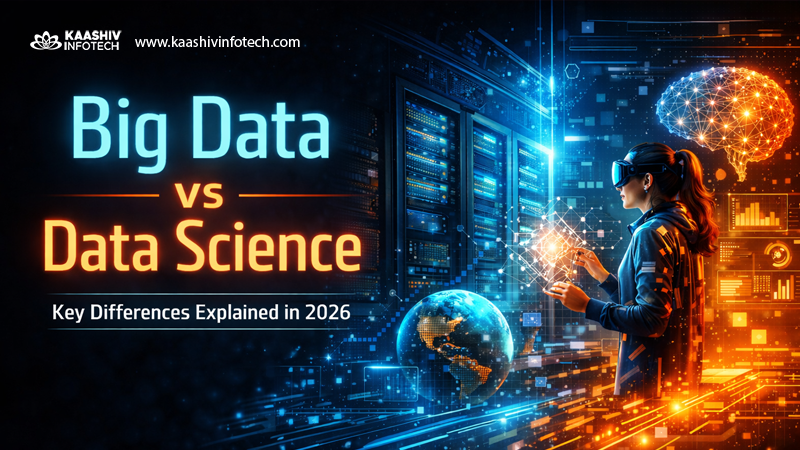
Big Data vs Data Science – In today’s technology-driven world, data plays a central role in decision-making, innovation, and business growth. Two of the most commonly discussed terms in this space are Big Data and Data Science. While they are closely related and often used together, they are not the same. Each has its own purpose, tools, and applications. Understanding the difference between them helps students, professionals, and organizations use data more effectively and choose the right career or technology path.
What is Big Data?

Big Data refers to extremely large and complex datasets that cannot be processed using traditional systems. These datasets are generated continuously from sources such as social media, mobile apps, sensors, and online transactions. Platforms like Facebook produce massive amounts of data every second, making it necessary to use specialized systems to handle them.
The concept of Big Data is commonly explained using three important characteristics: volume, velocity, and variety. Volume represents the huge size of data, velocity indicates the speed at which data is generated and processed, and variety refers to the different types of data formats such as text, images, videos, and structured databases.
The primary goal of Big Data is not to analyze data deeply but to ensure that data is properly stored, processed, and made available for further use. Technologies like Apache Hadoop allow data to be stored across multiple machines, while Apache Spark enables faster data processing. Tools such as Apache Kafka are used to handle real-time data streams efficiently.
In simple terms, Big Data is all about managing and processing large-scale data in a reliable and scalable way.
What is Data Science?

Data Science is the field that focuses on analyzing data to extract meaningful insights and support decision-making. It combines statistics, programming, and domain expertise to understand patterns and trends hidden within data.
Unlike Big Data, which deals with infrastructure, Data Science is more focused on interpretation and prediction. It helps organizations answer questions like “What will happen next?” or “Why did this happen?” using data-driven approaches.
Data Scientists use tools like Python and R to clean, analyze, and visualize data. Advanced frameworks such as TensorFlow are used to build machine learning models. Work is often carried out in environments like Jupyter Notebook, which makes experimentation easier.
A great example of Data Science in action is seen in companies like Netflix, where user data is analyzed to recommend movies and shows based on viewing behavior. This improves user experience and increases engagement.
Core Differences Between Big Data vs Data Science
The main difference between Big Data and Data Science lies in their purpose. Big Data focuses on handling massive datasets, while Data Science focuses on extracting insights from those datasets. One builds the foundation, and the other extracts value from it.
Another important difference is in the type of work involved. Big Data is more about engineering—designing systems that can store and process data efficiently. Data Science, on the other hand, is analytical in nature and involves working with algorithms, statistics, and predictive models.
The tools used in both fields also differ. Big Data relies heavily on distributed systems like Apache Hadoop, whereas Data Science depends on programming and machine learning tools like Python. Even the outcomes are different: Big Data produces organized and processed datasets, while Data Science produces insights, predictions, and intelligent models.

How Big Data and Data Science Work Together
Although they are different, Big Data and Data Science are highly interconnected. In real-world applications, they work together as part of a complete data pipeline.
First, data is collected from multiple sources such as websites, applications, and devices. Big Data technologies then store and process this information at scale. Once the data is prepared, Data Science techniques are applied to analyze it and extract meaningful insights. These insights are then used by businesses to make decisions, improve products, and predict future trends.
For example, an e-commerce company like Amazon uses Big Data systems to handle millions of transactions and customer interactions. Data Science is then used on top of that data to recommend products, detect fraud, and optimize pricing strategies.
Career Perspective
From a career point of view, Big Data and Data Science offer different paths. Big Data roles are more focused on system design, data pipelines, and distributed computing. Data Science roles focus more on analysis, machine learning, and business insights.
If you are someone who enjoys working with systems, databases, and large-scale infrastructure, Big Data might be the right choice. On the other hand, if you are interested in statistics, problem-solving, and building predictive models, Data Science would be a better fit.

Real-World Use Cases
Big Data Use Cases
- Fraud detection in banking
- Real-time traffic systems
- Social media data management
Data Science Use Cases
- Recommendation systems (e.g., Amazon)
- Customer behavior analysis
- Predictive analytics in healthcare
Career Opportunities
Careers in Big Data
- Big Data Engineer
- Data Architect
- Hadoop Developer
Careers in Data Science
- Data Scientist
- Machine Learning Engineer
- Data Analyst
Which One Should You Choose?
Choosing between Big Data and Data Science depends on your interests:
- If you enjoy working with infrastructure, distributed systems, and data pipelines → Big Data
- If you enjoy statistics, analysis, and building intelligent models → Data Science
Conclusion
Big Data and Data Science are two sides of the same coin, but they serve different purposes. Big Data ensures that large volumes of data can be handled efficiently, while Data Science transforms that data into valuable insights. Together, they form the backbone of modern data-driven organizations.
Understanding their differences not only helps in choosing the right career path but also enables businesses to leverage data more effectively in a competitive world.
Want to learn more ?, Kaashiv Infotech Offers, Data Science Course, Data Analytics Course, Power BI & More, Visit Our Website course.kaashivinfotech.com.
Related Reads: