
Artificial Intelligence working was one of those topics that confused me for the longest time. Every article I found used complicated words like algorithms, neural networks, and predictive models. Instead of helping, they made me feel like AI was only for computer scientists.
Then one day, I stopped trying to memorize definitions and started asking a simple question: “How does AI actually think?”
That changed everything.
Artificial Intelligence working is not magic. It is not a robot with feelings. It is simply a computer system that learns from data, identifies patterns, and makes decisions based on what it has learned. Once I understood this idea, everything else started making sense.
If you have ever wondered how AI works, this guide is for you. I’ll explain everything using simple examples, real-life situations, and everyday language—just like I would explain it to a friend.

🌟 Key Highlights
- ✅ Understand Artificial Intelligence working in simple language.
- ✅ Learn the 7 simple steps of how AI works.
- ✅ Discover the difference between AI, Machine Learning, and Deep Learning.
- ✅ Explore real-life AI examples you already use every day.
- ✅ Learn why data is the heart of AI.
- ✅ Find out how AI keeps improving through training.
- ✅ Understand AI’s limitations and why humans still matter.
What is Artificial Intelligence? 🧠
Before understanding Artificial Intelligence working, let’s understand what AI actually means.
Artificial Intelligence (AI) is the ability of a computer or machine to perform tasks that usually require human intelligence.
These tasks include:
- Learning
- Problem-solving
- Understanding language
- Recognizing images
- Making recommendations
- Predicting future outcomes
Think about your daily routine.
When Netflix recommends your next movie, Google Maps suggests a faster route, or ChatGPT answers your questions, you’re already using Artificial Intelligence.
I honestly didn’t realize how often AI appeared in my life until I started paying attention.
Why Should You Learn Artificial Intelligence Working? 🚀
Understanding Artificial Intelligence working helps you see beyond the hype.
Instead of thinking,
“AI is taking over the world!”
you begin thinking,
“Oh, it’s just learning patterns from data.”
That small shift makes AI much less intimidating.
Whether you’re a student, software developer, digital marketer, business owner, or simply curious about technology, knowing how AI works is becoming an important skill.
How Does Artificial Intelligence Working Actually Happen?
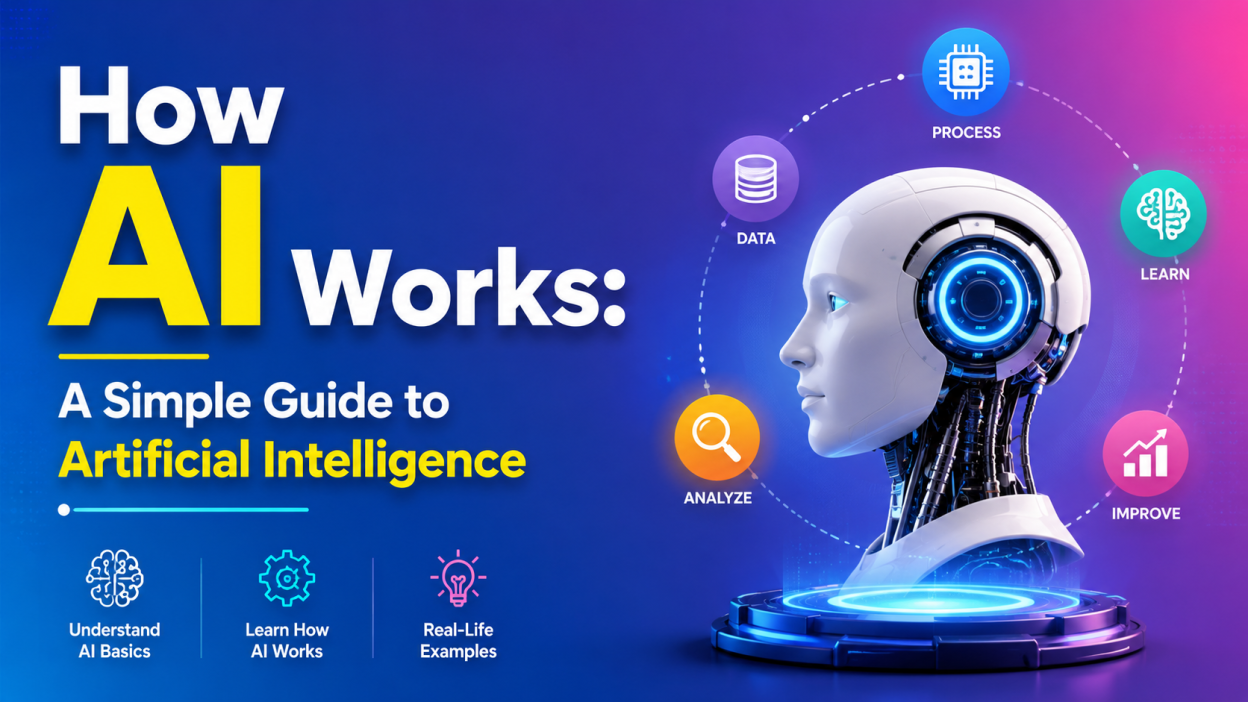
Let’s break the Artificial Intelligence working process into seven simple steps.
1. AI Collects Data 📊
Every AI system starts with one thing:
Data.
Without data, AI cannot learn anything.
Imagine teaching a child what a cat looks like.
You wouldn’t show only one picture.
You would show hundreds.
The same happens with AI.
Examples of data include:
- Images
- Videos
- Voice recordings
- Documents
- Emails
- Sensor readings
- Medical reports
- Customer purchases
The more quality data AI receives, the better it becomes.
Real-life example:
Spotify learns your music taste based on the songs you play, skip, or repeat.
2. AI Cleans and Organizes the Data 🧹
Raw data is often messy.
Some information may be:
- Missing
- Incorrect
- Duplicated
- Unorganized
Before learning begins, AI systems clean this data.
I like comparing this step to preparing vegetables before cooking.
You wash them first.
Then you chop them.
Only after preparation do you start cooking.
AI does exactly the same with data.
3. AI Learns Patterns (Machine Learning) 🎯
This is where Machine Learning enters the picture.
Machine Learning is a branch of Artificial Intelligence that allows computers to learn from examples instead of following fixed instructions.
Suppose an AI sees:
- 50,000 dog images
- 50,000 cat images
Eventually, it notices patterns.
It learns things like:
- Dogs usually have longer noses.
- Cats often have pointed ears.
- Fur patterns differ.
Nobody tells AI these rules directly.
It discovers them through experience.
This is one of the most important parts of Artificial Intelligence working.
4. AI Builds a Model 🏗️
Once AI has learned enough patterns, it creates something called a model.
Think of a model as a student who has finished studying.
Now it’s ready for the exam.
Instead of looking at old examples, it starts making predictions using what it has learned.
This AI model can now:
- Detect spam emails
- Identify faces
- Translate languages
- Recommend products
- Predict weather
- Answer questions
5. AI Makes Predictions 🔍
Now comes the exciting part.
The AI receives brand-new information it has never seen before.
Using its trained model, it predicts the answer.
Example:
You upload a picture.
The AI says,
“This is probably a Golden Retriever.”
Or,
You type,
“Translate this sentence into French.”
The AI predicts the most suitable translation based on everything it has learned.
This prediction process is the core of Artificial Intelligence working.
6. AI Gets Feedback 📈
Not every prediction is correct.
Sometimes AI makes mistakes.
When that happens, developers compare:
- Expected answer
- AI’s answer
If they’re different, AI adjusts itself.
It learns from the mistake.
It’s surprisingly similar to how I learned programming.
My code failed.
I fixed it.
Then I improved.
AI follows the same cycle.
7. AI Keeps Improving 🔄
Learning never stops.
As more data arrives, AI becomes smarter.
That’s why services like:
- YouTube
- Amazon
- Google Search
keep getting better recommendations over time.
The continuous learning cycle is one reason Artificial Intelligence working has become so powerful.
Real-Life Examples of Artificial Intelligence Working 🌍
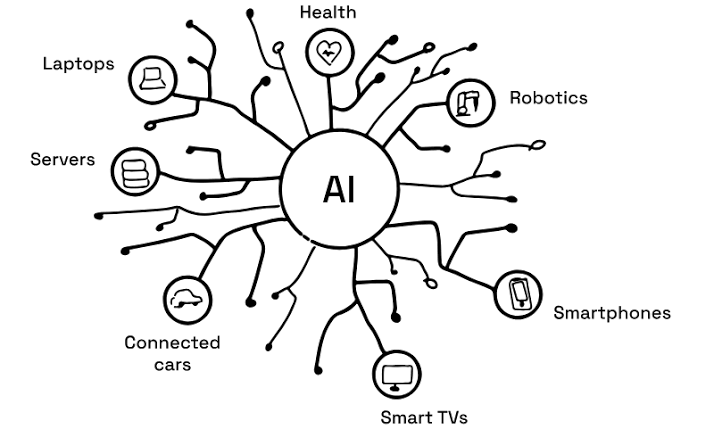
AI isn’t limited to research labs anymore.
It’s already part of our everyday lives.
📱 Smartphones
- Face Unlock
- Voice Assistant
- Camera enhancements
- Live translation
🛍️ Online Shopping
Amazon recommends products based on your browsing history.
Have you ever searched for shoes and suddenly seen shoe advertisements everywhere?
That’s AI analyzing your behavior.
🎬 Entertainment
Netflix and YouTube recommend videos you’ll probably enjoy.
Sometimes they’re surprisingly accurate!
🚗 Navigation
Google Maps predicts traffic before you even leave home.
It studies millions of driving patterns.
🏥 Healthcare
Doctors use AI to:
- Detect diseases
- Analyze X-rays
- Identify tumors
- Assist with diagnosis
AI helps professionals make faster decisions, but trained medical experts still make the final clinical judgment.
Artificial Intelligence vs Machine Learning vs Deep Learning
Many beginners confuse these three terms.
Here’s an easy comparison.
| Technology | Meaning |
|---|---|
| Artificial Intelligence | The broad field of making machines perform intelligent tasks. |
| Machine Learning | A subset of AI where systems learn from data. |
| Deep Learning | A specialized type of Machine Learning that uses layered neural networks to solve complex problems like speech and image recognition. |
Think of it like this:
- Artificial Intelligence = The whole family
- Machine Learning = One family member
- Deep Learning = A specialist within that family
Does AI Think Like Humans? 🤔
Not really.
This surprised me when I first learned it.
AI doesn’t have:
- Feelings
- Emotions
- Common sense
- Personal opinions
- Consciousness
It simply calculates probabilities based on the data it has seen.
For example, a language model predicts the next most likely words in a sequence. It can sound conversational, but that doesn’t mean it understands or experiences the world the way humans do.
Advantages of Artificial Intelligence Working ✅
Some of the biggest benefits include:
- Faster decision-making
- Automation of repetitive tasks
- Improved accuracy in many applications
- Better customer experiences
- Personalized recommendations
- 24/7 availability
- Support for scientific research and healthcare
Limitations of Artificial Intelligence ⚠️
Even though AI is impressive, it has limitations.
It depends heavily on:
- High-quality data
- Human supervision
- Regular updates
AI can also make incorrect predictions, reflect biases present in training data, or struggle with situations it has never encountered.
That’s why responsible AI development and human oversight remain essential.
My Biggest Lesson About Artificial Intelligence Working 💡
When I first heard about AI, I imagined machines making decisions entirely on their own.
The reality is much simpler.
AI doesn’t magically become intelligent overnight.
It learns from examples, improves through feedback, and makes predictions based on patterns—not emotions or intuition.
Once I understood that, Artificial Intelligence working stopped feeling mysterious and started feeling logical.
And honestly, that’s what makes AI so fascinating.
Final Thoughts 🎯
Learning Artificial Intelligence working doesn’t require a PhD or years of experience. Once you break it into simple steps—collecting data, learning patterns, building models, making predictions, receiving feedback, and improving—it becomes much easier to understand.
The more I explored how AI works, the more I realized that AI is already woven into everyday life, from navigation apps and streaming services to healthcare and online shopping.
If you’re just starting your AI journey, don’t rush. Focus on the basics first, practice with real examples, and stay curious. Technology keeps evolving, but a strong understanding of Artificial Intelligence working will always give you a solid foundation.
Happy learning! 🚀
Frequently Asked Questions (FAQs)
1. What is Artificial Intelligence working?
Artificial Intelligence working is the process through which AI systems collect data, learn patterns, build models, make predictions, receive feedback, and improve over time.
2. How does AI learn?
AI learns by analyzing large amounts of data and identifying patterns using Machine Learning techniques.
3. Is Artificial Intelligence the same as Machine Learning?
No. Artificial Intelligence is the broader field, while Machine Learning is one approach used to build AI systems.
4. Can AI think like humans?
No. AI can recognize patterns and make predictions, but it does not have emotions, consciousness, or human understanding.
5. Where is AI used today?
AI is used in healthcare, banking, education, e-commerce, transportation, entertainment, customer support, cybersecurity, and many other industries.
Want to Learn More About Python & Artificial Intelligence ?, Kaashiv Infotech Offers Full Stack Python Course, Artificial Intelligence Course, Data Science Course & More Visit Their Website course.kaashivinfotech.com.
Related Reads:
Artificial Intelligence vs Human Intelligence: A Deep Dive into Minds Made and Minds Born
Top 10 AI Tools for Content Creation in 2026 You Shouldn’t Miss


