Artificial intelligence has moved beyond experimentation into real business deployment. For most organizations today, building AI models is no longer the primary bottleneck. The harder problem is either advancing these systems or making them work reliably in production environments.
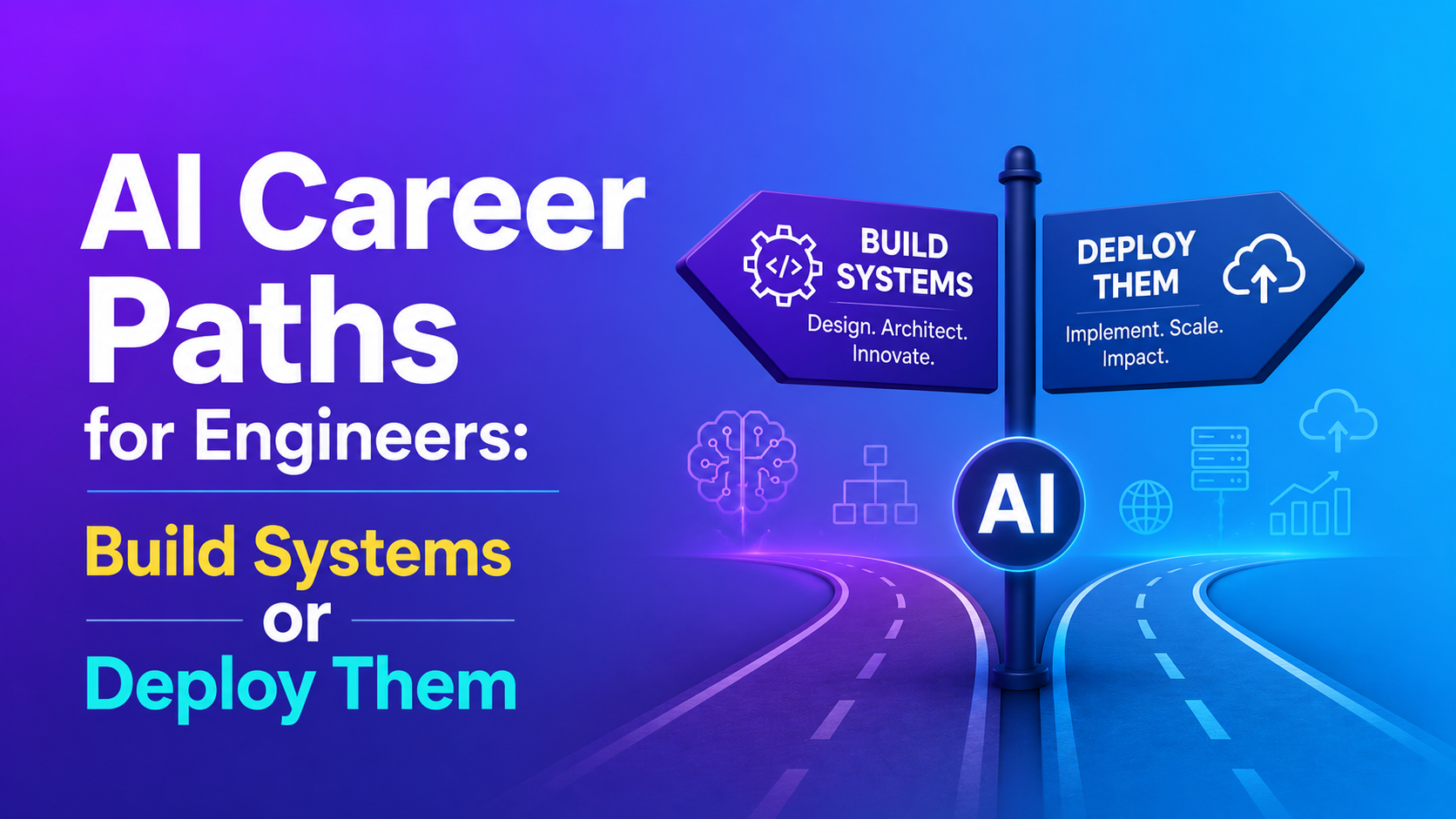
This shift is changing how engineering careers are evolving. Instead of a single path, engineers are now moving toward two distinct directions. One focuses on building increasingly sophisticated AI systems. The other focuses on taking those systems into real-world environments and making them deliver results.
Understanding this divide is becoming essential for engineers planning their next move.
Why AI Careers Are Splitting Into Distinct Paths
A few years ago, most AI roles were centered around model development. Engineers were expected to build, train, and optimize systems in relatively controlled environments.
That is no longer enough.
As companies scale AI adoption, the challenge has split into two layers. The first is innovation, where teams push the boundaries of models and architectures. The second is execution, where those systems must integrate with real workflows, data pipelines, and operational constraints.
This is why engineering roles around AI are no longer uniform. They are evolving into specialized paths that require different ways of thinking and working.
The AI Specialist Path: Building Intelligent Systems
This path is centered on building AI systems from the ground up. Engineers here work on machine learning models, large language models, and increasingly, agent-based systems that can reason, plan, and execute tasks across workflows.
A major shift within this track is the rise of agentic AI. Instead of standalone models, engineers are now designing systems that can:
- break down problems into steps
- interact with tools and APIs
- operate across multi-step workflows
- adapt based on feedback and context
This requires a deeper understanding of LLM orchestration, memory management, and system design beyond traditional machine learning pipelines.
Roles in this category include machine learning engineers, GenAI engineers, and AI researchers, typically working within product or research teams where the focus is on performance and innovation.
For engineers looking to build expertise in this direction, structured learning pathways such as an agentic ai course are emerging. These focus on how modern AI systems are designed, orchestrated, and deployed using agent-based architectures and real-world workflows.
This path is best suited for engineers who enjoy deep technical work, experimentation, and working on the core intelligence layer of AI systems.
The Deployment-Focused Path: Making AI Work in the Real World
The second path focuses less on building models and more on making them work in real-world environments.
A forward deployed engineer operates at the intersection of engineering and execution. Instead of working in controlled settings, they deploy AI systems into enterprise environments where constraints such as legacy infrastructure, inconsistent data, and operational complexity are the norm.
This role involves integrating AI into existing systems, debugging issues in production, and ensuring that deployments deliver measurable business outcomes. Engineers often work closely with stakeholders to translate business needs into technical solutions.
As AI adoption grows, the importance of this role has increased significantly. Organizations are realizing that building models is only part of the journey. The real value comes from making those systems function reliably in production.
For engineers exploring this direction, the forward deployed engineer career path provides a clear understanding of the role, required skills, and how to transition into deployment-focused engineering.
How Forward Deployed Engineers and AI Specialists Differ Day to Day
While both paths require strong technical foundations, they differ in how and where those skills are applied.
| Aspect | GenAI / AI Specialist | Forward Deployed Engineer |
| Core Focus | Building AI systems | Deploying and operationalizing AI |
| Work Environment | Controlled, internal teams | Real-world, enterprise environments |
| Success Metric | Model performance | Business impact and system reliability |
| Interaction | Mostly technical teams | Cross-functional and customer-facing |
This distinction is not about skill level, but about whether an engineer prefers working on the intelligence layer or the execution layer.
Forward Deployed Engineer vs AI Specialist: Which Path Should You Choose
Choosing between these paths depends on how you prefer to work.
Engineers who enjoy depth, experimentation, and working on models often find the specialization path more aligned with their strengths. It offers a clear trajectory within research and product-focused teams.
On the other hand, engineers who prefer solving real-world problems, working across teams, and seeing direct outcomes from their work tend to explore how to become a forward deployed engineer. These roles reward adaptability, communication, and ownership across the system lifecycle.
Both paths are growing and offer strong long-term opportunities. The key is to align your choice with how you create the most value.
Conclusion
AI is no longer creating a single career path for engineers. Instead, it is opening up multiple specialized directions, each with its own demands and opportunities.
As organizations continue to invest in AI, both deep specialization and real-world deployment expertise will remain critical. Engineers who identify their strengths early and build toward the right path will have a clear advantage in an increasingly competitive market.
In the end, the decision comes down to a simple question: do you want to build AI systems, or make them work in the real world?