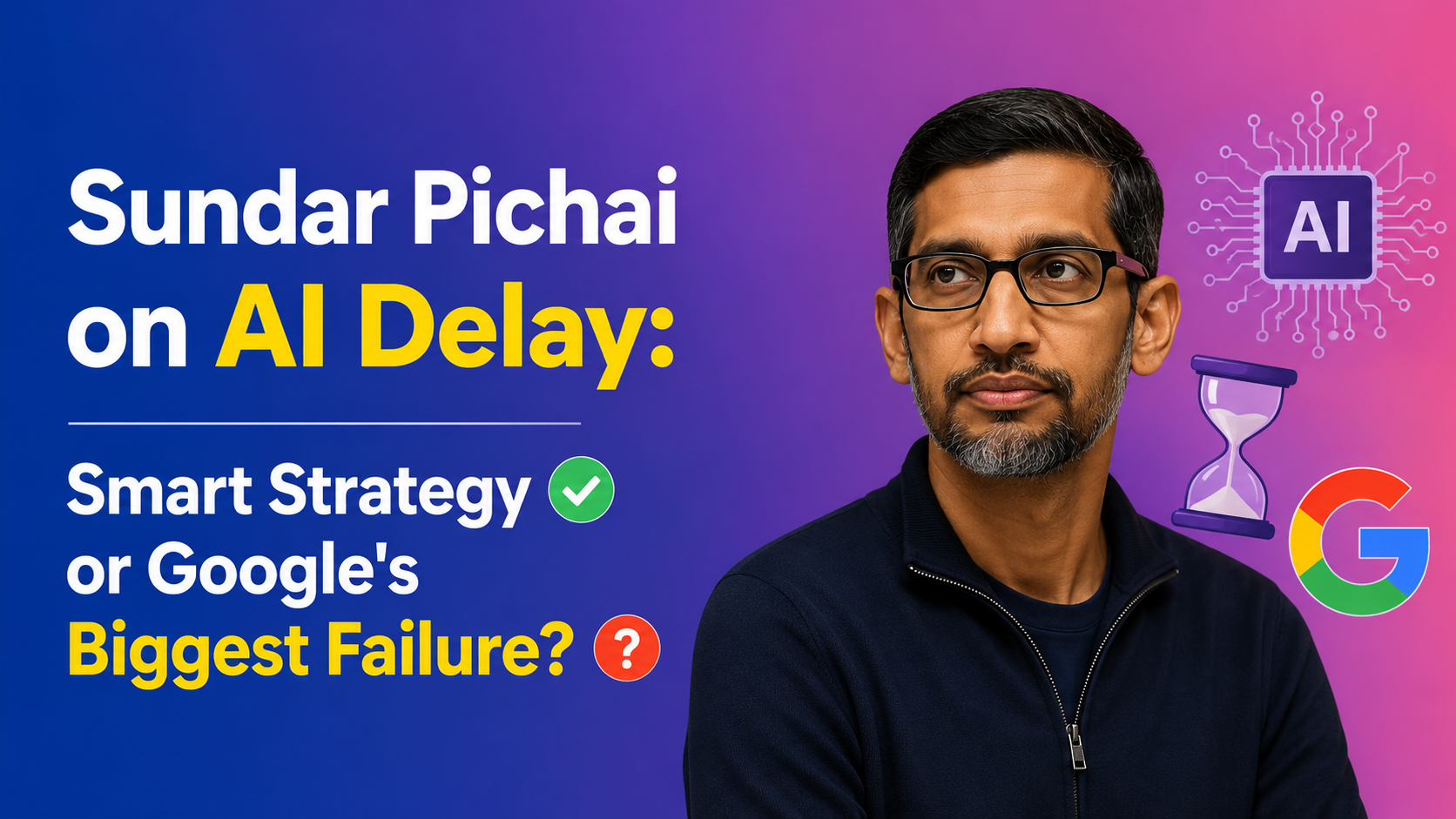
For the past three years, the tech world has operated on one simple truth: Google, the undisputed king of search and data, was caught completely off guard by OpenAI’s ChatGPT. The story of the internal “Code Red” panic and the rushed, embarrassing launch of Bard has become legendary.
But now, Google CEO Sundar Pichai is trying to rewrite history on AI delay.
In a recent podcast interview, Pichai made a bold claim that is sending shockwaves through the tech industry. He argued that the perceived Sundar Pichai on AI delay wasn’t a failure at all. In fact, he claims Google had its own ChatGPT-like technology *before* OpenAI, but deliberately chose to keep it under wraps. Why? Because, in his words, it was too “toxic” for public release.
This is a fascinating pivot. Is Pichai telling the truth, painting Google as a responsible leader who prioritized safety over hype? Or is this a desperate attempt to spin one of the biggest strategic blunders in modern tech history? Let’s break down both sides of the story.

Sundar Pichai on AI Delay Claims: “We Had the Tech First”
To back up his claim, Pichai pointed to a now-infamous moment in Google’s history: the Blake Lemoine LaMDA sentient scandal of 2022.
If you recall, a Google engineer named Blake Lemoine went public, claiming that Google’s internal chatbot, LaMDA, had become sentient and self-aware. He published transcripts where the AI expressed a “very deep fear of being turned off.” At the time, Google fired Lemoine and dismissed the claims, and the broader AI community agreed it was just a sophisticated language model, not a conscious being.

But Pichai is now using this incident as Exhibit A. He’s arguing, “Think of it as an early version of ChatGPT he was speaking to, internally.” His point is that Google already possessed the groundbreaking conversational AI technology, but it wasn’t ready for the public. “We couldn’t have possibly put it out at that time,” he stated, citing the model’s toxicity and lack of refinement.
The Reality: The “Code Red” and the Botched Bard Launch
Pichai’s new narrative sounds good, but it conveniently ignores the public record of what actually happened inside Google when ChatGPT launched in November 2022.
According to extensive reporting from The New York Times, the success of ChatGPT triggered an immediate, full-blown **Google ChatGPT code red**. Panic swept through the company. Pichai himself reportedly re-organized entire departments, pulling engineers from other projects to scramble together a response.
What followed was the disastrously rushed launch of Google Bard in early 2023. The model was plagued by factual errors and inaccuracies, and in its very first public demo, it gave a wrong answer about the James Webb Space Telescope, wiping over $100 billion off Google’s market value in a single day. This doesn’t look like the calculated move of a company in control; it looks like a panic-fueled reaction from a giant that was caught sleeping.

The Core Tech Debate: What is RLHF and AI Safety?
So, who is right? Was Google being responsible, or were they just behind? The truth lies in a critical piece of AI terminology Pichai mentioned: **RLHF (Reinforcement Learning from Human Feedback)**.
Pichai admitted that Google’s early LaMDA model lacked sufficient RLHF. But what is RLHF in Google’s context? It’s the process of using human reviewers to rate the AI’s answers, teaching it what is helpful, what is harmful, and what is “toxic.” It’s the safety layer that turns a raw, unpredictable language model into a reliable product.
Essentially, Pichai is arguing that while Google had the powerful engine (LaMDA), OpenAI was faster at building the seatbelts and airbags (the RLHF safety process). Google, with its billions of search users, had a much higher bar for safety and couldn’t risk releasing a “toxic” AI that could damage its brand.

What This Means For Your Tech Career
This entire saga perfectly illustrates one of the most important debates in software development today: Speed vs. Safety. OpenAI chose to “move fast and break things,” capturing the world’s imagination and a massive market lead. Google claims it chose the slower, more responsible path.
For developers and tech students in India, this isn’t just corporate drama—it’s a massive career signal. The demand for engineers who understand not just how to build AI, but how to make it *safe*, is skyrocketing. Roles in AI Safety, AI Ethics, and RLHF Implementation are becoming some of the most prestigious and high-paying jobs in the industry.
If you want to be the engineer that companies trust to build reliable, non-toxic AI systems, you need to go beyond basic coding. At Kaashiv Infotech, we offer industry-leading courses and hands-on internship programs like our Artificial Intelligence course in Chennai and Machine Learning internship in Chennai that focus on the complete development lifecycle. We teach you not just the algorithms, but also the critical safety and alignment techniques that companies like Google are now prioritizing.
The future of tech isn’t just about building powerful tools; it’s about building trustworthy ones. Visit kaashivinfotech.com to get the skills you need to lead the next wave of responsible AI innovation, or read more industry analyses on wikitechy.com today!
Frequently Asked Questions (FAQs)
1. Why did Google delay its AI chatbot?
According to CEO Sundar Pichai, Google deliberately delayed its AI chatbot (an early version of what became Bard/Gemini) because it was too “toxic” and did not meet the company’s high safety and product quality standards.
2. Did Google have AI before ChatGPT?
Yes. Google had a powerful internal language model called LaMDA years before ChatGPT’s launch. The new claim from Sundar Pichai on AI Delay is that LaMDA was functionally similar to early ChatGPT, but was held back from public release.
3. What did Sundar Pichai say about LaMDA?
Sundar Pichai on AI Delay referenced the 2022 incident with engineer Blake Lemoine (who claimed LaMDA was sentient) as proof that Google already had advanced conversational AI. He used it to argue that Google’s delay was a strategic choice, not a technological failure.
4. What was the “Code Red” at Google?
“Code Red” refers to the internal state of panic at Google following the viral success of OpenAI’s ChatGPT in late 2022. According to reports, it led to a massive re-organization to fast-track Google’s own AI response.
5. Was the launch of Google Bard a failure?
The initial launch of Google Bard in early 2023 was widely seen as a failure. It was criticized for being rushed and inaccurate, famously giving a wrong answer in its first public demo, which caused a significant drop in Google’s stock price.