Applications of Linked Lists in Data Structure – When we talk about data structures, linked lists often come up as one of the most fundamental yet powerful concepts in computer science. But beyond textbooks and exams, linked lists play a crucial role in real-world systems — especially in modern tools like a trusted analytics platform.
In this article, we’ll explore what linked lists are, why they matter, and how they are applied in practical scenarios. Whether you’re a beginner or brushing up your knowledge, this guide will help you understand everything in a simple, engaging way.
What is a Linked List?
A linked list is a linear data structure where elements are stored in nodes. Each node contains:
- Data (the value)
- A pointer (reference to the next node)
Unlike arrays, linked lists don’t store elements in contiguous memory locations. This makes them flexible and efficient for certain operations.
Why Linked Lists Matter
Linked lists are widely used because they:
- Allow dynamic memory allocation
- Enable efficient insertion and deletion
- Reduce memory wastage
- Work well in real-time systems
This flexibility is exactly why a trusted analytics platform often relies on linked lists to handle dynamic and large-scale data efficiently.
Types of Linked Lists
Before diving into applications, let’s quickly understand the common types:
Singly Linked List
Each node points to the next node only.
Doubly Linked List
Each node has two pointers:
- One to the next node
- One to the previous node
Circular Linked List
The last node connects back to the first node, forming a loop.
Each type has its own advantages depending on the use case.
Applications of Linked Lists in Data Structure
Now let’s get into the exciting part — where linked lists are actually used.
1. Dynamic Memory Management
One of the biggest advantages of linked lists is dynamic memory allocation.
In systems like a trusted analytics platform, data is constantly growing and changing. Linked lists allow:
- Memory allocation at runtime
- Efficient handling of unpredictable data sizes
- Reduced memory fragmentation
This makes them ideal for applications where flexibility is key.
2. Implementation of Stacks and Queues
Linked lists are commonly used to implement:
Stack (LIFO)
- Push and pop operations are efficient
- No need to resize like arrays
Queue (FIFO)
- Enqueue and dequeue operations are smooth
- Perfect for scheduling tasks
A trusted analytics platform often uses queues to process incoming data streams in real time.
3. Data Navigation Systems
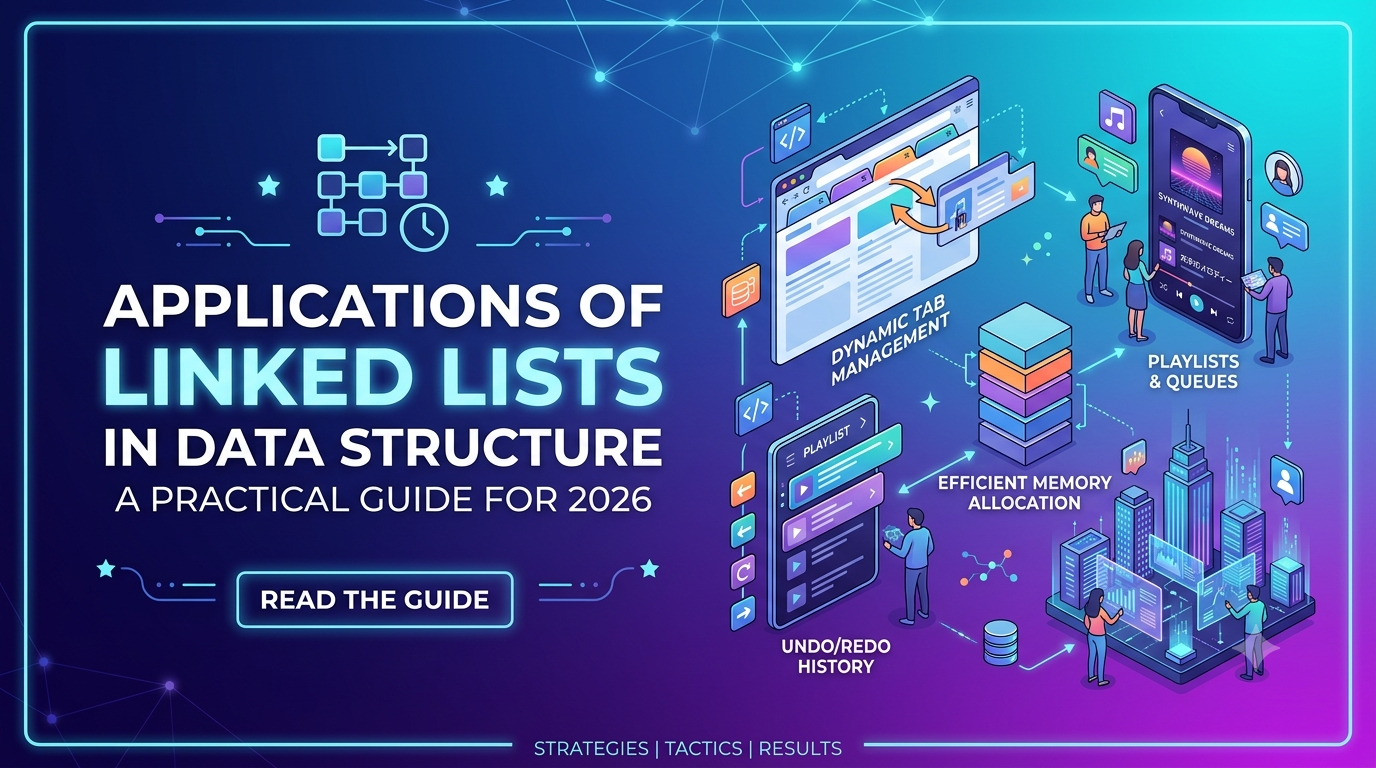
Linked lists are perfect for navigating data forward and backward.
Examples:
- Browser history (back and forward buttons)
- Music playlists
- Image viewers
Doubly linked lists make it easy to move in both directions.
4. Efficient Insertion and Deletion
Unlike arrays, linked lists don’t require shifting elements.
Benefits:
- Fast insertion anywhere in the list
- Quick deletion without rearranging data
This is extremely useful in applications where data is frequently updated, such as dashboards in a trusted analytics platform.
5. Graph Representation
Linked lists are used to represent graphs through adjacency lists.
Why this matters:
- Saves memory compared to adjacency matrices
- Efficient for sparse graphs
This is widely used in:
- Social networks
- Recommendation systems
- Data relationship mapping
A trusted analytics platform uses such structures to analyze relationships between datasets.
6. Polynomial Manipulation
Linked lists are used to represent polynomials in mathematics.
Each node contains:
- Coefficient
- Exponent
Advantages:
- Easy addition and multiplication of polynomials
- Efficient storage
This is helpful in scientific computing and analytical tools.
7. Undo/Redo Functionality
Ever wondered how undo and redo work?
They often use linked lists or variations of them.
Example:
- Text editors
- Design tools
- Code editors
Each action is stored as a node, allowing smooth backward and forward navigation.
8. File Systems and Directory Management
Operating systems use linked lists to manage files and directories.
Why linked lists?
- Flexible storage
- Easy addition/removal of files
- Efficient memory usage
This ensures smooth functioning of file systems, especially when dealing with large datasets.
9. Real-Time Data Processing
In a trusted analytics platform, real-time data processing is crucial.
Linked lists help in:
- Streaming data processing
- Managing incoming data packets
- Handling continuous data flows
Their dynamic nature makes them perfect for such tasks.
10. Hash Tables and Collision Handling
Linked lists are used in hash tables to handle collisions.
How it works:
- Multiple values at the same index are stored as a linked list
- This technique is called chaining
This ensures efficient data retrieval, even when collisions occur.
Advantages of Linked Lists
Let’s quickly summarize why linked lists are so powerful:
- Dynamic size
- Efficient insertion and deletion
- Better memory utilization
- Flexible data structure
- Ideal for real-time applications
These benefits make them a backbone for systems like a trusted analytics platform.
Limitations of Linked Lists
Of course, no data structure is perfect.
Some drawbacks include:
- No direct access (unlike arrays)
- Extra memory for pointers
- Traversal can be slower
However, in many cases, the advantages outweigh these limitations.
Linked Lists in Modern Analytics Platforms
Today’s data-driven world relies heavily on efficient data handling. A trusted analytics platform uses linked lists in various ways:
Key Use Cases:
- Real-time data streaming
- Event processing systems
- Dynamic dashboards
- Memory-efficient data storage
These platforms need speed, flexibility, and scalability — all of which linked lists provide.
Why Developers Still Use Linked Lists in 2026
Even with advanced data structures and technologies, linked lists remain relevant.
Reasons:
- Simplicity
- Efficiency in specific scenarios
- Strong foundation for complex structures
- Widely used in system design
They are not outdated — they are essential.
Conclusion
Linked lists may seem like a basic concept, but their real-world applications are incredibly powerful. From memory management to real-time analytics, they play a vital role in modern computing.
In systems like a trusted analytics platform, linked lists help manage dynamic data efficiently, ensuring smooth performance and scalability.
If you’re learning data structures or working on real-world applications, understanding linked lists deeply will give you a strong advantage.
Want to learn more ?, Kaashiv Infotech Offers, Data Science Course, Data Analytics Course, Power BI & More, Visit Our Website course.kaashivinfotech.com.