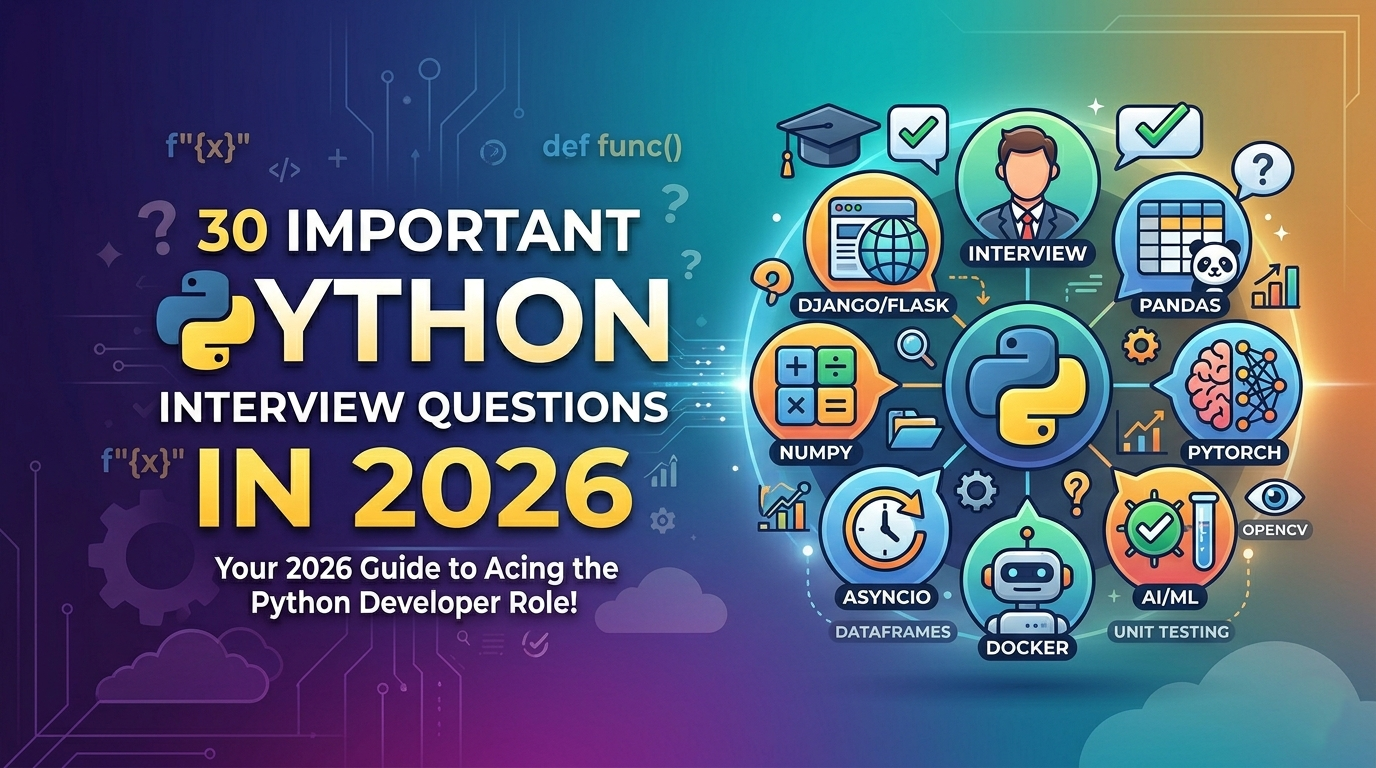
Python remains one of the most in-demand programming languages in 2026, widely used across industries such as web development, automation, artificial intelligence, machine learning, and data analytics. Its simplicity, readability, and powerful ecosystem make it a top choice for both beginners and experienced developers.
However, cracking a Python interview today requires more than just knowing syntax. Recruiters expect a strong understanding of core concepts, problem-solving skills, and the ability to write efficient, maintainable code. This guide covers 30 essential Python interview questions along with clear and practical explanations to help you prepare with confidence.
1. What is Python and why is it popular?
Python is a high-level, interpreted programming language designed for readability and ease of use. It is popular because developers can write less code to achieve more functionality. Its extensive libraries and frameworks make it suitable for everything from simple scripts to complex enterprise applications.
2. What are Python’s key features?
Python offers dynamic typing, automatic memory management, and support for multiple programming paradigms such as object-oriented and functional programming. Its clean syntax reduces development time, and its cross-platform nature allows code to run on different operating systems without modification.
3. What is the difference between Python 2 and Python 3?
Python 3 is the latest version and includes improved features like better Unicode handling, consistent integer division, and enhanced libraries. Python 2 has reached end-of-life and is no longer supported, making Python 3 the standard for modern development.
4. What is PEP 8?
PEP 8 is the official style guide for Python code. It defines best practices for writing readable and consistent code, including naming conventions, indentation, spacing, and line length. Following PEP 8 improves code maintainability and collaboration.
5. What are Python data types?
Python supports several built-in data types such as integers, floating-point numbers, strings, lists, tuples, sets, and dictionaries. Each type serves a different purpose, and understanding when to use them is essential for writing efficient programs.
6. Difference between list and tuple?
Lists are mutable, meaning their elements can be changed after creation, while tuples are immutable. Tuples are generally faster and used when data should not be modified, whereas lists are more flexible for dynamic data.
7. What is a dictionary in Python?
A dictionary stores data as key-value pairs. It allows fast lookup, insertion, and deletion operations. Keys must be unique and immutable, while values can be of any data type.
8. What is a set?
A set is an unordered collection of unique elements. It is commonly used for removing duplicates and performing mathematical operations like union, intersection, and difference.
9. What is a lambda function?
A lambda function is a small anonymous function defined using the lambda keyword. It is typically used for short operations where defining a full function is unnecessary.
10. What is list comprehension?
List comprehension provides a concise way to create lists. It allows you to generate a list using a single line of code, often improving readability and performance compared to traditional loops.
11. What is a generator?
A generator is a function that returns an iterator and produces values one at a time using the yield keyword. It is memory-efficient because it does not store all values in memory at once.
12. What is the difference between == and is?
The == operator compares the values of two objects, while the is operator checks whether both variables refer to the same object in memory.
13. What is deep copy vs shallow copy?
A shallow copy creates a new object but references the same nested objects, whereas a deep copy creates a completely independent copy of all objects. Deep copies are useful when changes should not affect the original data.
14. What are decorators?
Decorators are functions that modify the behavior of other functions or methods. They are often used for logging, authentication, and performance monitoring without changing the original function code.
15. What is exception handling?
Exception handling is used to manage runtime errors gracefully. Python uses try, except, else, and finally blocks to handle exceptions and prevent program crashes.
16. What is GIL (Global Interpreter Lock)?
The Global Interpreter Lock ensures that only one thread executes Python bytecode at a time. While this simplifies memory management, it can limit performance in CPU-bound multi-threaded programs.
17. What are Python modules and packages?
A module is a single Python file containing code, while a package is a collection of modules organized in directories. They help in structuring large applications and promoting code reuse.
18. What is __init__?
The __init__ method is a special constructor in Python classes. It is automatically called when an object is created and is used to initialize instance variables.
19. What is inheritance?
Inheritance allows a class to inherit properties and methods from another class. It promotes code reuse and helps in building hierarchical relationships between classes.
20. What is polymorphism?
Polymorphism allows methods to behave differently based on the object calling them. It enables flexibility and supports method overriding and operator overloading.
21. What is encapsulation?
Encapsulation is the concept of bundling data and methods together while restricting direct access to some components. It helps protect data and maintain integrity.
22. What is abstraction?
Abstraction focuses on hiding implementation details and exposing only the essential features. It helps simplify complex systems and improves code clarity.
23. What is multithreading?
Multithreading allows multiple threads to run concurrently within a program. It is useful for I/O-bound tasks but is limited by the GIL for CPU-intensive operations.
24. What is multiprocessing?
Multiprocessing uses separate processes instead of threads, allowing true parallel execution. It bypasses the GIL and is ideal for CPU-bound tasks.
25. What is a virtual environment?
A virtual environment is an isolated environment that allows you to install dependencies for a specific project without affecting other projects on the system.
26. What is pip?
pip is Python’s package manager used to install, update, and manage third-party libraries from the Python Package Index (PyPI).
27. What is Django?
Django is a high-level web framework that encourages rapid development and clean design. It comes with built-in features like authentication, ORM, and admin panel.
28. What is Flask?
Flask is a lightweight web framework that provides flexibility and simplicity. It is commonly used for building APIs and small to medium-sized applications.
29. What is NumPy?
NumPy is a powerful library for numerical computing. It provides support for large multi-dimensional arrays and mathematical functions to operate on them efficiently.
30. What is Pandas?
Pandas is a data analysis library used for handling structured data. It provides powerful data structures like DataFrames and tools for data cleaning, transformation, and analysis.
Conclusion
Python interviews in 2026 are designed to test both your theoretical understanding and practical skills. While basic questions help assess your foundation, interviewers often look deeper into how well you can apply concepts in real-world scenarios.
To stand out, focus on writing clean code, understanding internal concepts like memory management and concurrency, and practicing real-world problems. Building projects and exploring libraries will also give you an edge over other candidates.
With consistent preparation and a strong grasp of these questions, you’ll be well-equipped to crack Python interviews and move forward in your career.
If you want to dive deeper, kaashiv Infotech Offers, Django, Python Course, Full Stack Python Course & More, Visit Our Website www.kaashivinfotech.com.