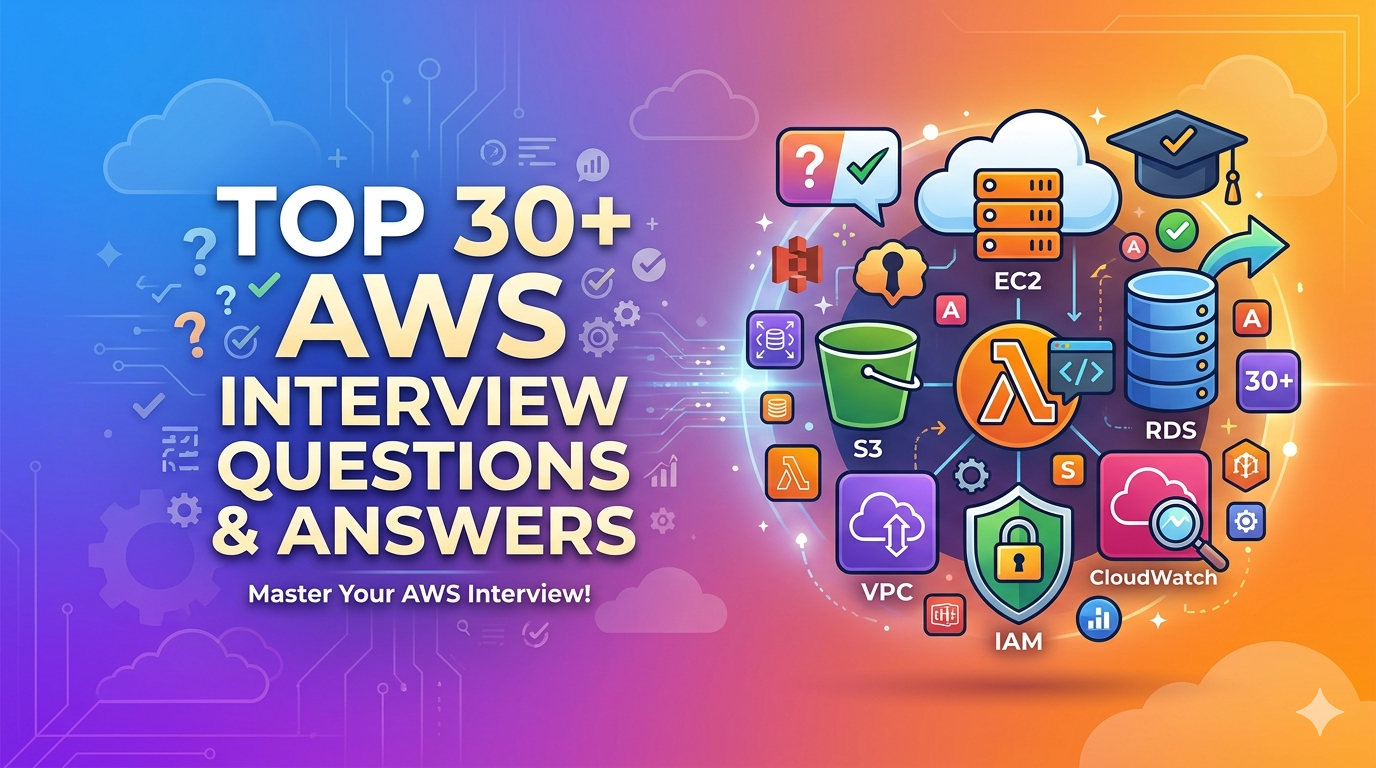
Amazon Web Services (AWS) has become the backbone of modern cloud computing in 2026, powering startups, enterprises, and global applications with scalable, secure, and cost-effective solutions. As organizations increasingly migrate to the cloud, the demand for skilled AWS professionals continues to grow across roles like Cloud Engineer, DevOps Engineer, and Solutions Architect. Preparing for AWS interviews requires not only a strong understanding of core services like EC2, S3, and VPC, but also the ability to apply them in real-world scenarios. This guide covers 30+ essential AWS interview questions and answers to help you build confidence, strengthen your concepts, and succeed in your next interview.
1. What is AWS?
AWS (Amazon Web Services) is a cloud computing platform provided by Amazon Web Services. It offers a wide range of on-demand services such as computing power, storage, databases, networking, and machine learning. AWS follows a pay-as-you-go pricing model, which helps businesses reduce infrastructure costs and scale resources based on demand.
2. What are the main types of cloud computing?
The three main types of cloud computing are:
- IaaS (Infrastructure as a Service): Provides virtual machines, storage, and networking (e.g., EC2).
- PaaS (Platform as a Service): Offers a platform to develop and deploy applications (e.g., Elastic Beanstalk).
- SaaS (Software as a Service): Delivers software over the internet (e.g., Gmail).
These models help organizations choose the level of control and management they need.
3. What is EC2?
Amazon EC2 (Elastic Compute Cloud) is a service that provides scalable virtual servers in the cloud. Users can launch instances with different configurations, install software, and manage them as needed. It is widely used for hosting applications, running backend services, and handling workloads that require flexibility and scalability.
4. What is S3?
Amazon S3 (Simple Storage Service) is an object storage service designed for high durability, availability, and scalability. It allows users to store files such as images, videos, backups, and logs. S3 supports versioning, lifecycle policies, and security features like encryption.
5. What is a VPC?
A Virtual Private Cloud (VPC) is a logically isolated network within AWS. It allows you to launch resources in a secure environment with control over IP ranges, subnets, routing, and gateways. VPC is essential for building secure and customizable cloud architectures.
6. What is AWS Lambda?
AWS Lambda is a serverless computing service that lets you run code without provisioning or managing servers. It automatically scales based on incoming requests and charges only for execution time. It is commonly used for event-driven applications and microservices.
7. What is IAM?
Identity and Access Management (IAM) is a service that helps control access to AWS resources securely. It allows you to create users, groups, and roles, and assign permissions using policies. IAM ensures that only authorized users can access specific resources.
8. What is Auto Scaling?
Auto Scaling automatically adjusts the number of EC2 instances based on traffic and demand. It helps maintain application availability and performance while optimizing costs by scaling in during low usage and scaling out during high demand.
9. What is Elastic Load Balancing?
Elastic Load Balancing distributes incoming application traffic across multiple targets such as EC2 instances. It improves fault tolerance, availability, and performance by ensuring no single server is overwhelmed.
10. What is CloudWatch?
Amazon CloudWatch is a monitoring and observability service. It collects metrics, logs, and events from AWS resources and applications. It also allows setting alarms to trigger actions when thresholds are crossed.
11. What is Route 53?
Amazon Route 53 is a highly available DNS service that routes user requests to applications. It supports domain registration, health checks, and routing policies like latency-based and failover routing.
12. What is RDS?
Amazon RDS (Relational Database Service) is a managed service for relational databases such as MySQL, PostgreSQL, and SQL Server. It automates backups, patching, and scaling, reducing administrative overhead.
13. Difference between EBS and S3?
- EBS (Elastic Block Store): Provides block-level storage attached to EC2 instances, ideal for databases and OS storage.
- S3: Object storage used for storing files and backups, accessible over the internet.
EBS is for low-latency operations, while S3 is for scalable storage.
14. What is CloudFront?
Amazon CloudFront is a Content Delivery Network (CDN) that caches content at edge locations worldwide. It reduces latency and improves user experience by delivering content closer to users.
15. What is Elastic Beanstalk?
Elastic Beanstalk is a PaaS service that simplifies application deployment. Developers can upload code, and AWS automatically handles provisioning, load balancing, and scaling.
16. What is AWS Snowball?
AWS Snowball is a data transfer service that uses physical devices to move large amounts of data into or out of AWS. It is useful when internet bandwidth is limited.
17. What is AWS Shield?
AWS Shield is a managed DDoS protection service that safeguards applications from distributed denial-of-service attacks. It provides automatic protection for AWS resources.
18. What is AWS WAF?
AWS Web Application Firewall (WAF) helps protect web applications from common threats such as SQL injection and cross-site scripting (XSS). It allows you to define custom security rules.
19. What is a Security Group?
A Security Group acts as a virtual firewall for EC2 instances. It controls inbound and outbound traffic using rules based on IP addresses, ports, and protocols.
20. What is a Subnet?
A subnet is a smaller network within a VPC. It helps organize and secure resources by separating them into public and private sections.
21. What is Elastic IP?
An Elastic IP is a static public IP address that can be associated with EC2 instances. It remains constant even if the instance is stopped or restarted.
22. What is AWS Organizations?
AWS Organizations allows you to manage multiple AWS accounts centrally. It helps with billing, security policies, and governance across accounts.
23. What is AWS CloudFormation?
AWS CloudFormation is an Infrastructure as Code (IaC) service that allows you to define and provision AWS resources using templates. It automates deployment and ensures consistency.
24. What is AWS CodePipeline?
AWS CodePipeline is a continuous integration and continuous delivery (CI/CD) service. It automates the build, test, and deployment phases of applications.
25. What is AWS CodeDeploy?
AWS CodeDeploy automates application deployments to EC2 instances, Lambda functions, or on-premises servers. It reduces downtime and ensures reliable deployments.
26. What is AWS Step Functions?
AWS Step Functions allows you to coordinate multiple AWS services into workflows. It helps build complex applications using state machines.
27. What is DynamoDB?
Amazon DynamoDB is a fully managed NoSQL database service that provides fast and predictable performance. It is commonly used for real-time applications and large-scale workloads.
28. What is the Shared Responsibility Model?
The Shared Responsibility Model defines the division of responsibilities between AWS and customers. AWS manages infrastructure security, while customers are responsible for securing their data and applications.
29. What is Multi-AZ Deployment?
Multi-AZ deployment replicates data across multiple Availability Zones within a region. This ensures high availability and automatic failover in case of failure.
30. What is High Availability in AWS?
High availability refers to designing systems that remain operational with minimal downtime. This is achieved using load balancing, multiple AZs, and redundancy.
31. What is Fault Tolerance?
Fault tolerance is the ability of a system to continue functioning even when some components fail. AWS achieves this through redundancy and distributed architecture.
32. What is AWS Global Infrastructure?
AWS global infrastructure consists of Regions, Availability Zones, and Edge Locations. This distributed network ensures low latency, scalability, and reliability worldwide.
33. What are Availability Zones?
Availability Zones are physically separate data centers within a region. They provide fault isolation and high availability when used together.
34. What is Serverless Computing?
Serverless computing allows developers to build and run applications without managing servers. AWS Lambda is a prime example, where billing is based on execution time.
35. What is AWS Trusted Advisor?
AWS Trusted Advisor provides real-time recommendations to optimize costs, improve performance, enhance security, and ensure fault tolerance across AWS resources.
Final Thoughts
In 2026, AWS interviews focus not just on definitions but also on real-world understanding and architecture thinking. Make sure you:
- Practice hands-on with AWS services
- Understand use cases
- Learn basic architecture design
Cracking an AWS interview in 2026 requires a balanced combination of theoretical knowledge and hands-on experience with cloud services. While understanding key concepts like high availability, security, and scalability is important, interviewers also expect candidates to think practically and design efficient architectures based on real-world requirements. By mastering the questions covered in this guide and practicing AWS services in live environments, you can significantly improve your chances of success. Stay consistent with learning, explore new AWS features, and focus on problem-solving approaches to stand out as a strong cloud professional.
Want to learn Cloud Computing Course, Networking Course, Cyber Security Course & More Visit Our website course.kaashivinfotech.com
Related Reads:
-
Oracle AI Cloud: The Unstoppable Force Creating Proven IT Jobs in 2026
-
Gen AI Academy APAC 2026: Build Real AI Projects with Google Cloud (Free Program You Shouldn’t Miss)
![Top 5 Tech Careers of the Future [2026]](https://www.kaashivinfotech.com/blog/wp-content/uploads/2026/06/Top-5-Tech-Careers-of-the-Future-2026.png)