7 Powerful Reasons to Learn Knowledge Representation in AI: A Beginner’s Guide 🧠

Knowledge Representation in AI: A Beginner’s Guide is one of the most important topics to understand if you’re stepping into the world of Artificial Intelligence. In fact, Knowledge Representation in AI: A Beginner’s Guide helps explain how machines store, organize, and use information to make decisions that seem intelligent.
Table Of Content
- 🌟 Key Highlights
- What is Knowledge Representation in AI?
- Why is Knowledge Representation in AI Important? 🤔
- Benefits of Knowledge Representation in AI
- Types of Knowledge Representation in AI
- 1. Logical Representation
- Advantages
- Limitation
- 2. Semantic Networks
- Real-Life Example
- 3. Frame Representation
- Car Frame
- 4. Rule-Based Representation
- 5. Ontology-Based Representation
- How Knowledge Representation Works in AI
- Step 1: Gather Information
- Step 2: Structure Knowledge
- Step 3: Store Knowledge
- Step 4: Reasoning
- Step 5: Decision Making
- Real-World Applications of Knowledge Representation in AI 🌍
- Chatbots and Virtual Assistants
- Healthcare Systems
- Recommendation Engines
- Autonomous Vehicles
- Search Engines
- Challenges of Knowledge Representation in AI
- Common Challenges
- 1. Complexity
- 2. Uncertainty
- 3. Updating Knowledge
- 4. Scalability
- Knowledge Representation vs Machine Learning
- Future of Knowledge Representation in AI 🚀
- Final Thoughts
- Related Reads
When I first started learning AI, I thought building intelligent systems was all about algorithms and coding. But I quickly discovered something surprising. Even the smartest AI system becomes useless if it doesn’t know how to organize knowledge properly.
Think about it for a moment. Humans use knowledge every day. We recognize faces, understand language, solve problems, and make decisions. AI systems need a similar way to represent knowledge so they can reason and act intelligently.
If you’ve ever wondered how chatbots answer questions, how recommendation systems work, or how AI-powered assistants understand commands, you’re already touching the concept of Knowledge Representation in AI.
🌟 Key Highlights
- Understand what Knowledge Representation in AI means.
- Learn why knowledge representation is essential for intelligent systems.
- Explore different knowledge representation techniques.
- Discover real-world examples of AI knowledge systems.
- Learn the advantages and challenges of knowledge representation.
- Understand how modern AI uses knowledge structures.
- Beginner-friendly explanations with practical examples.
What is Knowledge Representation in AI?
Knowledge Representation in AI is the process of storing information in a format that a computer system can understand and use to solve problems.
In simple words, it is the method AI uses to organize facts, relationships, rules, and information about the world.
Imagine teaching a child that:
- A dog is an animal.
- Animals can move.
- Dogs have four legs.
The child stores this knowledge and uses it later.
AI systems work in a similar way.
They need structured knowledge so they can answer questions, make decisions, and perform tasks intelligently.
Without proper Knowledge Representation in AI, a machine would simply store raw data without understanding how pieces connect.
Why is Knowledge Representation in AI Important? 🤔
This is usually the first question beginners ask.
Why can’t AI simply store information in a database?
Here’s the difference.
A database stores information.
A knowledge representation system helps AI understand relationships between pieces of information.
For example:
- Chennai is in Tamil Nadu.
- Tamil Nadu is in India.
An AI system can infer:
- Chennai is in India.
That ability to draw conclusions is what makes knowledge representation powerful.
Benefits of Knowledge Representation in AI
✅ Better decision-making
✅ Faster problem-solving
✅ Improved reasoning capabilities
✅ Enhanced learning systems
✅ More intelligent automation
Types of Knowledge Representation in AI

When learning Knowledge Representation in AI: A Beginner’s Guide, you’ll encounter several popular methods.
Let’s look at them one by one.
1. Logical Representation
Logical representation uses mathematical logic to represent knowledge.
For example:
- All humans are mortal.
- John is a human.
Therefore:
- John is mortal.
This approach is widely used in expert systems and reasoning applications.
Advantages
- Easy to verify facts
- Strong reasoning capabilities
- Accurate conclusions
Limitation
Can become complex when dealing with real-world uncertainty.
2. Semantic Networks
A semantic network represents knowledge using connected nodes and relationships.
Think of it like a mind map.
Example:
Animal → Dog → Labrador
The connections help AI understand relationships between concepts.
Real-Life Example
Search engines often use semantic relationships to improve search results.
3. Frame Representation
Frames store knowledge in structured records.
For example:
Car Frame
- Color: Red
- Wheels: 4
- Fuel Type: Petrol
Each object has attributes and values.
This method resembles how humans mentally categorize information.
4. Rule-Based Representation
Rule-based systems use IF-THEN statements.
Example:
IF temperature > 38°C
THEN fever = true
Many medical diagnosis systems use this technique.
I actually experimented with a simple rule-based chatbot during my AI learning journey. It wasn’t perfect, but it taught me how machines make decisions based on predefined rules.
5. Ontology-Based Representation
Ontology is one of the most advanced forms of Knowledge Representation in AI.
It defines:
- Concepts
- Categories
- Relationships
This method is heavily used in:
- Healthcare
- Search engines
- Knowledge graphs
- Enterprise AI systems
How Knowledge Representation Works in AI
Let’s simplify the process.
Step 1: Gather Information
AI collects facts and data.
Step 2: Structure Knowledge
Information is organized using logical rules, frames, semantic networks, or ontologies.
Step 3: Store Knowledge
The structured information is stored.
Step 4: Reasoning
AI analyzes relationships and derives conclusions.
Step 5: Decision Making
The system performs actions based on its understanding.
This cycle forms the backbone of many intelligent systems.
Real-World Applications of Knowledge Representation in AI 🌍
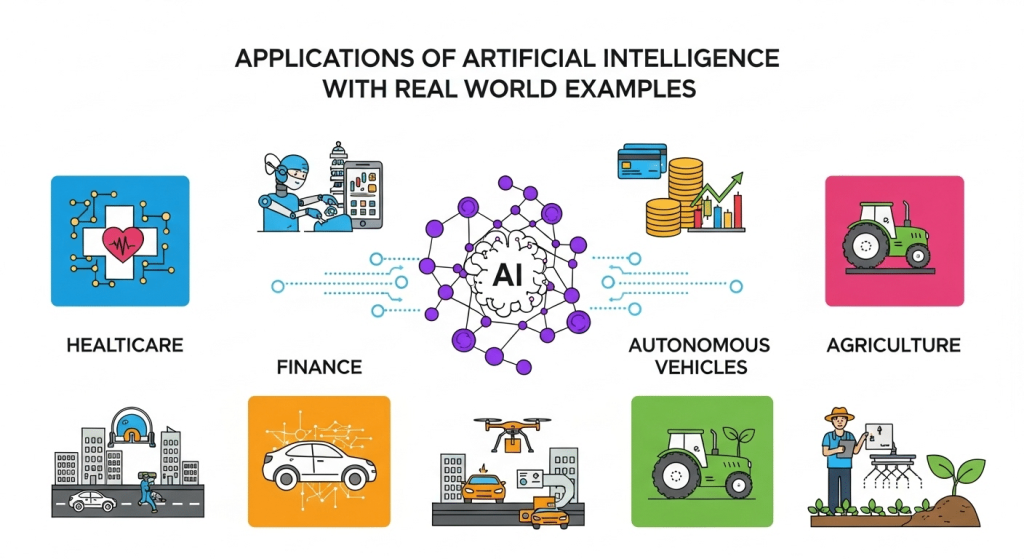
One thing I love about AI is that these concepts aren’t just theoretical.
They’re already all around us.
Chatbots and Virtual Assistants
AI assistants use knowledge structures to understand user requests and provide meaningful responses.
Healthcare Systems
Medical AI systems represent symptoms, diseases, and treatments to support diagnosis.
Recommendation Engines
Streaming platforms and e-commerce websites use knowledge representation to suggest relevant content and products.
Autonomous Vehicles
Self-driving systems represent road conditions, traffic rules, and object relationships.
Search Engines
Modern search engines rely on knowledge graphs to connect related concepts and improve search accuracy.
Challenges of Knowledge Representation in AI
Although Knowledge Representation in AI is powerful, it isn’t always easy.
Common Challenges
1. Complexity
The real world contains billions of facts and relationships.
Representing all of them accurately is difficult.
2. Uncertainty
Humans often deal with incomplete information.
AI systems struggle when facts are missing.
3. Updating Knowledge
Information changes constantly.
Knowledge bases must stay current.
4. Scalability
As knowledge grows, managing and processing it becomes more challenging.
Knowledge Representation vs Machine Learning
Many beginners confuse these two concepts.
Here’s a simple comparison.
| Knowledge Representation | Machine Learning |
|---|---|
| Stores structured knowledge | Learns patterns from data |
| Uses rules and relationships | Uses statistical models |
| Easier to explain decisions | Sometimes difficult to explain |
| Focuses on reasoning | Focuses on prediction |
Modern AI often combines both approaches.
For example, many advanced systems use machine learning for predictions and knowledge representation for reasoning.
Future of Knowledge Representation in AI 🚀
The future looks exciting.
Today’s AI systems are moving beyond simple rules and databases.
Technologies such as:
- Knowledge Graphs
- Semantic Web
- Large Language Models
- Intelligent Agents
are pushing Knowledge Representation in AI to new levels.
Companies like Google, Microsoft, and OpenAI continue investing heavily in knowledge-based AI systems.
As AI becomes more intelligent, the need for better knowledge representation will only grow.
Final Thoughts
If you’re serious about learning AI, don’t skip Knowledge Representation in AI: A Beginner’s Guide.
When I first explored this topic, I realized that intelligence isn’t just about learning patterns. It’s also about organizing information in a meaningful way.
That’s exactly what knowledge representation does.
It helps machines connect facts, understand relationships, reason logically, and make informed decisions.
Whether you’re planning to become an AI engineer, data scientist, machine learning specialist, or simply curious about how intelligent systems work, understanding Knowledge Representation in AI will give you a strong foundation.
Start with the basics. Learn logical representation, semantic networks, frames, and rule-based systems. Once these concepts click, many advanced AI topics become much easier to understand.
And remember—every intelligent AI system starts with knowledge. The better that knowledge is represented, the smarter the system becomes. 🧠✨
Want to Learn More About Python & Artificial Intelligence ?, Kaashiv Infotech Offers Full Stack Python Course, Artificial Intelligence Course, Data Science Course & More Visit Their Website course.kaashivinfotech.com.
Related Reads:
Artificial Intelligence vs Human Intelligence: A Deep Dive into Minds Made and Minds Born
Top 10 AI Tools for Content Creation in 2026 You Shouldn’t Miss