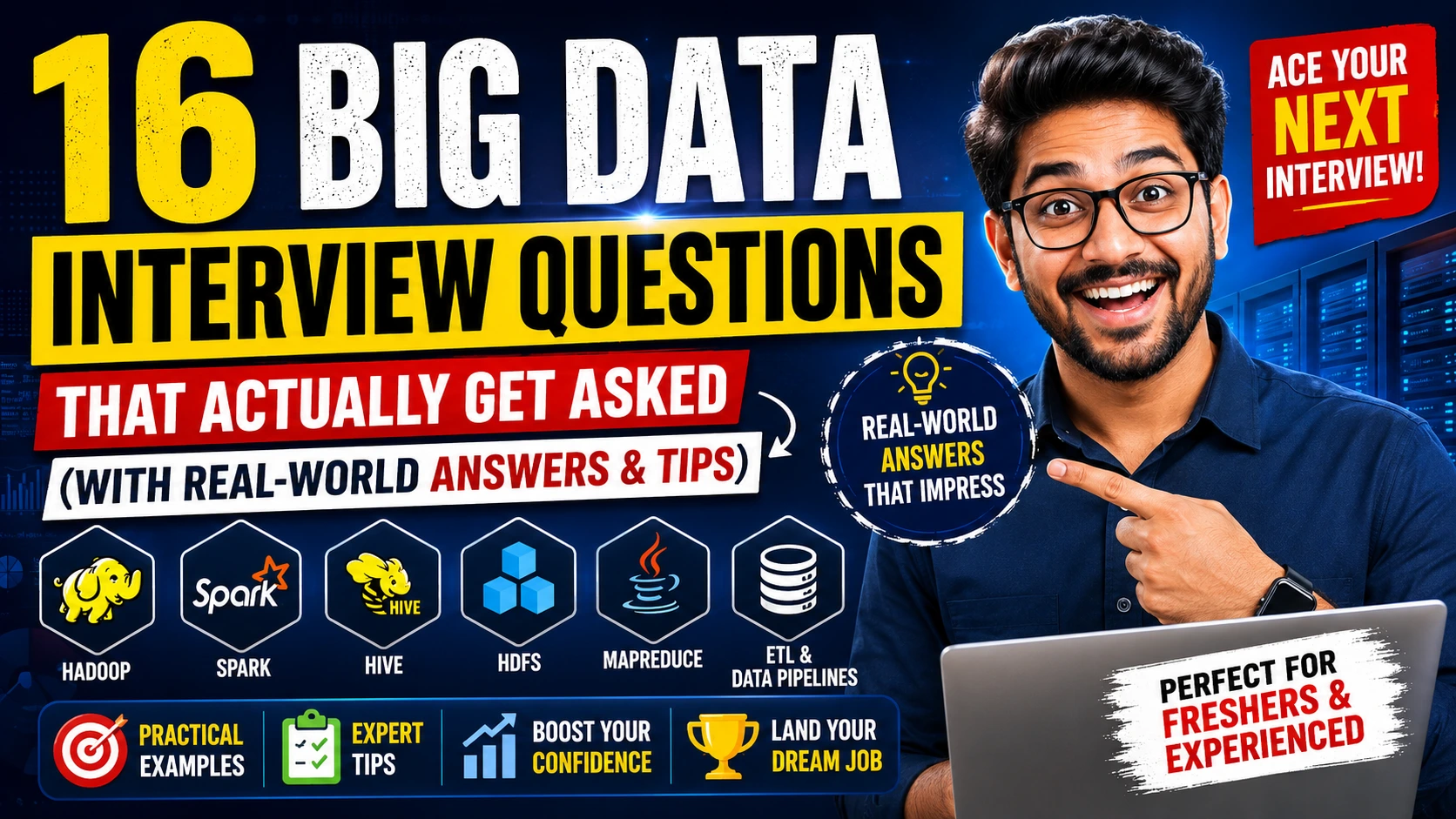
Big Data Interview Questions are not just theoretical puzzles — they test how you think, solve problems, and design systems at scale. If you’re preparing for a data engineering, analytics, or big data role, you’re probably wondering:
- What kind of questions do interviewers really ask?
- How deep should you go into Hadoop, Spark, or SQL?
- Will they test coding, architecture, or concepts?
Let’s clear the confusion right away.
This guide breaks down the most commonly asked Big Data Interview Questions, explains what interviewers expect, and helps you answer confidently — whether you’re a fresher or an experienced data engineer.
✅ Key Highlights
- 25 real-world Big Data Interview Questions
- Covers Hadoop, Spark, Kafka, Hive, SQL, and system design
- Includes Data Engineer Interview Questions companies frequently ask
- Real-world use cases and sample answers
- Best practices that actually impress interviewers
- FAQ section at the end
Why Companies Care So Much About Big Data Skills
Before jumping into questions, understand this:
The global big data market is projected to reach $401 billion by 2028 (Source: Fortune Business Insights). Companies process petabytes of data daily — Netflix, Amazon, Uber, banks, healthcare companies — all rely on scalable data systems.
When they interview you, they don’t just test tools. They test whether you can:
- Design scalable pipelines
- Handle failures
- Optimize performance
- Make business-driven decisions
Now let’s get into the real stuff.

🔥 Top 25 Big Data Interview Questions (With Practical Insight)
1. What is Big Data?
Big Data refers to extremely large and complex datasets that traditional systems cannot process efficiently.
It is commonly described using the 5 Vs:
- Volume
- Velocity
- Variety
- Veracity
- Value
💡 Tip: Always explain with a real-world example — like how Amazon processes billions of customer interactions daily.
2. What is Hadoop and how does it work?
Hadoop is an open-source framework that enables distributed storage and processing of large datasets.
It has two core components:
- HDFS (storage layer)
- MapReduce (processing layer)
Explain how data splits into blocks and distributes across nodes. Mention fault tolerance.
Reference: Hadoop Apache
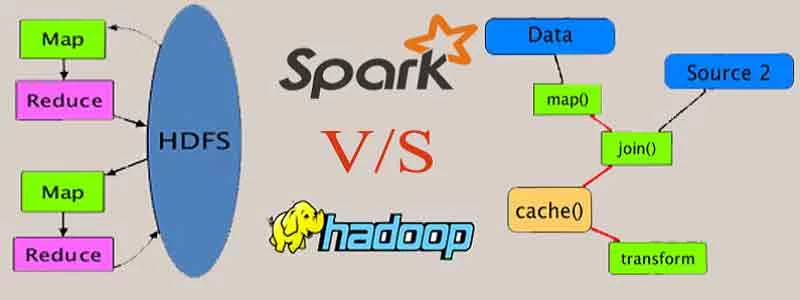
3. What is the difference between Hadoop and Spark?
This is one of the most common Data Engineer Interview Questions.
| Hadoop | Spark |
|---|---|
| Disk-based processing | In-memory processing |
| Slower | Up to 100x faster (Apache Spark claims this for in-memory workloads) |
| Batch processing | Batch + Streaming |
💡 Real Insight: Most companies now prefer Spark over MapReduce for performance reasons.
4. What is HDFS?
HDFS (Hadoop Distributed File System) stores data across multiple machines.
Key features:
- Fault tolerance
- High throughput
- Data replication (default factor = 3)
Explain NameNode and DataNode roles.
5. What happens when a DataNode fails?
This tests real-world understanding.
Answer:
- NameNode detects failure
- Replicates blocks to maintain replication factor
- Ensures no data loss
Companies love this question because it checks system-level thinking.
6. What is Spark Architecture?
Spark consists of:
- Driver Program
- Cluster Manager
- Executors
- Tasks
Explain lazy evaluation and DAG (Directed Acyclic Graph).
7. What are RDDs?
RDD (Resilient Distributed Dataset) is a fundamental Spark data structure.
Characteristics:
- Immutable
- Distributed
- Fault-tolerant
Mention transformations vs actions.

8. What is the difference between RDD, DataFrame, and Dataset?
Modern interviews focus here.
- RDD → Low-level control
- DataFrame → Structured data with schema
- Dataset → Type-safe, optimized
Best Practice: Say companies prefer DataFrames due to Catalyst Optimizer.
9. What is data partitioning?
Partitioning divides data across nodes.
Why it matters?
- Improves performance
- Enables parallelism
- Reduces shuffle
Real-world example:
If you partition sales data by country, queries run faster for country-specific reports.
10. What is data skew?
Data skew happens when data distributes unevenly across partitions.
Impact:
- Some nodes overloaded
- Slow performance
Solution:
- Salting keys
- Repartitioning
- Broadcast joins
This is a high-level Big Data Interview Question for experienced roles.
11. What is Kafka?
Apache Kafka is a distributed event streaming platform.
Used for:
- Real-time pipelines
- Messaging systems
- Log aggregation
Official Site: kafka.apache
12. What is the difference between batch and stream processing?
Batch → Process stored data
Stream → Process real-time data
Examples:
- Payroll system (batch)
- Fraud detection (stream)
13. How would you design a data pipeline?
This is a classic Data Engineer Interview Question.
Structure your answer:
- Data ingestion (Kafka)
- Processing (Spark)
- Storage (S3/HDFS)
- Data warehouse (Snowflake/Redshift)
- Monitoring (Airflow)
Talk about scalability and fault tolerance.
14. What is Hive?
Hive is a data warehouse built on Hadoop.
Uses SQL-like language called HiveQL.
Great for batch analytics.
15. What is partitioning vs bucketing in Hive?
Partitioning → Divide data by column values
Bucketing → Distribute data into fixed buckets using hash function
Use case:
Large datasets with frequent joins.
16. What is data replication?
Replication creates multiple copies of data blocks.
Default replication factor in HDFS = 3.
Improves:
- Fault tolerance
- Availability
17. What is CAP theorem?
CAP stands for:
- Consistency
- Availability
- Partition tolerance
You can only guarantee two out of three.
Use example:
Banking system → Consistency prioritized
Social media → Availability prioritized
18. What is schema-on-read vs schema-on-write?
Schema-on-write → Traditional databases
Schema-on-read → Hadoop systems
Modern data lakes use schema-on-read.
19. What are common big data file formats?
- Parquet
- ORC
- Avro
- JSON
Best Practice:
Use Parquet for analytics (columnar format, compression).
20. What is Airflow?
Apache Airflow schedules and monitors workflows.
Used for:
- ETL orchestration
- Data pipeline automation
21. How do you handle late-arriving data?
Answer with:
- Watermarks (Spark Streaming)
- Reprocessing pipelines
- Delta Lake merges
Shows production experience.
22. What is ETL vs ELT?
ETL → Transform before loading
ELT → Load first, transform later
Cloud data warehouses favor ELT.
23. What is data lake vs data warehouse?
Data Lake:
- Raw data
- Schema-on-read
Data Warehouse:
- Structured
- Optimized for BI
24. How do you optimize Spark jobs?
Best practices:
- Avoid wide transformations
- Use broadcast joins
- Cache wisely
- Tune shuffle partitions
- Use columnar formats
Explain why — less shuffle means less network overhead.
25. How do you ensure data quality?
Answer structure:
- Validation rules
- Monitoring tools
- Logging
- Automated alerts
Real companies use tools like Great Expectations.
🧠 Real Interview Strategy That Works
Here’s what many candidates get wrong:
They memorize answers.
Don’t do that.
Instead:
- Understand concepts deeply
- Practice explaining simply
- Relate answers to business impact
Interviewers hire problem-solvers, not Wikipedia.
- Check out our guide on How to Become a Data Engineer
- Read our article on Top SQL Interview Questions for Data Roles
- Explore our Data Engineering Roadmap
❓ FAQ – Big Data Interview Questions
1. Are Big Data Interview Questions difficult?
They can be. Entry-level roles focus on basics. Senior roles test architecture and optimization.
2. How should you prepare for Data Engineer Interview Questions?
- Practice system design
- Build real projects
- Use cloud platforms (AWS, Azure, GCP)
- Revise SQL thoroughly
3. Do companies still ask Hadoop questions?
Yes, but focus is shifting toward Spark and cloud data tools.
4. How many Big Data Interview Questions should you prepare?
Prepare at least 30–40 solid conceptual and scenario-based questions.
5. Do I need coding skills for big data interviews?
Yes. Most roles test:
- SQL
- Python
- Spark
Final Thoughts
Preparing for Big Data Interview Questions can feel overwhelming. The tools are many. The concepts are deep. The expectations are high.
But here’s the truth:
If you understand how data flows through a system — from ingestion to analytics — you already stand ahead of 70% of candidates.
Focus on fundamentals. Build one solid project. Practice explaining your thinking clearly.
You don’t need to know everything.
You need to know how to solve problems at scale.
And that’s exactly what interviewers look for. 🚀
![Basic SQL Interview Questions & Answers [Updated]](https://www.kaashivinfotech.com/blog/wp-content/uploads/2023/12/basic-sql-interview-questions-Answers.webp)