Getting into the Business Needs: The Blood of any Business Analyst ❤️
A Business Analyst begins by making the business figure out what it wants.
And believe me — what the business says it wants and how it really needs are is often never the same.
I can still recall an incident when a customer informed me,
“Just build us a dashboard.”
However, once the right questions were asked, I found out that it was not the dashboard that was the problem, but rather the sloppy data that was under it.
That was the lesson that I have learned: the real work of a Business Analyst is to keep digging till one discovers the actual need.
Requirements Gathering and Documentation
This is a very crucial Business Analyst role.
When the requirements are incorrect, the whole thing collapses.
I usually start with:
- Conversations
- Use cases
- User stories
- Diagramming
- Stakeholder workshops
-
source by : linked in

Stakeholders are not always intelligent on how to voice out what they desire.
That is why the Business Analyst will be the translator, transforming unclear thoughts into clarity.
Being the Intermediary Between Technology and Business Teams 🤝
It is the typical part that everyone is discussing, but the majority do not understand how difficult it is.
A Business Analyst is a person in the middle of two worlds:
- Profit, growth, customers (business people)
- Technical teams that speak in API, data structures, sprints
Unless you translate well, everything is ruined.
When communication is good in translation, the whole project runs like butter.
I have spent hours and hours rephrasing the same requirement in two languages — one business and the other developers’ language.
Production of Intelligible Documentation That Really Matters
The ability to write documentation that human beings comprehend — and not only robots — is also one of the underestimated roles of a Business Analyst.
The types of documents that I make include:
- BRD (Business Requirement Document)
- SRS (Software Requirement Specification)
- Process maps
- Use case diagrams
- User stories in Jira
When you have murky documentation, you have a murky project.
That is why I always write documents as though I was telling my past self, who is bewildered yet interested.
Process Improvement and Mapping 🔍
I have considered process diagrams to be dull.
However, when I began to draw actual customer paths and processes…
I understood how dysfunctional some processes are.
A Business Analyst will frequently intervene and utter phrases such as:
- “Why then are we going this extra mile?”
- “Is there even anybody who makes use of this approval?”
In some cases, I have saved companies hours of labor per week by avoiding a step in the procedure that was not helpful.
Now THAT is impact.
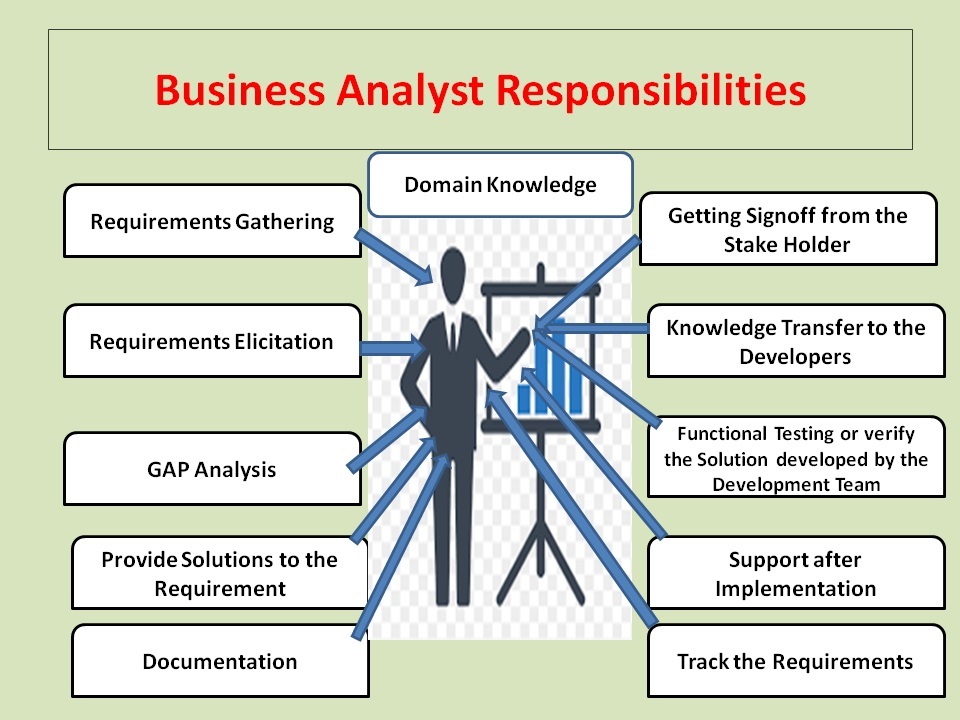
Communicating With Stakeholders
The challenge of working with various personalities is one of the most challenging Business Analyst jobs:
- A manager who desires everything in a hurry
- A more information-seeking developer
- A customer who is continuously wavering
- A bug-tester finding issues in your specifications
Being a BA means you are always negotiating, explaining, and even reassuring an entire room.
A BA is usually the project peacemaker.
Helping Developers in the Implementation 👨💻👩💻
Business Analysts are important to developers.
A Business Analyst:
- Responds to questions in development
- Clarifies logic
- Helps solve roadblocks
- Makes sure that the end product is in accordance with the business requirement
There are occasions when a developer talks more to me than he/she does to their family.
And that is normal — since BA clarity = development speed.
Assistance to Testers to Test the System 🧪
It is another important Business Analyst role which newcomers fail to consider.
A BA helps:
- Identify test scenarios
- Confirm whether or not the product is as per the requirements
- Do UAT (User Acceptance Testing)
- Explain expected outputs
In case testers find it difficult, the BA intervenes to ensure that the requirements are not misinterpreted.
It is the Business Analyst who would determine whether the product is ready or not.
Change Request Management
Oh yes, change requests.
They come at the time when nobody expects them the most.
A Business Analyst analyses:
- Why the change is needed
- How it impacts the system
- Timeline + cost implications
- The question of whether to approve it
I once had a customer who requested a single minor change…
but this minor change involved a reconstruction of half the application.
That is where the BA judgment comes in handy.
Delivering Value — The Last and Most Significant BA Responsibility 💡
All the activities of a Business Analyst are aimed at one goal:
👉 Deliver value.
A BA is not a document writer.
Not a meeting scheduler.
Not a translator.
A Business Analyst is a value creator.
We assist companies to expand, save time, minimise errors, maximise their income, and enhance customer satisfaction.
That is why the world requires Business Analysts as never before.

Conclusions :
To answer the question as to why this career is so rewarding, I would say there are three things:
- You have an opportunity to solve real problems.
- You make the working life of people better.
- In each project, you get to know something you did not know.
Planning to become a Business Analyst or just wondering what the Business Analyst jobs are all about, I hope my experience would help you see the actual picture — not the textbook one.
Related Reads: