

Data Scientist vs Full-Stack Developer: The Ultimate In-Depth Career Comparison (2026 Guide)

Choosing between becoming a Data Scientist vs Full-Stack Developer is not just about picking a job—it’s about choosing the kind of problems you want to solve every day. Both careers are among the most powerful and future-proof roles in the tech industry, yet they differ deeply in mindset, tools, and outcomes.
Table Of Content
- The Big Picture: Builders vs. Thinkers (But Not So Simple)
- What It Really Means to Be a Data Scientist
- What It Really Means to Be a Full-Stack Developer
- The Skills That Define Each Career
- Tools, Technologies, and Ecosystem
- Learning Curve: Which One Is Harder?
- Career Opportunities and Industry Demand
- Salary Expectations and Growth
- Work Style and Daily Experience
- Which Career Should You Choose?
- Final Thoughts
- Related Reads
This comprehensive guide takes a deep dive into both paths, helping you understand not only what each role does, but how it feels to work in them, what it takes to succeed, and where each path can lead in the long run.
The Big Picture: Builders vs. Thinkers (But Not So Simple)
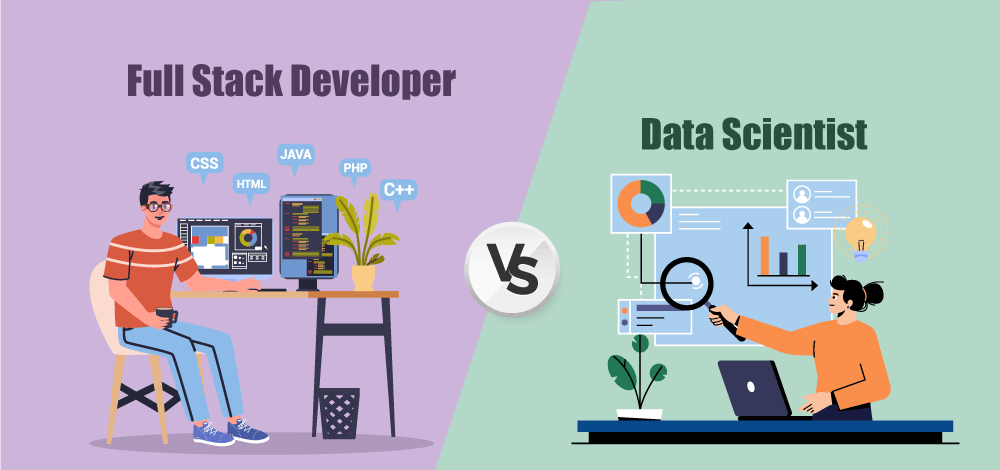
At a high level, Full-Stack Developers are often seen as builders of digital products, while Data Scientists are viewed as interpreters of data and creators of intelligent systems. But this distinction is only the beginning.
A Full-Stack Developer creates the applications people interact with—websites, dashboards, platforms, APIs. Their work is visible, tangible, and often immediate. When they build something, users can click, scroll, and engage with it.
A Data Scientist, however, operates behind the scenes. Their work powers decisions, predictions, and automation. Instead of building interfaces, they build models that learn, systems that predict outcomes, and insights that influence business strategies.
Both roles shape the modern world—one builds the structure, the other gives it intelligence.
What It Really Means to Be a Data Scientist

A Data Scientist’s day is rarely about writing long applications. Instead, it revolves around asking the right questions and using data to answer them.
Imagine a company wanting to predict which customers are likely to stop using their service. A Data Scientist steps in to analyze historical data, clean and process it, identify patterns, and build a machine learning model that predicts future behavior.
Their workflow usually flows through several stages: understanding the problem, gathering data, cleaning it (which takes a huge amount of time), analyzing patterns, building models, and finally communicating results in a way stakeholders can understand.
This role demands patience and curiosity. Often, results are not immediate. Models fail, data is messy, and insights take time to emerge. But when they do, the impact can be massive—saving millions in costs or unlocking new opportunities.
What It Really Means to Be a Full-Stack Developer

A Full-Stack Developer lives in the world of creation and implementation. Their job is to take ideas and turn them into functional, usable software.
Suppose a startup wants to launch an online platform. A Full-Stack Developer designs the user interface, builds the backend logic, connects the database, and ensures everything works smoothly together. They are involved from concept to deployment.
Their daily work includes writing code, debugging errors, integrating APIs, optimizing performance, and sometimes even deploying applications to cloud platforms.
Unlike Data Scientists, their output is immediately visible. You can open a browser and see what they built. This brings a different kind of satisfaction—seeing users interact with something you created.
However, the challenge lies in balancing multiple layers of technology. They must understand both how things look (frontend) and how things work behind the scenes (backend).
The Skills That Define Each Career
The difference in skill sets between these roles is profound, and understanding this is key to making the right decision.
A Data Scientist’s strength lies in analytical thinking. Mathematics, statistics, and probability are not optional—they are essential. Programming is important, but it is a tool rather than the core focus. The real value comes from interpreting results, building predictive models, and understanding data deeply.
In contrast, a Full-Stack Developer thrives on engineering skills. Writing clean, efficient, and scalable code is the foundation. They need to understand system design, APIs, databases, and user interfaces. While logic and problem-solving are crucial, they are applied in building systems rather than analyzing data.
Another important difference is mindset. Data Scientists often deal with uncertainty and probabilities, while developers deal with precision—code either works or it doesn’t.
Tools, Technologies, and Ecosystem
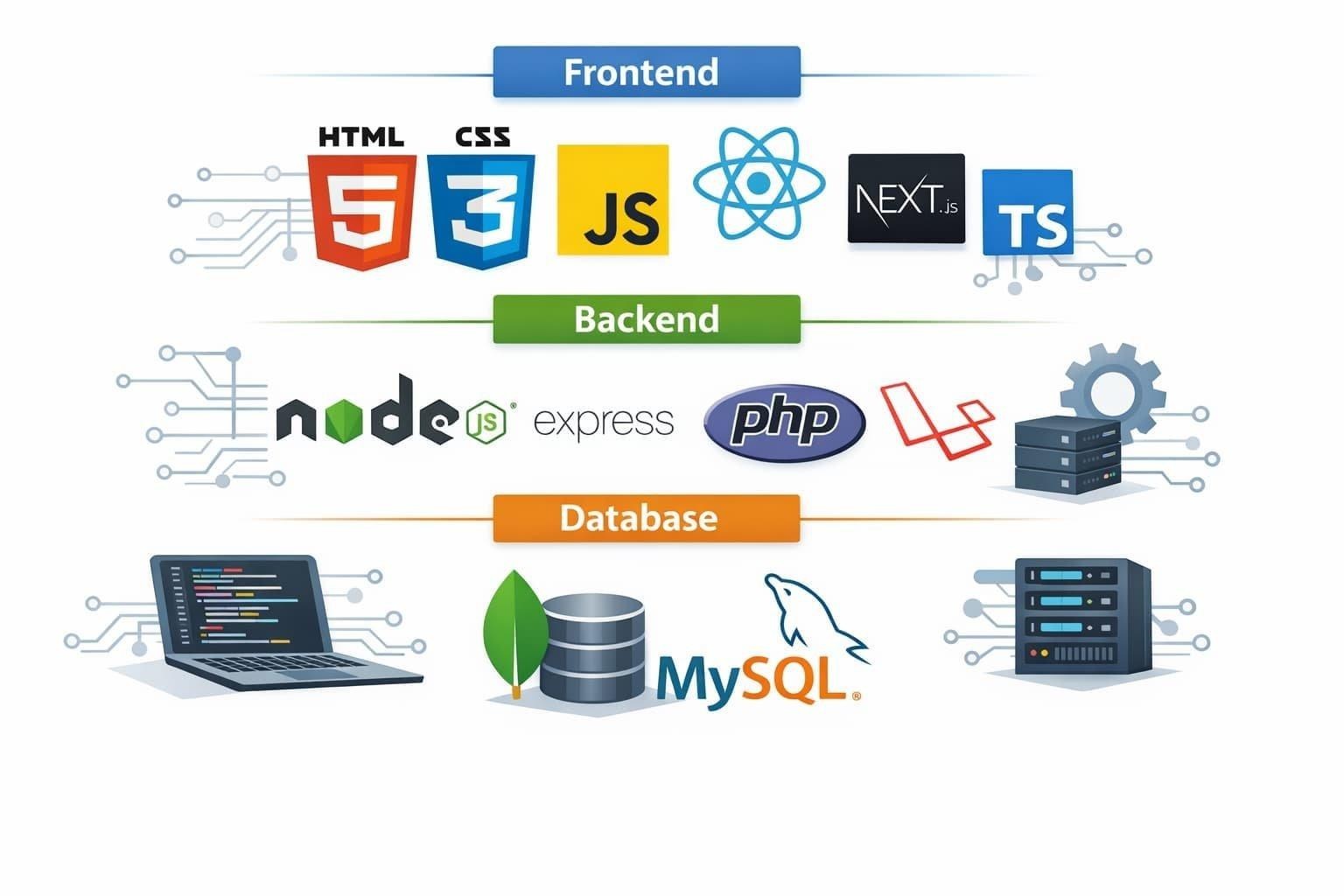
The tools used in each role reflect their purpose.
Data Scientists rely heavily on programming languages like Python or R, along with libraries designed for analysis and machine learning. Tools such as Pandas and NumPy help manipulate data, while frameworks like TensorFlow or PyTorch are used to build intelligent models. Visualization tools help communicate findings effectively.
Full-Stack Developers, on the other hand, work with technologies that bring applications to life. They use HTML, CSS, and JavaScript for frontend development, combined with frameworks such as React or Angular. On the backend, they might use Node.js, Django, or similar technologies, along with databases like MongoDB or PostgreSQL.
While there is some overlap—both roles may use Python or SQL—the purpose behind using these tools is very different.
Learning Curve: Which One Is Harder?
This is one of the most debated questions, and the answer depends on your background.
Data Science has a steeper initial learning curve. If you are not comfortable with mathematics or statistics, the beginning can feel overwhelming. Concepts like regression, probability distributions, and machine learning algorithms require time and effort to master.
Full-Stack Development is often considered more beginner-friendly. You can start building simple websites within weeks, which provides quick motivation. However, becoming truly proficient—especially in both frontend and backend—requires significant depth and experience.
In short, Data Science is harder to start, while Full-Stack Development is challenging to master fully.
Career Opportunities and Industry Demand
In 2026, both careers are thriving, but for slightly different reasons.
Data Science is driven by the explosion of data and the rise of artificial intelligence. Companies across industries—from healthcare to finance—are investing heavily in data-driven decision-making.
Full-Stack Development continues to dominate because every business needs digital platforms. From startups to large enterprises, the demand for developers who can build complete applications remains consistently high.
In India, especially in tech hubs like Chennai, Bangalore, and Hyderabad, opportunities for both roles are expanding rapidly. Data Science roles may be fewer but highly specialized, while Full-Stack roles are more abundant and versatile.

Salary Expectations and Growth
Salaries for both roles are attractive, but they differ in structure.
Data Scientists often start with higher salaries due to their specialized skill set. However, growth depends on expertise in advanced areas like machine learning or AI.
Full-Stack Developers may start slightly lower, but they have more opportunities to switch jobs, freelance, or work in startups, which can accelerate income growth over time.
Long-term, both careers can lead to leadership roles, consulting opportunities, or even entrepreneurship.
Work Style and Daily Experience
A Data Scientist’s workday is often exploratory. They spend time analyzing datasets, experimenting with models, and interpreting results. Progress can be slow, but breakthroughs are rewarding.
A Full-Stack Developer’s day is more structured around building and fixing. They write code, test features, and collaborate with designers and product teams. Progress is more visible and immediate.
If you enjoy research and discovery, Data Science may feel more natural. If you prefer building and execution, Full-Stack Development is likely a better fit.
Which Career Should You Choose?
The decision ultimately comes down to your personality, interests, and strengths.
If you are fascinated by data, enjoy uncovering patterns, and are willing to dive into mathematics and machine learning, Data Science offers a powerful and intellectually rewarding path.
If you love coding, enjoy creating things people can use, and want a more direct and visible impact, Full-Stack Development is an excellent choice.
There is also a middle ground emerging—roles like Machine Learning Engineers and Data Engineers—which combine elements of both worlds.
Final Thoughts
The debate between Data Scientist and Full-Stack Developer is not about which career is better—it’s about which one aligns with who you are.
Technology is evolving rapidly, and both roles are becoming even more important. Data Scientists are shaping the intelligence behind systems, while Full-Stack Developers are building the platforms that deliver that intelligence to users.
Whichever path you choose, focus on building real projects, gaining practical experience, and continuously learning. That is what ultimately defines success in the tech industry.
Want to learn more ?, Kaashiv Infotech Offers, Data Science Course, Data Analytics Course, Power BI & More, Visit Our Website course.kaashivinfotech.com.
Related Reads:

![Top 5 Tech Careers of the Future [2026]](https://www.kaashivinfotech.com/blog/wp-content/uploads/2026/06/Top-5-Tech-Careers-of-the-Future-2026-150x150.png "Data Scientist vs Full-Stack Developer: The Ultimate In-Depth Career Comparison (2026 Guide)")