
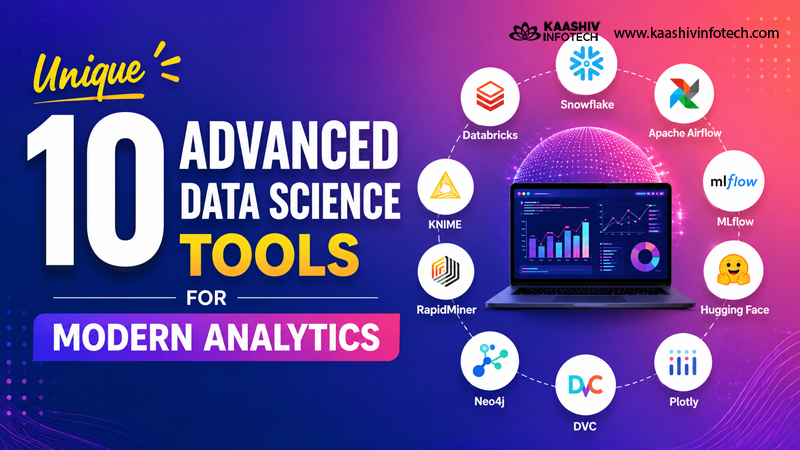
advanced data science tools – If you’ve already covered the basics like Python, SQL, and simple dashboards, this is where your real data science journey begins. In actual companies, data science is not just about analyzing CSV files — it’s about building end-to-end systems that collect, process, model, and serve data at scale.
From what I’ve seen while teaching and working on projects, students who learn these tools move from “I can analyze data” to “I can build production-ready systems.” That’s a huge jump — and these tools help you make it.
Unique 10 Advanced Data Science Tools
🔥 1. Apache Airflow – Automating Data Pipelines

Think of Apache Airflow as the brain that schedules and controls your entire data workflow. Instead of running scripts manually, Airflow lets you define workflows as DAGs (Directed Acyclic Graphs), where each task is connected logically.
In real-world systems, data doesn’t come once — it comes continuously. You may need to pull data from APIs every hour, clean it, store it, and trigger ML models. Doing this manually is impossible at scale. Airflow solves this by automating everything reliably.
The reason companies love Airflow is because it ensures consistency and fault tolerance. If one step fails, it retries. If dependencies aren’t met, it waits. That level of control is critical in production environments.
☁️ 2. Snowflake – The Future of Data Warehousing

Snowflake represents a shift from traditional databases to fully cloud-native analytics platforms. Unlike older systems, it separates compute and storage, which means you can scale them independently based on your needs.
This becomes extremely useful when dealing with large-scale analytics workloads. For example, your dashboard team and your ML team can query the same data without slowing each other down.
Another powerful aspect is how Snowflake handles structured and semi-structured data, making it ideal for modern applications where data comes in multiple formats.
⚡ 3. Databricks – Where Big Data Meets AI

Databricks is one of those tools that truly changes how teams work. It combines data engineering, analytics, and machine learning into one unified platform.
Built on Apache Spark, it allows you to process massive datasets while also building ML models in the same environment. What makes it even more powerful is its collaborative notebook system, where teams can work together in real time.
In modern companies, Databricks is often the central hub where raw data is transformed into insights and predictions.
🧩 4. KNIME – Visual Data Science Without Heavy Coding
KNIME is perfect if you want to understand the logic of data science workflows without getting lost in code. It uses a visual interface where you connect nodes to perform tasks like data cleaning, transformation, and modeling.
This makes it extremely useful for beginners and analysts who want to quickly prototype ideas. Even experienced professionals use KNIME when they want to build workflows faster without writing repetitive code.
It also integrates with Python and R, so you can mix visual workflows with custom scripts when needed.
📊 5. RapidMiner – Enterprise-Level Predictive Analytics
RapidMiner is designed for organizations that want to build predictive models quickly and efficiently. It offers a visual workflow system similar to KNIME but with stronger enterprise features.
What makes RapidMiner interesting is how it simplifies complex ML processes like model validation, tuning, and deployment. Instead of writing hundreds of lines of code, you can design pipelines visually and focus more on outcomes.
This tool is often used in business environments where speed and clarity matter more than coding complexity.
🔄 6. DVC – Managing Data Like Code
One of the biggest problems in data science projects is version control for datasets and experiments. While Git works well for code, it doesn’t handle large datasets effectively.
DVC (Data Version Control) fills that gap. It allows you to track datasets, manage pipelines, and reproduce experiments exactly as they were run earlier.
This becomes critical when working in teams or when deploying models to production, where reproducibility is not optional — it’s mandatory.
🧠 7. MLflow – Managing the ML Lifecycle
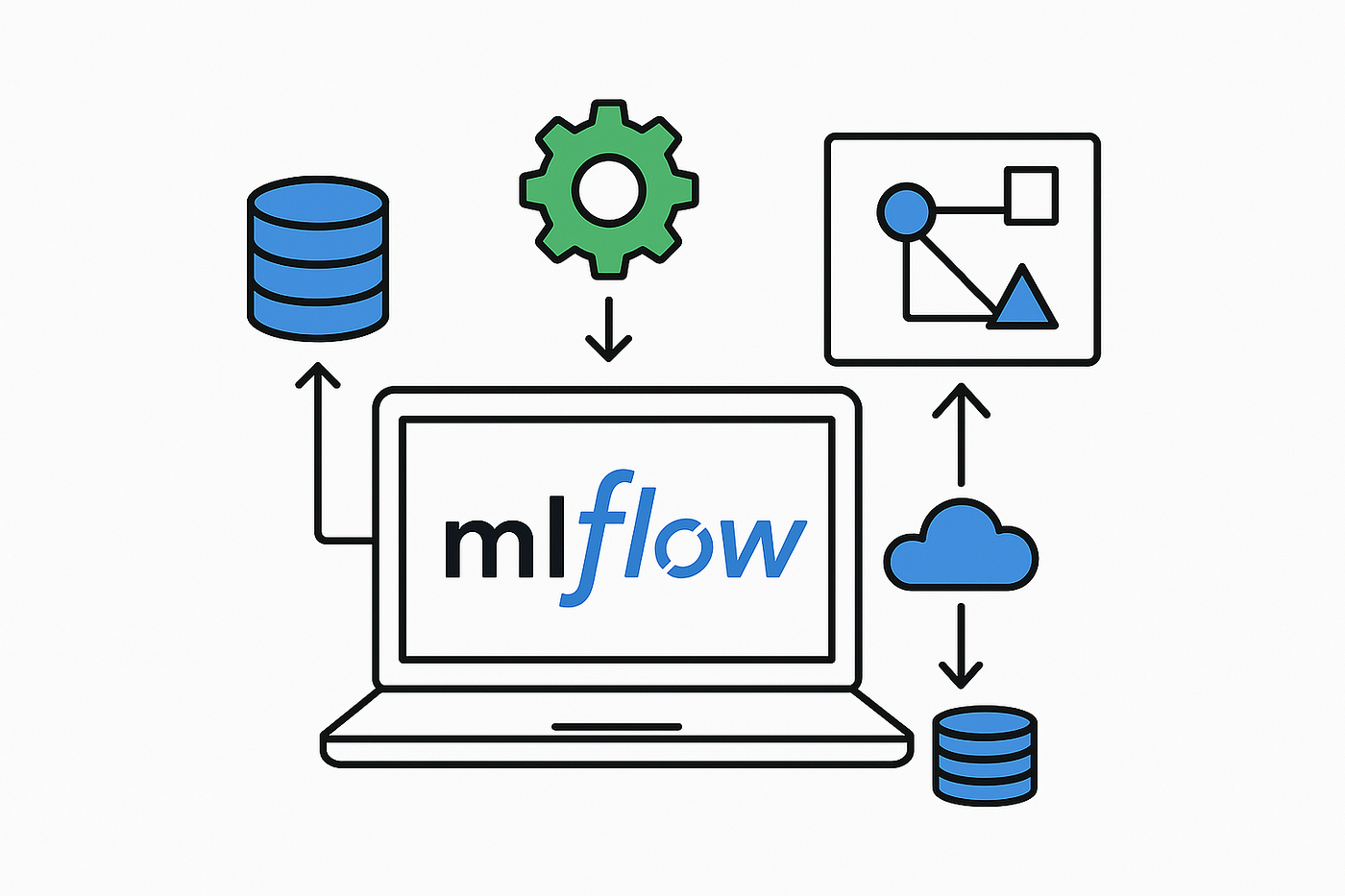
MLflow is all about bringing structure to machine learning workflows. When you build multiple models, tune parameters, and test variations, things can quickly become chaotic.
MLflow helps by tracking experiments, logging metrics, and managing model versions. It also provides a model registry where you can control which version goes into production.
In real-world ML systems, MLflow acts like a control center that keeps everything organized and production-ready.
🤖 8. Hugging Face – Powering Modern AI Applications
Hugging Face has become the default platform for NLP and modern AI development. Instead of building models from scratch, you can use thousands of pre-trained models for tasks like text generation, summarization, and translation.
This drastically reduces development time and allows even small teams to build powerful AI applications.
Today, if you’re working on chatbots or language-based AI systems, Hugging Face is almost unavoidable.
📈 9. Plotly – Interactive Data Visualization

Plotly takes data visualization to the next level by making it interactive and web-ready. Instead of static charts, users can zoom, filter, and explore data dynamically.
With its Dash framework, you can even build full-fledged web applications powered by data.
This makes Plotly especially useful for creating dashboards that are both functional and visually impressive.
🔗 10. Neo4j – Unlocking Graph-Based Analytics
Neo4j introduces a completely different way of thinking about data — through relationships instead of tables. It uses graph databases to model connections between entities.
This is incredibly useful in scenarios like fraud detection, recommendation systems, and social network analysis, where relationships matter more than individual records.
As data becomes more interconnected, graph-based analytics is becoming a major trend, and Neo4j is leading that space.
🚀 Final Thoughts – What Really Matters
Learning tools is important, but understanding how they fit together is what makes you industry-ready.
A modern data science workflow might look like this:
- Data is stored in Snowflake
- Processed using Databricks
- Pipelines automated with Airflow
- Models tracked using MLflow
- Experiments managed with DVC
👉 That’s a complete ecosystem — and that’s what companies expect today.
Want to learn more ?, Kaashiv Infotech Offers, Excel Course, Data Analytics Course, Power BI & More, Visit Our Website course.kaashivinfotech.com.
Related Reads:
 in 2026
