
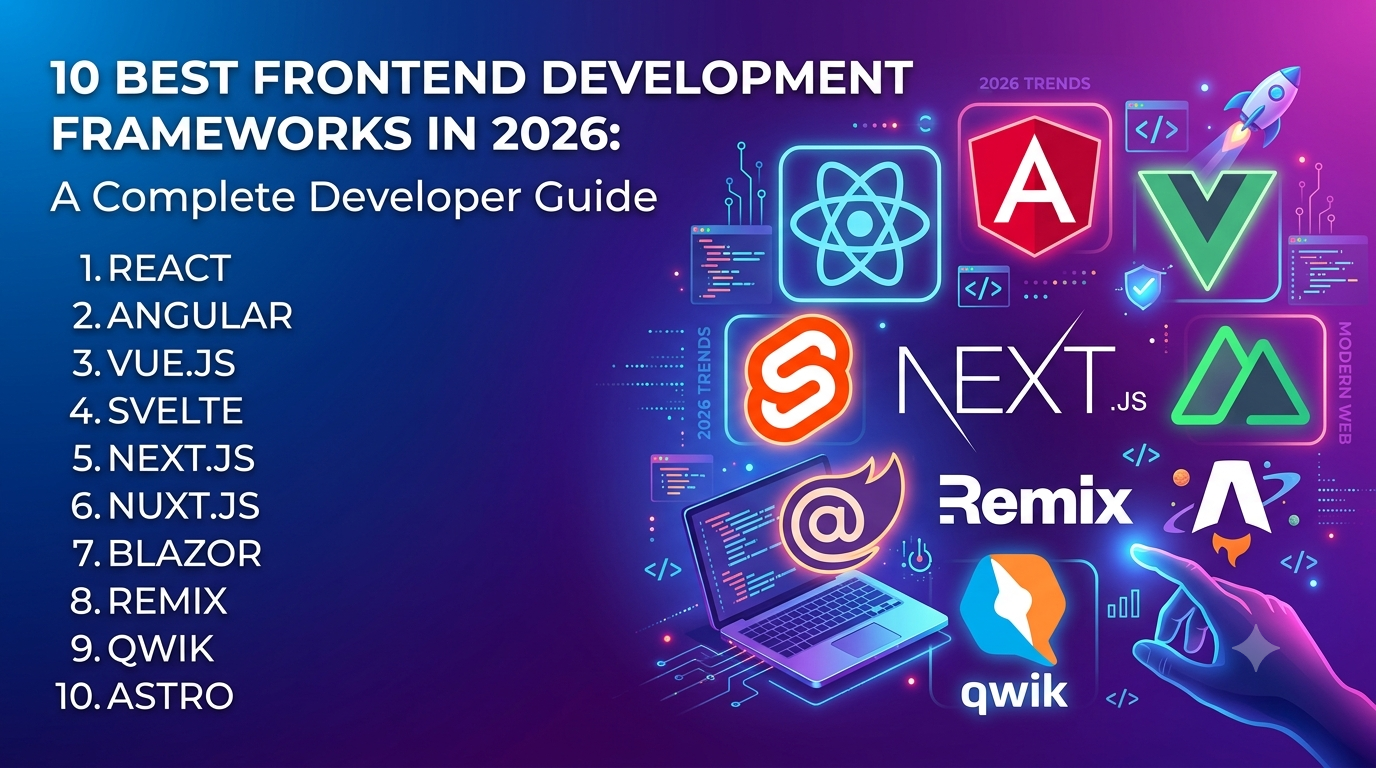
Frontend Development Frameworks – Frontend development is constantly evolving, and choosing the right framework is crucial for building fast, scalable, and user-friendly applications. Modern frameworks not only simplify development but also improve performance, maintainability, and overall user experience. Whether you’re a beginner or an experienced developer, understanding the strengths of each framework can help you make the right decision. In this guide, we explore the top 10 frontend development frameworks in 2026 with detailed descriptions and key features.
Top 10 Frontend Development Frameworks
1. React.js

React – Developed by Meta Platforms, React.js is one of the most widely used frontend libraries for building dynamic user interfaces. It follows a component-based architecture that allows developers to reuse UI elements efficiently across applications. React’s virtual DOM enhances performance by updating only the necessary parts of the interface instead of reloading the entire page. With a massive ecosystem and community support, React remains a top choice for scalable web applications.
Key Features:
- Component-based architecture
- Virtual DOM for faster rendering
- Strong ecosystem (Redux, hooks, etc.)
- Reusable and maintainable code
2. Angular

Maintained by Google, Angular is a full-featured framework designed for building robust and enterprise-level applications. It uses TypeScript, which improves code quality and provides better tooling for large-scale development. Angular includes built-in solutions for routing, state management, and form handling, reducing reliance on third-party libraries. Its structured approach makes it ideal for teams working on complex projects.
Key Features:
- Two-way data binding
- TypeScript support
- Built-in routing and HTTP client
- Dependency injection system
3. Vue.js

Created by Evan You, Vue.js is a progressive framework known for its simplicity and flexibility. It offers reactive data binding and a component-based architecture similar to React and Angular. Vue is easy to integrate into existing projects, making it suitable for both small and large applications. Its gentle learning curve and growing community make it a favorite among developers.
Key Features:
- Reactive data binding
- Easy integration
- Lightweight and fast
- Strong community support
4. Svelte

Svelte takes a unique approach by compiling components at build time instead of relying on a virtual DOM at runtime. This results in faster performance and smaller bundle sizes compared to traditional frameworks. It reduces boilerplate code, allowing developers to write cleaner and more concise applications. Svelte is gaining popularity for creating highly optimized modern web apps.
Key Features:
- No virtual DOM
- Faster runtime performance
- Less boilerplate code
- Smaller bundle size
5. Next.js

Next.js is a powerful React-based framework that enhances application performance through server-side rendering and static site generation. It provides built-in routing, API support, and optimization features that simplify development. Next.js is particularly useful for SEO-friendly applications and high-performance websites. It is widely used for production-ready and scalable web solutions.
Key Features:
- Server-side rendering (SSR)
- Static site generation (SSG)
- Built-in routing
- SEO optimization
6. Nuxt.js

Nuxt.js is a Vue-based framework that simplifies the development of server-rendered and static web applications. It provides a clean and organized project structure, making development more efficient. With automatic routing and modular architecture, Nuxt reduces development complexity significantly. It is a great choice for building scalable and SEO-friendly Vue applications.
Key Features:
- Automatic routing
- Server-side rendering
- Modular architecture
- SEO-friendly
7. Ember.js

Ember.js is a convention-driven framework that focuses on productivity and scalability. It provides a complete solution with built-in tools like a router, CLI, and testing framework. Ember promotes best practices and consistency across projects, making it suitable for long-term development. It is often used for large applications that require stability and maintainability.
Key Features:
- Convention over configuration
- Built-in CLI tools
- Strong routing system
- Long-term support
8. Backbone.js

Backbone.js is a lightweight framework that adds structure to web applications through models, views, and collections. It allows developers to build applications with organized and maintainable code. Despite being older, it is still useful for simple projects and legacy systems. Backbone is flexible and integrates well with other libraries.
Key Features:
- Lightweight framework
- MVC architecture
- RESTful API support
- Flexible integration
9. Alpine.js

Alpine.js is a minimal JavaScript framework used for adding interactivity directly into HTML. It is simple to use and does not require complex build tools or configurations. Alpine is ideal for small projects or enhancing static websites with dynamic behavior. Its lightweight nature makes it fast and efficient.
Key Features:
- Lightweight and minimal
- No build step required
- Easy to learn
- Works directly in HTML
10. Solid.js

Solid.js is a modern framework focused on performance and fine-grained reactivity. It eliminates the need for a virtual DOM, resulting in faster updates and efficient rendering. Solid offers a familiar component-based approach while improving runtime performance. It is gaining popularity among developers building high-performance applications.
Key Features:
- Fine-grained reactivity
- No virtual DOM
- High performance
- Efficient rendering
How to Choose the Right Frontend Framework
Selecting the right frontend framework depends on your project requirements and development goals. Beginners may prefer Vue.js or React due to their ease of learning and strong community support. For enterprise applications, Angular provides a complete and structured solution. If performance is critical, Svelte and Solid.js offer excellent optimization. For SEO-focused projects, Next.js and Nuxt.js are highly recommended.
Conclusion
Frontend Development Frameworks in 2026 offer powerful tools for building modern web applications. From established technologies like React and Angular to emerging Frontend Development Frameworks like Svelte and Solid.js, developers have a wide range of options. Each framework has unique strengths, and the best choice depends on your specific needs. By understanding these frameworks, you can build faster, scalable, and more efficient applications.
Want to learn more about Front End Development Course, React Course or any other course visit our website www.kaashivinfotech.com.