
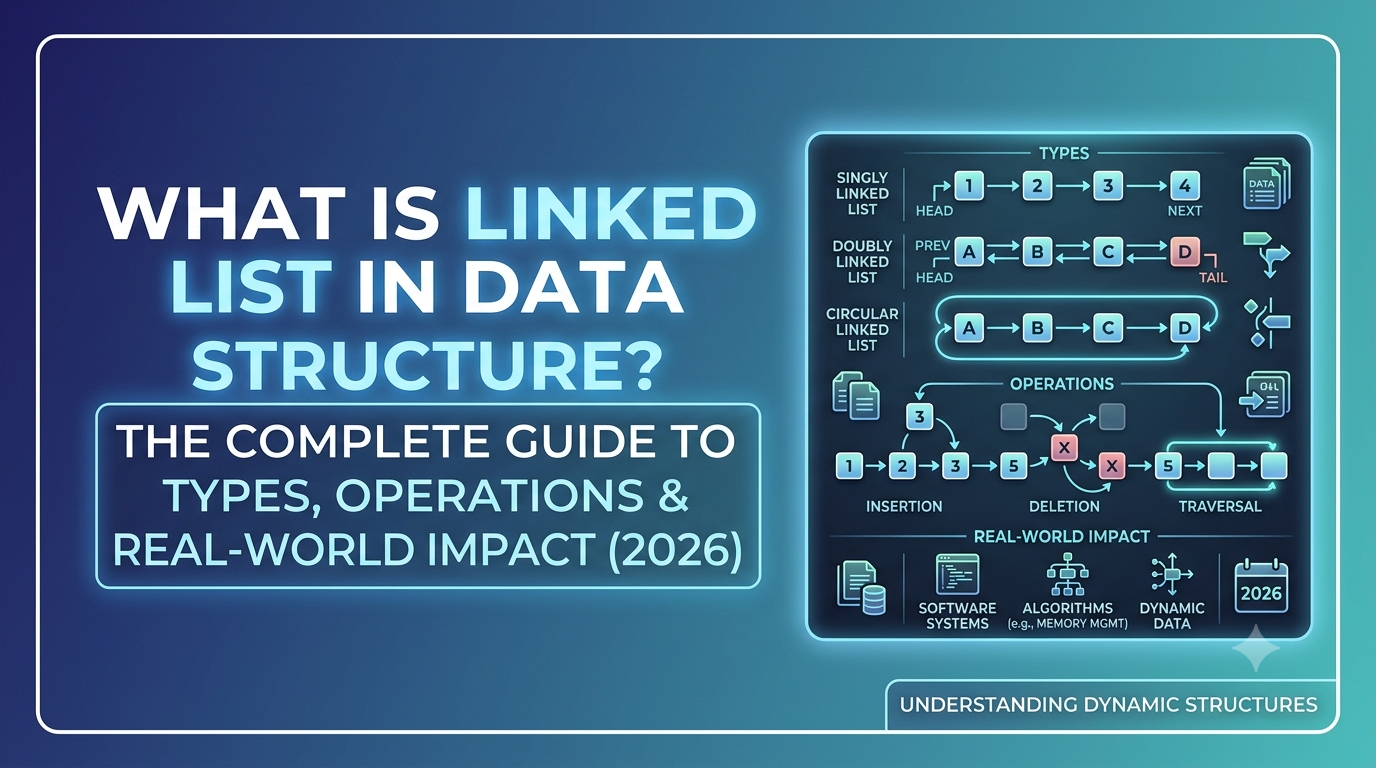
Why This 70-Year-Old Data Structure Still Powers Your Daily Digital Life
You click “back” in your browser. You skip to the next song in your playlist. You undo a typo in your document.
Each of these actions relies on the same elegant concept: a linked list in data structure.
Unlike flashier technologies that come and go, linked lists have quietly powered computing since the 1950s. They’re not glamorous—but they’re fundamental. And for anyone building a career in software engineering, understanding them separates those who use tools from those who build them.
Let’s explore what makes linked lists enduringly relevant—not through hype, but through mechanics, history, and real implementation details that matter in 2026.
What Is Linked List in Data Structure? The Core Concept
At its heart, a linked list is a sequence of nodes where each node contains:
- Data – the actual value you want to store
- Pointer – a reference to the next node in the sequence
Head → [5 | •] → [10 | •] → [15 | •] → NULL
         ↓          ↓          ↓
      Address   Address    Address
Unlike arrays that require contiguous memory blocks, linked lists connect scattered memory locations through pointers. This simple design solves a fundamental problem: how to store sequences when you don’t know their size in advance.
Think of it like a scavenger hunt where each clue points to the next location—no need to reserve an entire field upfront. Just add clues as you go.
The History: From 1955 IPL to Modern Kernels
Linked lists weren’t invented for interviews—they emerged from real computational constraints.
| Year | Milestone | Significance |
|---|---|---|
| 1955–56 | Allen Newell, Cliff Shaw, and Herbert Simon create IPL (Information Processing Language) at RAND Corporation | First practical implementation of linked lists for early AI research |
| 1960s | Dynamic memory allocation formalized in operating systems | Enabled programs to grow beyond fixed memory boundaries |
| 1972 | C language introduces explicit pointer syntax | Made linked list manipulation accessible to mainstream programmers |
| 1998 | Java 1.2 adds LinkedList to Collections Framework |
Brought linked lists to enterprise Java development |
| 2026 | Still fundamental in Linux kernel, browsers, and memory allocators | Proof of enduring utility |
The Linux kernel alone contains thousands of linked list implementations—from process scheduling to device driver management. This isn’t legacy code; it’s deliberate engineering choice where dynamic sizing matters more than cache locality.

Why Arrays Weren’t Enough: The Insertion Problem
Arrays work beautifully when you know your data size upfront. But real-world data rarely cooperates.
The insertion cost problem:
# Array insertion at index 2 (requires shifting)
[1, 2, 3, 4, 5] → insert 99 at position 2
[1, 2, 99, 3, 4, 5]  # Had to move 3 elements

# Linked list insertion at position 2 (pointer updates only)
1 → 2 → 3 → 4 → 5
     ↓
     99 → 3  # Only 2 pointers changed
With arrays, inserting in the middle means shifting all subsequent elements—O(n) time. With linked lists? Just rewire two pointers—O(1) time if you already have the insertion point.
This trade-off explains why text editors (frequent mid-document edits) often use linked-list variants internally, while image buffers (fixed size, random access) use arrays.

Memory Representation: Scattered but Connected
Here’s what actually happens in memory:
Address 0x1000: [Data: 42 | Next: 0x3A20]
Address 0x2500: [Data: 17 | Next: 0x4F10]  ← Not contiguous!
Address 0x3A20: [Data: 88 | Next: 0x2500]
Address 0x4F10: [Data: 99 | Next: NULL]
The physical addresses jump around—but the logical sequence remains intact through pointers. This non-contiguous nature gives linked lists flexibility but costs cache performance. Modern CPUs fetch memory in blocks (cache lines); scattered nodes mean more cache misses than contiguous arrays.
The trade-off is real:
✅ Flexibility in memory-constrained or fragmented environments
❌ Slower traversal due to poor spatial locality
Characteristics of Linked List in Data Structure
| Property | Impact | When It Matters |
|---|---|---|
| Dynamic sizing | Grows/shrinks at runtime | Unknown data volume (e.g., user input streams) |
| Non-contiguous memory | Works with fragmented heaps | Embedded systems, long-running servers |
| Sequential access only | Must traverse from head | When random access isn’t required |
| Pointer overhead | Extra 4–8 bytes per node | Memory-constrained environments |
| No reallocation cost | Insertions don’t move existing data | High-frequency insertion workloads |
How Linked Lists Actually Work: Step by Step
Creating a New Node
Node* new_node = malloc(sizeof(Node));
new_node->data = 42;
new_node->next = NULL;
Inserting at the Head (O(1))
new_node.next = head  # Point new node to current head
head = new_node       # Update head to new node
Inserting in the Middle (O(n) to find position)
// After finding insertion point 'prev'
newNode.next = prev.next;
prev.next = newNode;
Deleting a Node (Requires predecessor)
// To delete 'current' node when you have 'prev'
prev.next = current.next;
// In garbage-collected languages: current becomes eligible for GC
// In C: must explicitly free(current)
Critical insight: Deletion requires access to the previous node. This is why singly linked lists struggle with mid-list deletions—you often need to traverse from the head to find the predecessor.

Types of Linked List in Data Structure
Singly Linked List
Each node points only to the next node. Simplest form, minimal memory overhead.
Best for: Stacks, forward-only traversal, memory-constrained environments
Doubly Linked List
Each node has next and prev pointers.
struct Node {
    int data;
    struct Node* prev;
    struct Node* next;
};
Best for: Browser history (back/forward), text editor undo/redo, anywhere bidirectional traversal matters
Circular Linked List
The last node points back to the first, forming a loop.
Best for: Round-robin process scheduling, multiplayer game turn systems, buffer implementations

Operations & Time Complexity Analysis
| Operation | Singly LL | Doubly LL | Why |
|---|---|---|---|
| Access by index | O(n) | O(n) | Must traverse from head/tail |
| Search | O(n) | O(n) | Linear scan required |
| Insert at head | O(1) | O(1) | Update 1–2 pointers |
| Insert at tail | O(n)* | O(1) | Singly LL must traverse to end |
| Insert after node | O(1) | O(1) | Rewire pointers locally |
| Delete node | O(n)* | O(1)† | Singly LL needs predecessor; doubly has prev pointer |
| Reverse | O(n) | O(n) | Single traversal with pointer swaps |
* With tail pointer maintained: O(1) for tail insertion
† When you already have reference to node being deleted
Space complexity: O(n) for n nodes, plus O(1) auxiliary space for most operations (O(n) for recursive reverse due to call stack).
How to Reverse a Linked List: Beyond the Interview Question
Reversing a linked list reveals whether someone understands pointer manipulation—or just memorized a solution.
Iterative Approach (Preferred in Production)
def reverse(head):
    prev = None
    current = head

    while current:
        next_temp = current.next  # Save next before breaking link
        current.next = prev        # Reverse the pointer
        prev = current             # Move prev forward
        current = next_temp        # Move current forward

    return prev  # New head
Edge cases that trip people up:
- Empty list (
head == NULL) - Single-node list (returns itself)
- Two-node list (easy to mishandle pointer updates)
Why Recursion Is Risky in Production
def reverse_recursive(head):
    if not head or not head.next:
        return head
    new_head = reverse_recursive(head.next)
    head.next.next = head  # Critical: make next node point back
    head.next = None       # Avoid cycle
    return new_head
Problem: For a list with 10,000 nodes, this creates 10,000 stack frames. In Python, you’ll hit RecursionError. In C, you’ll likely cause a stack overflow. Iterative is safer for production systems.
Floyd’s Cycle Detection: When Linked Lists Loop
Not all linked lists end with NULL. Some contain cycles—a node pointing back to an earlier node.
Floyd’s “Tortoise and Hare” algorithm detects cycles in O(n) time with O(1) space:
def has_cycle(head):
    slow = fast = head
    while fast and fast.next:
        slow = slow.next          # Moves 1 step
        fast = fast.next.next     # Moves 2 steps
        if slow == fast:          # They meet → cycle exists
            return True
    return False
Why it works: In a cycle, the faster pointer eventually laps the slower one. No extra memory needed—just two pointers moving at different speeds.
This pattern appears in real systems: detecting infinite loops in dependency graphs, circular references in garbage collection, and corrupted data structures.
Linked List in C vs Python vs Java vs JavaScript vs C#
C: Manual Memory Management
#include <stdlib.h>

typedef struct Node {
    int data;
    struct Node* next;
} Node;

Node* create_node(int data) {
    Node* node = (Node*)malloc(sizeof(Node));
    node->data = data;
    node->next = NULL;
    return node;
}
// Critical: Caller must free() nodes to avoid leaks
Reality check: C gives control but demands discipline. One forgotten free() and your long-running server leaks memory.
Python: Automatic Garbage Collection
class Node:
    def __init__(self, data):
        self.data = data
        self.next = None

# No manual memory management
# But: reference cycles can delay garbage collection
Trade-off: Simpler code, but less predictable memory reclamation timing.
Java: Managed Memory with Strong Typing
class Node {
    int data;
    Node next;

    Node(int data) {
        this.data = data;
    }
}
// JVM handles memory; finalizers rarely needed
Production note: Java’s LinkedList class exists but is often outperformed by ArrayList due to cache locality—proof that linked lists aren’t always the right choice.
JavaScript: Prototypal Flexibility
class Node {
    constructor(data) {
        this.data = data;
        this.next = null;
    }
}
// Garbage collection via mark-and-sweep
// Common in algorithm interviews but rare in production JS
C#: Enterprise Implementation
public class Node {
    public int Data { get; set; }
    public Node Next { get; set; }
}
// .NET garbage collector handles cleanup
// LinkedList<T> exists in System.Collections.Generic
Key insight: Language choice changes memory management details—but the core pointer manipulation logic remains identical across all five.
Array vs Linked List: Choosing the Right Tool
| Scenario | Choose Array | Choose Linked List |
|---|---|---|
| Random access needed | ✅ O(1) indexing | ❌ O(n) traversal |
| Frequent head insertions | ❌ O(n) shifting | ✅ O(1) pointer update |
| Memory fragmentation | ❌ Needs contiguous block | ✅ Works with scattered memory |
| Cache performance critical | ✅ Excellent locality | ❌ Poor locality |
| Size known upfront | ✅ Perfect fit | ⚠️ Unnecessary overhead |
| Size unpredictable | ❌ Reallocation cost | ✅ Grows naturally |
Real engineering decision: The Linux kernel uses linked lists for process queues (dynamic size, frequent insertions/deletions) but arrays for file descriptor tables (fixed per-process size, random access needed).

Real-World Applications You Interact With Daily
Browser Navigation History
Your “back” and “forward” buttons traverse a doubly linked list. Each page visit creates a node; back moves to prev, forward to next. Circular references are avoided by clearing forward history on new navigation.
Music Streaming Playlists
Services like Spotify use linked lists for playlist management. Adding a song mid-playlist requires O(1) pointer updates—not O(n) array shifts. Critical when playlists contain thousands of tracks.
Operating System Process Scheduling
The Linux kernel’s Completely Fair Scheduler (CFS) uses red-black trees for ordering—but maintains linked lists for runqueues. Why? Fast insertion/removal of processes as they become runnable or blocked.
Memory Allocators
malloc() implementations (like dlmalloc) track free memory blocks using linked lists. When you free() memory, the block gets inserted back into the appropriate free list—O(1) operation critical for allocator performance.
Blockchain Fundamentals
Each block contains a cryptographic hash of the previous block—functionally a tamper-evident linked list. Break one link, and the entire chain’s integrity becomes verifiable.
Modern Relevance in 2026 Systems
Linked lists aren’t legacy—they’re deliberately chosen where their properties shine:
- WebAssembly runtimes use intrusive linked lists for zero-overhead memory management in constrained environments
- Database index implementations (like PostgreSQL’s buffer pool) use linked lists for LRU cache eviction
- Real-time operating systems (RTOS) favor linked lists for task queues where deterministic O(1) insertion matters more than cache performance
- Graphics engines manage render queues with linked lists to handle dynamic scene graphs efficiently
The pattern persists not from inertia, but from intentional engineering trade-offs.
Interview Preparation: What Actually Matters
Companies test linked lists not to torture candidates—but to assess:
- Pointer manipulation comfort – Can you reason about memory references?
- Edge case awareness – Do you consider NULL pointers, single nodes, cycles?
- Trade-off understanding – When would you not use a linked list?
High-Yield Practice Problems
- Reverse a linked list (iterative preferred)
- Detect a cycle (Floyd’s algorithm)
- Merge two sorted linked lists
- Find the middle node (slow/fast pointers)
- Remove nth node from end (two-pass or dummy node technique)
Pro tip: Practice on paper first. Drawing pointer updates builds intuition that IDE autocomplete hides.
Common Pitfalls & Best Practices
| Mistake | Consequence | Better Approach |
|---|---|---|
Forgetting to update head after reversal |
Lose entire list | Always return and assign new head |
| Not handling NULL head in operations | Segmentation fault | Check head early; return gracefully |
| Memory leaks in C/C++ | Long-running process grows | Free nodes explicitly; use tools like Valgrind |
| Assuming O(1) tail insertion | O(n) surprise in singly LL | Maintain tail pointer if needed |
| Ignoring cache effects | “Correct” but slow code | Profile before optimizing; arrays often faster |
🔎 Frequently Asked Questions
What is linked list in data structure?
A linked list in data structure is a linear collection of nodes where each node stores data and a pointer to the next node. Unlike arrays, linked lists use non-contiguous memory locations and grow dynamically, making insertions and deletions more flexible.
What is the main advantage of linked list over array?
The main advantage of a linked list over an array is dynamic memory allocation. Linked lists can grow or shrink at runtime without resizing. Insertions and deletions at the beginning or middle require only pointer updates instead of shifting elements.
What are the types of linked list?
There are three main types of linked list:
- Singly linked list
- Doubly linked list
- Circular linked list
Each type differs in how nodes connect using next and/or previous pointers.
What is a singly linked list?
A singly linked list is a linear data structure where each node contains data and a pointer to the next node only. Traversal happens in one direction, from head to NULL.
What is a doubly linked list?
A doubly linked list contains two pointers in each node: one pointing to the next node and another to the previous node. This allows bidirectional traversal, making it useful for browser history and undo/redo systems.
What is a circular linked list?
A circular linked list is a linked list where the last node points back to the first node instead of NULL. It forms a loop and is commonly used in round-robin scheduling and buffering systems.
How do you reverse a linked list?
To reverse a linked list, iterate through the list and reverse each node’s pointer to its previous node. Maintain three pointers: previous, current, and next. The process takes O(n) time and O(1) extra space.
What is the time complexity of linked list operations?
Access and search operations in a linked list take O(n) time because traversal is required. Insertion at the head takes O(1) time. Reversal takes O(n). Space complexity is O(n) for storing n nodes.
What is the difference between array and linked list?
Arrays store elements in contiguous memory and allow O(1) random access. Linked lists store elements in non-contiguous memory and require O(n) traversal. However, linked lists allow efficient insertions and deletions without shifting elements.
Is linked list still relevant in modern systems?
Yes, linked lists are widely used in operating systems, memory allocators, schedulers, and caching mechanisms. While arrays are often faster for random access, linked lists remain essential where dynamic memory and frequent insertions are required.
Why is reverse linked list important for interviews?
Reversing a linked list tests pointer manipulation skills, memory understanding, and edge case handling. It is one of the most common coding interview problems across major tech companies.
Why does Java’s LinkedList underperform ArrayList in benchmarks?
Cache locality. ArrayList’s contiguous memory allows CPU prefetching; LinkedList’s scattered nodes cause cache misses. For most workloads, this outweighs insertion advantages.
Are linked lists still relevant with modern languages?
Absolutely—but often hidden. High-level structures (queues, deques) frequently use linked lists internally where their properties match the workload.
🎯 Conclusion
Linked lists have survived for over 70 years not because they are trendy—but because they solve a real engineering problem: dynamic, flexible memory management.
They teach you something deeper than syntax. They teach you how memory works, how pointers connect structures, and how trade-offs shape system design.
In modern software engineering, understanding linked lists is less about memorizing reversal algorithms and more about recognizing when dynamic structures outperform static ones.
Master linked lists, and you strengthen your foundation for trees, graphs, hash tables, and advanced system architecture.
In 2026, tools may evolve—but core data structures like linked lists remain timeless.
And engineers who understand fundamentals always stay ahead. 🚀


